
Wassa Fiase chiefs demand Ghanaian takeover of Tarkwa Mines

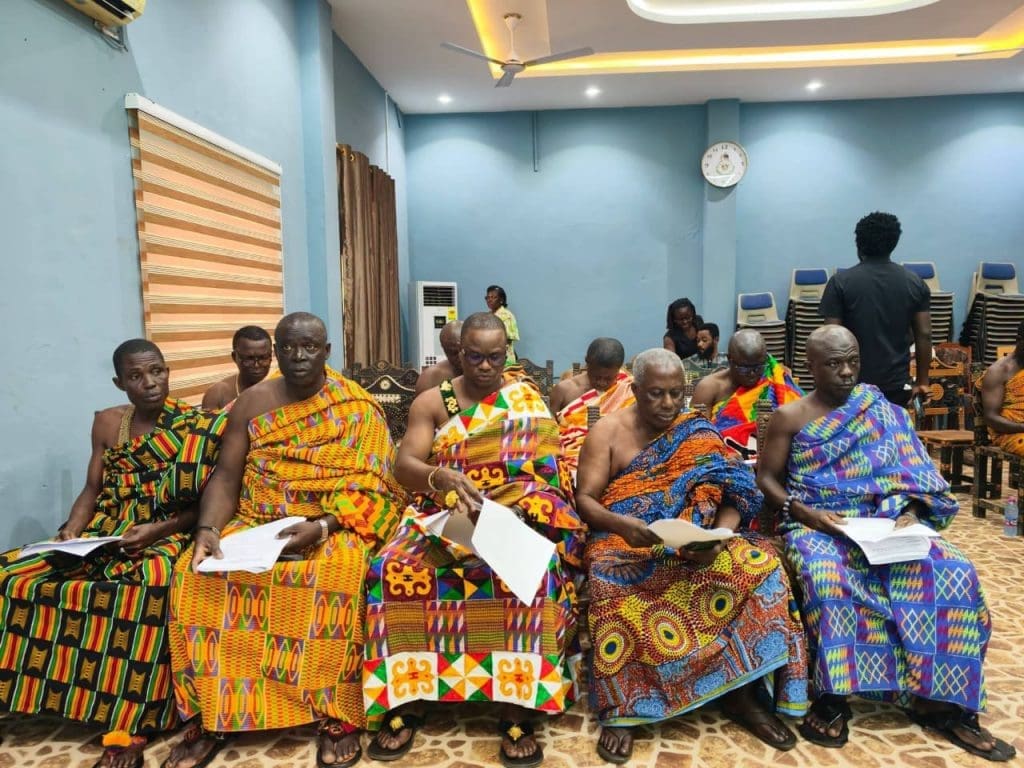
Nana Adu Panyin, Nana Sompreh, Divisional Chief of Bogoso, Nana Abena Kunadjoa II, Paramount Queen Mother of Wassa Fiase Traditional Area and Nana Nteboah Prah, Divisional Chief of Prestea-Heman
The Wassa Fiase Traditional Council has unanimously called on the government not to renew the mining leases of Gold Fields Ghana Limited when they expire in April 2027, demanding instead that the Tarkwa Gold Mine be transferred to Ghanaian ownership.
The chiefs said decades of extensive mining have failed to deliver development benefits commensurate with the scale of operations, raising concerns over inadequate corporate social responsibility (CSR), poor roads and infrastructure in host communities, and delays in the payment of royalties.
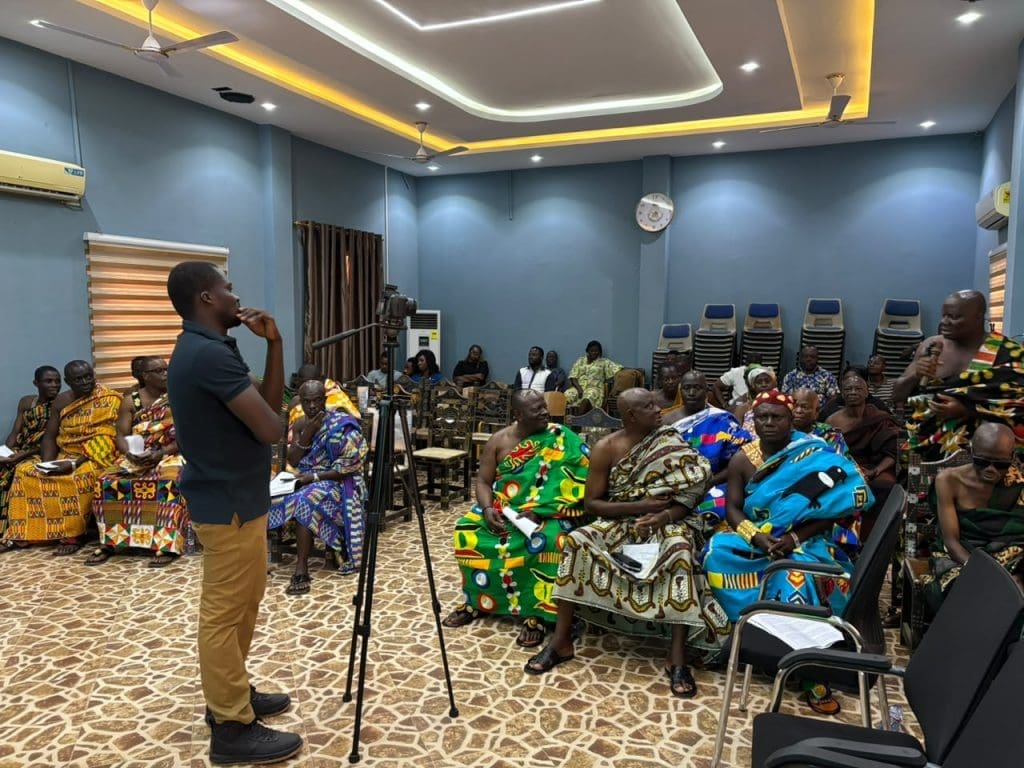
At a meeting of the Traditional Council on Wednesday, November 4, 2026, the chiefs urged President John Dramani Mahama and the government to give a capable Ghanaian investor the opportunity to take over the mine, arguing that indigenous ownership could make mining revenues more responsive to local development needs.
The demand has been reinforced by the Apinto Divisional Council, within whose jurisdiction the mine is located, which has petitioned the government against renewing Gold Fields’ licence.
The Council wants the concession transferred to a Ghanaian investor it believes would prioritise the development of host communities.
Nana Adu Panyin of the Apinto Divisional Council raised concerns over the delay in royalty payments.
The Council’s Registrar explained that the royalties had been lodged in an account but could not be disbursed because of land litigation, assuring that the funds would be released once the dispute was resolved.
Paramount Queen Mother of the Wassa Fiase Traditional Area, Nana Abena Kunadjoa II, expressed deep disappointment with Gold Fields’ CSR performance, saying community benefits had been inadequate after years of mining.
She referred to the company’s profits in 2025 and the first half of 2026, comparing them with royalties paid and CSR projects undertaken, to argue that its contribution to community development and government revenue was woefully inadequate. Specific figures were not provided at the meeting.
Nana Abena Kunadjoa II pointed to the poor state of roads and other infrastructure in Wassa Fiase, saying repeated appeals for assistance had gone unanswered.
She contrasted the situation with development projects emerging in the Damang enclave following the transfer of Damang Mine to Ghanaian ownership, citing roads, hospitals, an astroturf and an airport project as examples of what local ownership could deliver.
She appealed to President Mahama to heed the chiefs’ call and ensure that the Tarkwa mine is handed over to a Ghanaian investor when the leases expire.
She advocated the transfer of the lease to a Ghanaian investor, arguing that local ownership would enhance in-country returns, stimulate the local economy and improve the livelihoods of people in the catchment area.
Nana Kobina Gyan II, Chief of Mahamo also supported the demand for the mine to be transferred to indigenous ownership, while Nana Sompreh, Divisional Chief of Bogoso, and Nana Nteboah Prah, Divisional Chief of Prestea-Heman, backed calls for a Ghanaian to take over the concession after the expiry of the leases.
A major gold asset facing a lease expiry
The Tarkwa Gold Mine is a major gold-producing operation operated by Gold Fields Ghana Limited.
Its mining leases cover approximately 20,825 hectares, with five leases dated April 18, 1997, covering the property.
The leases are due to expire in April 2027, placing the future ownership and management of the mine at the centre of growing local demands.
The mine currently operates four large open pits extracting stacked, narrow auriferous conglomerates.
Ore is processed through a conventional carbon-in-leach (CIL) plant, with a gyratory crusher feeding a semi-autogenous grinding (SAG) mill and ball mill.
Gold is recovered from solution through electrowinning and smelted in an induction furnace.
The plant has a current processing capacity of 13.5 million tonnes per annum.
Tarkwa’s geology is dominated by the Banket Series, which comprises barren quartzite in the footwall and hanging wall, separated by mineralised conglomerates and pebbly quartzites.
The operation has been restructured to mine approximately 85 million to 90 million tonnes annually, with the aim of improving operational flexibility and maintaining targeted grades to produce about 500,000 to 530,000 ounces of gold each year.
The mine continues to report competitive mining and processing costs.
Its reserves declined by two per cent, with depletion partly offset by pit-slope optimisation, including wall steepening in selected areas, and a shift from owner mining to contractor mining that improved the overall cost base.
Mining plans have also been modified because of blasting restrictions at the Pepe 8, Atuabo and Mantraim pits, which are close to structures in the Brahaboboom community.
A gravity circuit was installed and commissioned in July 2018 to recover gravity gold and improve plant recovery.
Nearly a century of mining history
Tarkwa’s mining history dates back to the 1930s. The Abontiakoon vertical shaft was completed in 1935, and a central mill with a capacity of 30,000 tonnes per month was constructed over the following four years.
Several small mining companies operated the Abontiakoon concession before all workings were abandoned and allowed to flood in 1960.
Production resumed in 1961 under the State Gold Mining Corporation, and in 1963 the mines were renamed Tarkwa Goldfields Limited.
The Apinto shaft was sunk in the mid-1970s. Gold Fields Ghana entered the operation in 1993 through a management contract with the government and completed a feasibility study in 1996 for an open-pit and heap-leach operation.
The first phase of open-pit development was completed in 1998, with a mining rate of 14.5 million tonnes annually, including 4.7 million tonnes of heap-leach feed ore.
A second-phase expansion in 1999 raised the mining rate to 20.7 million tonnes and heap-leach feed production to 7.2 million tonnes.
Underground operations and the associated processing plant ceased that year.
In 2000, Gold Fields acquired the northern area of Teberebie, increasing mining production to 36 million tonnes annually.
Tarkwa adopted owner mining in July 2004 and commissioned a CIL plant with a nameplate capacity of 4.2 million tonnes per annum in October.
An expanded CIL plant was commissioned in January 2009, reaching a design throughput of 12.3 million tonnes by September that year.
The transition to owner maintenance was completed in 2010.
In 2011, Gold Fields acquired IAMGold’s 18.9 per cent interest in Tarkwa, bringing its stake to 90 per cent, with the remaining 10 per cent held by the Ghanaian government.
All heap-leach operations ended in 2013. The CIL plant’s capacity was increased to 13.5 million tonnes per annum in late 2014, while further enhancements to raise capacity to 15.5 million tonnes were considered.
In 2018, Tarkwa reverted to a contractor-mining model after a comprehensive review identified cash-flow and all-in-cost benefits.
With the lease expiry approaching, the Wassa Fiase chiefs say the next phase of the mine’s history must deliver a greater share of its benefits to Ghanaian communities and the national economy.
Their demand places the government before a major policy decision: whether to renew the existing leases or pursue a new ownership arrangement that gives capable indigenous companies a greater role in the country’s mineral wealth.


