Minority’s cocoa price cut protest ignites Parliament
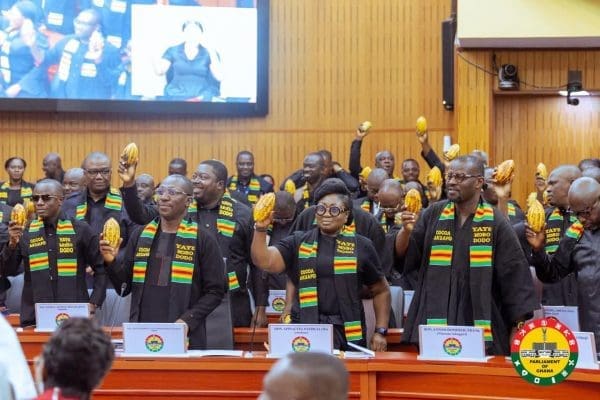
Minority NPP MPs
Parliament erupted in drama and symbolism on Friday as President John Dramani Mahama delivered the 2026 State of the Nation Address (SONA), fulfilling his constitutional duty under Article 67 of the 1992 Constitution.
The session was defined by stark contrasts between the Majority and Minority caucuses, reflecting the deep political and economic divides in the country.
Members of the Minority caucus dressed in black, adorned with sashes reading “Ya yɛ mobo dodo”—translated as “we are too pitiful”—and rose in unison holding cocoa pods while singing in protest.
Their display highlighted dissatisfaction with the recent 28% reduction in the cocoa producer price, which was cut from GH¢3,625 to GH¢2,587 per 64kg bag for the remainder of the 2025/2026 crop season.
Farmers and opposition lawmakers described the cut as devastating, leaving cocoa growers struggling to cope with rising costs of fertilizers, agrochemicals, hired labor, and transportation.
In contrast, the Majority caucus appeared in white attire, applauding the President and praising his address, with some members chanting “the best” in approval.
The visual contrast of black and white attire underscored the political divide over economic and social issues, with each side projecting a distinct narrative of Ghana’s current situation.
While the Majority celebrated perceived progress under the government, the Minority sought to signal the hardships faced by rural cocoa communities.
President Mahama maintained his composure throughout the display, describing the state of the nation as resilient. “Ghana is back, Ghana is working again,” he declared, urging citizens to embrace renewal, growth, and national determination.
His address covered key sectors including health, education, agriculture, infrastructure, and the fight against corruption, highlighting both progress achieved and priorities for 2026.
Injecting levity into the tense atmosphere, the President made a humorous reference to Minority Leader Alexander Afenyo-Markin after mentioning former Minister of Defence Dominic Nitiwul in the context of cocoa pricing. “I and Nitiwul are from the North; you, Afenyo, you are from Winneba,” he quipped, eliciting laughter across the chamber.
Despite the humor, the session concluded with the Minority expressing disapproval through boos, while the Majority responded with cheers and chants praising the President.
A moment of cross-party civility occurred afterward, when President Mahama was seen in a cordial conversation with Mr. Afenyo-Markin, demonstrating that personal relationships can transcend partisan divides.
Cocoa price cuts spark nationwide protests
The parliamentary drama mirrored widespread anger in cocoa-growing communities.
Hundreds of farmers in the Western North Region picketed the offices of the Ghana Cocoa Board (COCOBOD), demanding a reversal of the producer price cut.
Similar demonstrations took place in the Central and Ashanti Regions, highlighting the intensity of frustration among rural communities.
In towns such as Sefwi-Wiawso, Bekwai, Asunafo, and Amenfi, demonstrators marched through principal streets carrying placards with messages like “Save the Cocoa Farmer” and “Our Labour Deserves Better Pay.” Participants included elderly farmers, women engaged in cocoa cultivation, and young growers, all expressing disappointment over what they described as broken promises.
In the Assin North District of the Central Region, farmers from Assin Dansame, Asempanaye, Praso, Bereku, and Assin Nuaso staged peaceful demonstrations. Meanwhile, in Adomfe, Asante Akyem, a protest caused temporary traffic disruptions, prompting deployment of security personnel to maintain order.
Farmers consistently pointed to rising production costs as a central concern, warning that the reduced farmgate price could force many smallholders to abandon cocoa farming.
Analysts also raised concerns that lower domestic prices could drive cocoa smuggling to neighboring Côte d’Ivoire, where farmgate prices are perceived as more favorable.
Placards in several communities directly criticized President Mahama, accusing his administration of betraying cocoa farmers.
In Bia West and Juaboso, demonstrators said the price cut, combined with inflation and increasing input costs, posed an existential threat to smallholder livelihoods. Farmers argued that while global market conditions may be challenging, the burden of adjustment fell disproportionately on rural producers, who are already vulnerable to climate-related risks and yield fluctuations.
Economic and political implications
The protests underscore the central role cocoa plays in Ghana’s rural economy, where thousands of families depend on the crop for their livelihoods.
Any adjustment to producer prices carries significant political and economic weight, with potential ramifications for both national output and Ghana’s standing as one of the world’s leading cocoa producers.
Analysts suggest that the parliamentary protest and nationwide demonstrations could influence ongoing policy discussions, particularly in ensuring that farmers receive fair compensation and that measures are implemented to stabilize incomes amidst volatile global commodity prices.
While the 2026 SONA provided a platform for President Mahama to reaffirm his administration’s commitment to justice, accountability, and sustainable development, the Minority’s dramatic protest highlighted ongoing tensions between political symbolism and economic realities.
The visual of black-clad lawmakers with cocoa pods served as a stark reminder of the challenges facing Ghanaian farmers, contrasting with the Majority’s celebratory response to government initiatives.
The session ultimately illustrated the balancing act inherent in Ghanaian democracy: spirited debate, symbolic protest, and cross-party civility coexist in the halls of Parliament.
It also underscored the sensitivity of cocoa pricing decisions and the importance of addressing farmer welfare to maintain both economic stability and public confidence.