Mahama unveils $270m AI plan to position Ghana as tech hub
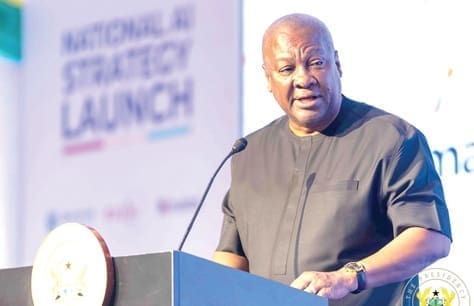
President John Dramani Mahama
President John Dramani Mahama has unveiled Ghana’s National Artificial Intelligence (AI) Strategy, a bold $270-million initiative designed to position the country as West Africa’s leading hub for AI innovation. The strategy seeks to harness artificial intelligence to drive national development and sustainable growth across all sectors.
Launching the policy in Accra, the President described it as a defining milestone in Ghana’s journey toward a digitally driven economy, stressing the need for the country to move beyond simply consuming foreign technologies to actively shaping them.
“This is a significant milestone in our national journey towards a digitally empowered, innovation-driven and globally competitive Ghana,” President Mahama said.
“It is also a statement of intent that Ghana will not be just a passive consumer of technologies shaping the future but that we are going to be an active participant in designing, governing and deploying them for our national transformation,” he added.
$250m computing centre at core
At the heart of the strategy is a $250-million AI computing centre, envisioned as a national hub for research, innovation and enterprise development. An additional $20 million has been earmarked for short- to medium-term implementation.
“Infrastructure is the foundation upon which innovation rests,” President Mahama said, adding, “These investments are bold but necessary.”
He further revealed that ministers and senior government officials have already undergone a national AI boot camp, with designated AI focal persons within ministries to accelerate adoption across public administration.
A glimpse into the future
The launch event at Labadi Beach Hotel blended formal statecraft with a striking vision of the future. A sleek, AI-powered robot, draped in kente fabric, captured attention as it smoothly delivered the first copy of the strategy document to the President—prompting applause and signaling Ghana’s technological ambitions.
New institutions and innovation push
The Minister for Communications, Digital Technology and Innovations, Samuel Nartey George, showcased “Aku,” an interactive AI assistant demonstrating real-world applications across healthcare, agriculture, education and finance. The system responded in multiple Ghanaian languages, including English, Ga, Twi, Dagbani, Ewe and Gonja, illustrating its potential for inclusive development.
The event drew a broad cross-section of stakeholders, including the Chief Justice, Paul Baffoe-Bonnie, Senior Presidential Advisor on Governance Valarie Sawyer, ministers, private sector leaders, and representatives of traditional authority such as the Nungua Traditional Council—underscoring the strategy’s whole-of-society approach.
George emphasized collaboration among government, academia, industry and civil society, noting that AI is already transforming key sectors.
“I trust that the judiciary will guide our ethical and legal application of artificial intelligence. Ghana stands capable and ready of leading and becoming Africa’s AI hub,” he said, while stressing that AI adoption must remain responsible and ethically grounded.
Governance, funding and oversight
Kwame Nkrumah University of Science and Technology researcher Jerry John Kponyo disclosed that an independent Responsible AI Authority will be established within the first year, alongside a National AI Office under the ministry. A National AI Fund is also proposed to ensure sustained financing for research and innovation.
Call for caution
Chairing the event, Speaker of Parliament Alban Sumana Kingsford Bagbin warned of the risks of poorly governed AI.
“If left unchecked or poorly governed, it can deepen inequality, weaken social trust, threaten privacy, and marginalise the most vulnerable among us,” Bagbin said.
He emphasised that the strategy must function as a social contract—ensuring technological advancement aligns with human development and inclusivity.