
Every GH¢1 invested in sanitation could yield GH¢556 – ISSER
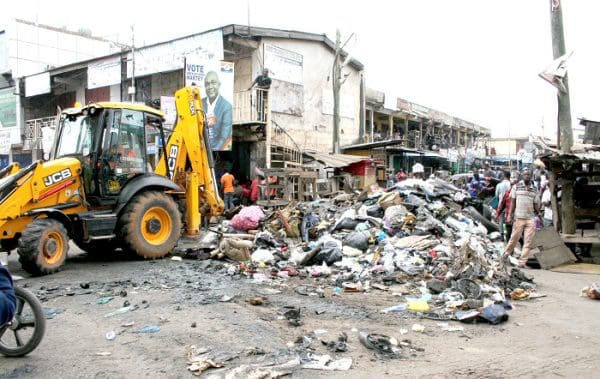
University of Ghana researchers have urge government to treat waste management as a high-return economic investment. Ghana could unlock billions of cedis in annual economic benefits by significantly increasing investment in waste management and sanitation, according to a new study by the Institute of Statistical, Social and Economic Research (ISSER).
The February 2026 policy brief, titled “Waste or Wealth? The Economic Returns to Sanitation Investment in Ghana” argues that the country’s sanitation crisis represents not only a public-health and environmental challenge but also a major missed economic opportunity.
ISSER estimates that increasing Ghana’s waste-management investment to the level it considers appropriate for lower-middle-income countries could generate GH¢556 in discounted annual benefits for every GH¢1 invested.
The study projects annual economic benefits of between GH¢58.1 billion and GH¢67.2 billion between 2025 and 2032 under its best-case investment scenario.
A massive return on investment
ISSER’s analysis compares Ghana’s current “business-as-usual” spending with a scenario in which waste-management investment is increased to the lower-middle-income-country benchmark.
Under the current system, the study estimates that Ghana spends an average of only GH¢38.78 per tonne of waste managed. Even at that relatively low level of spending, the researchers estimate a discounted annual benefit of about GH¢180 for every GH¢1 invested.
But increasing investment to GH¢1,028 per tonne produces a dramatically higher projected return of GH¢556 for every GH¢1 invested.
ISSER says the enhanced investment could reduce sanitation-related morbidity by 97.4% and attributable mortality by 81%. The projected economic benefits would come largely from reductions in healthcare costs and improvements in productivity.
Health savings would drive the gains
The researchers estimate that health-related savings would account for approximately 55.3% of the projected annual economic benefits.
Productivity savings would contribute the remaining 44.7%, including savings from preventing premature deaths, reducing absenteeism and improving working capacity. The implication is significant.
Investment in sanitation would not merely produce cleaner communities.
It could reduce the financial burden on the healthcare system, keep children in school, keep workers at their jobs and reduce deaths from preventable diseases.
From waste to wealth
ISSER’s central argument is that Ghana must fundamentally change how it thinks about sanitation.
The report describes the existing investment gap as an opportunity rather than simply a problem.
According to the researchers, strategic investment in sanitation could improve public health, strengthen human capital, create jobs, stimulate circular-economy innovation and improve quality of life.
This would require government to move beyond periodic clean-up exercises and emergency waste evacuation.
The researchers are calling for sustained investment in the physical and institutional systems required to manage waste properly.
These include household and communal latrines, faecal-sludge treatment plants, improved stormwater drainage, reliable solid-waste collection, elimination of open refuse dumps, landfill and treatment infrastructure and stronger institutional capacity at the MMDA level.
MMDAs need stronger capacity
ISSER also warns that simply increasing funding will not be enough.
The report recommends strengthening the institutional capacity of MMDAs to plan, budget, monitor and regulate waste and sanitation services.
It calls for environmental and public-health data to be integrated into local planning so that resources can be directed towards areas where the risks and potential returns are greatest.
The researchers also recommend formalizing the informal sector involved in waste management.
Govt cannot afford to wait
The findings provide a powerful economic case for government to act urgently.
If the projections in the ISSER study are realized, sanitation investment could generate economic benefits many times greater than the resources committed.
That makes the current underinvestment difficult to justify purely on fiscal grounds.
The report recommends that government increase investment to levels consistent with lower-middle-income-country standards and prioritize areas where sanitation interventions can generate the greatest health and economic returns.
It also recommends that the economic benefits of improved sanitation be incorporated into government budgeting and medium-term expenditure planning.
The underlying message is straightforward: Ghana should stop treating sanitation as a cost center and start treating it as an investment portfolio.
With the country facing persistent waste-management challenges, the ISSER analysis gives government a strong economic rationale to act now — before the costs of inaction become even greater.
The question is no longer simply how much sanitation investment Ghana can afford. It is how much Ghana can afford to lose by not investing enough.
By KOBINA WELSING