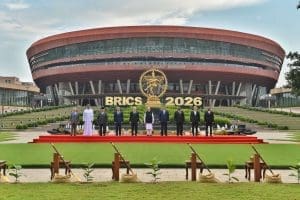
BRICS explained: Members, goals and global influence

BRICS has emerged as an influential platform for economic cooperation and diplomatic engagement among some of the world’s major emerging economies.
With an expanding membership, growing ambitions for reform of global institutions and increased cooperation across trade, finance and development, the bloc has become an important feature of international affairs.
Originally formed around Brazil, Russia, India and China, BRICS has expanded to include countries from Africa, the Middle East and Southeast Asia. Its growth reflects efforts by emerging economies to strengthen their collective influence in global decision-making and explore alternatives to traditional economic partnerships.
But what exactly is BRICS, how does it operate, and what does its expansion mean for Africa and countries such as Ghana? Here is everything you need to know.
What is BRICS?
BRICS is a grouping of countries that cooperate on economic, political, financial and development issues. It serves as a forum for member states to discuss shared interests, coordinate positions on international matters and promote greater representation for emerging economies in global governance.
The name originally came from the initials of Brazil, Russia, India and China, which were identified as major emerging economies. South Africa joined in 2011, adding the letter “S” and transforming BRIC into BRICS.
The grouping subsequently expanded, with Egypt, Ethiopia, Iran, Saudi Arabia and the United Arab Emirates invited to join in the 2023 expansion process. Indonesia formally became a full member in January 2025.
BRICS is not a traditional military alliance or a regional organisation with a single governing authority. Rather, it is a platform through which participating countries pursue cooperation while retaining their national sovereignty and independent foreign policies. The group does not have a constitutive treaty, a permanent secretariat or its own general budget.
Which countries are members of BRICS?
As of October 2026, BRICS has 11 full members.
They are:
- Brazil – A major Latin American economy with significant agricultural, mineral and energy resources.
- Russia – A major energy and natural resources producer.
- India – A large economy with substantial technology, manufacturing and services sectors.
- China – A major global manufacturing, trading and investment power.
- South Africa – An important African economy and a key participant in regional and continental affairs.
- Egypt – A North African country with strategic importance in trade, transport and regional diplomacy.
- Ethiopia – An East African country with a large population and an important role in regional affairs.
- Iran – A Middle Eastern country with significant energy resources.
- United Arab Emirates – A major trade, logistics, finance and energy centre.
- Indonesia – Southeast Asia’s largest economy by nominal GDP and a major regional player.
- Saudi Arabia – A major oil producer and an influential economy in the Middle East.
These countries bring different economic strengths, political interests and development priorities to the grouping. Their participation provides BRICS with a broad geographical reach across Latin America, Africa, Asia and the Middle East.
How did BRICS begin?
The term BRIC was introduced in 2001 by economist Jim O’Neill to describe the economic potential of Brazil, Russia, India and China. The four countries later developed their cooperation into a government-led diplomatic forum.
The first BRIC summit took place in Russia in 2009, providing leaders with an opportunity to discuss the global economy, financial cooperation and international governance.
South Africa joined in 2011, broadening the group’s representation and bringing a major African economy into the fold.
A further expansion was agreed upon at the 2023 summit in Johannesburg, South Africa. Several countries subsequently joined, and Indonesia became a full member in 2025.
The expansion has strengthened BRICS’ geographical reach and increased the diversity of its economic and political interests.
What are the main objectives of BRICS?
BRICS pursues several objectives aimed at strengthening cooperation among its members and increasing their influence in international affairs.
- Reforming global institutions
One of the bloc’s major priorities is to push for reforms in institutions such as the International Monetary Fund, the World Bank and the United Nations. Members argue that global decision-making structures should better reflect the economic importance and interests of developing countries.
- Increasing trade and investment
BRICS encourages trade among its members, investment partnerships and cooperation in areas such as infrastructure, agriculture, manufacturing, energy and technology.
- Promoting financial cooperation
The bloc explores ways to facilitate cross-border payments, expand the use of national currencies in trade where mutually beneficial, and strengthen financial cooperation.
- Supporting development
Members cooperate on issues including poverty reduction, sustainable development, food security, public health and technological advancement.
- Strengthening the voice of emerging economies
BRICS provides a platform for members to coordinate positions on international issues and advocate for a more representative global economic and political system.
However, members do not always share identical positions on international conflicts, trade or economic policy. Decisions generally depend on consultation and consensus.
What is the BRICS New Development Bank?
One of the most significant institutions associated with the grouping is the New Development Bank (NDB), established in 2015.
The bank was created to mobilise resources for infrastructure and sustainable development projects in BRICS countries and other emerging and developing economies.
Its financing priorities include transport, clean energy, water and sanitation, urban development and other projects that support economic growth.
The NDB is important because developing countries often face substantial financing requirements for roads, electricity, water systems and other essential infrastructure.
By providing another potential source of development finance, the bank can complement funding from existing international financial institutions and other lenders.
However, access to funding depends on the bank’s membership arrangements, project assessments, financing conditions and approval processes. Its existence does not mean every BRICS country or African state automatically qualifies for loans.
What are BRICS partner countries?
BRICS has also introduced a partner-country category for countries that wish to cooperate more closely with the grouping without becoming full members.
As of October 2026, the 10 partner countries are Belarus, Bolivia, Cuba, Kazakhstan, Malaysia, Nigeria, Thailand, Uganda, Uzbekistan and Vietnam.
Partner countries may be invited to participate in BRICS summits and selected meetings, subject to the group’s arrangements and members’ agreement.
Their status differs from full membership, so attending a BRICS event or expressing interest in joining does not automatically make a country a member.
The partner framework allows BRICS to expand its engagement with other countries while managing the process of cooperation and potential future expansion.
Why is BRICS important to Africa?
Africa has a significant interest in BRICS because several member countries have strong economic and diplomatic ties with the continent.
South Africa, Egypt and Ethiopia are full members, while Nigeria and Uganda participate as partner countries. Other African nations may also engage with the bloc through diplomatic meetings, trade arrangements and development initiatives.
BRICS cooperation could create opportunities for African countries in several areas.
Trade and investment: African businesses could explore new markets for agricultural products, minerals, manufactured goods and services.
Infrastructure financing: Development partnerships could help support transport networks, renewable energy, water systems and industrial projects, depending on financing terms and project viability.
Industrial development: Cooperation in manufacturing, technology and skills development could help African economies move beyond exporting raw materials.
Diplomatic representation: BRICS provides African countries with additional opportunities to discuss international economic reforms, debt, climate finance and development priorities.
Nevertheless, these opportunities are not guaranteed. African countries must negotiate favourable agreements, protect domestic industries and ensure that partnerships deliver measurable economic benefits.
What does BRICS mean for Ghana?
Ghana is not a full member of BRICS, nor is it among the bloc’s 10 partner countries as of October 2026.
However, the country could benefit from stronger economic engagement with BRICS members through trade, investment, industrial development and diplomatic cooperation.
For example, Ghana could explore partnerships with member countries in agriculture, mining, manufacturing, renewable energy, digital technology and infrastructure.
The country could also seek investment that supports local processing of minerals and agricultural products rather than relying heavily on exports of unprocessed commodities.
For Ghanaian businesses, stronger commercial relationships with BRICS economies could potentially open new markets and create opportunities to source machinery, technology and industrial inputs.
At the same time, Ghana would need to assess the terms of any partnership carefully. Factors such as debt sustainability, local employment, technology transfer, environmental protection and the competitiveness of domestic businesses would be important.
BRICS membership is not a prerequisite for trade or investment with its member countries. Ghana can pursue bilateral agreements and commercial partnerships independently.
Does BRICS want to replace the US dollar?
One issue frequently associated with BRICS is the role of the US dollar in international trade and finance.
Some members have advocated for greater use of national currencies in transactions between participating countries. Such arrangements could help reduce certain currency-conversion costs and exposure to exchange-rate movements involving the dollar.
The bloc has also discussed ways to improve cross-border payment systems and strengthen financial cooperation.
However, efforts to increase the use of national currencies should not be confused with the creation of a common BRICS currency.
There is no established single BRICS currency that has replaced the US dollar. Any major shift in global currency use would depend on factors such as financial-market depth, convertibility, confidence, trade patterns and the willingness of businesses and governments to adopt alternatives.
The dollar continues to play a major role in international trade, central-bank reserves and global financial markets.
What challenges does BRICS face?
Despite its growing influence, BRICS faces several challenges.
First, its members have different political systems, economic structures and foreign-policy priorities. These differences can complicate efforts to reach common positions.
Second, economic relationships within the group are unequal. China’s economy is considerably larger than those of many other members, raising questions about the balance of influence.
Third, geopolitical tensions among members and their international partners can make cooperation difficult.
Fourth, expanding membership increases the diversity of interests that must be accommodated when making decisions.
Finally, the bloc must demonstrate that its initiatives can deliver practical outcomes in trade, investment, development finance and international cooperation.
Its future influence will depend not only on its size but also on its ability to translate shared objectives into effective policies and sustainable partnerships.
Conclusion
BRICS has developed from a grouping of four emerging economies into a wider international platform with 11 full members and 10 partner countries.
Its focus on trade, investment, development finance and reform of global institutions has made it increasingly relevant to discussions about the future of the international economic order.
For Africa and Ghana, the bloc offers potential opportunities for investment, industrialisation, trade diversification and diplomatic engagement. However, the benefits will depend on the quality of individual agreements and the ability of countries to protect and advance their national development priorities.
Ultimately, BRICS is best understood as a forum for cooperation among countries seeking a greater role in global affairs, rather than a unified political or economic system with identical interests.