
AGI, GUTA, GNCCI, economist back BoG’s costly recovery

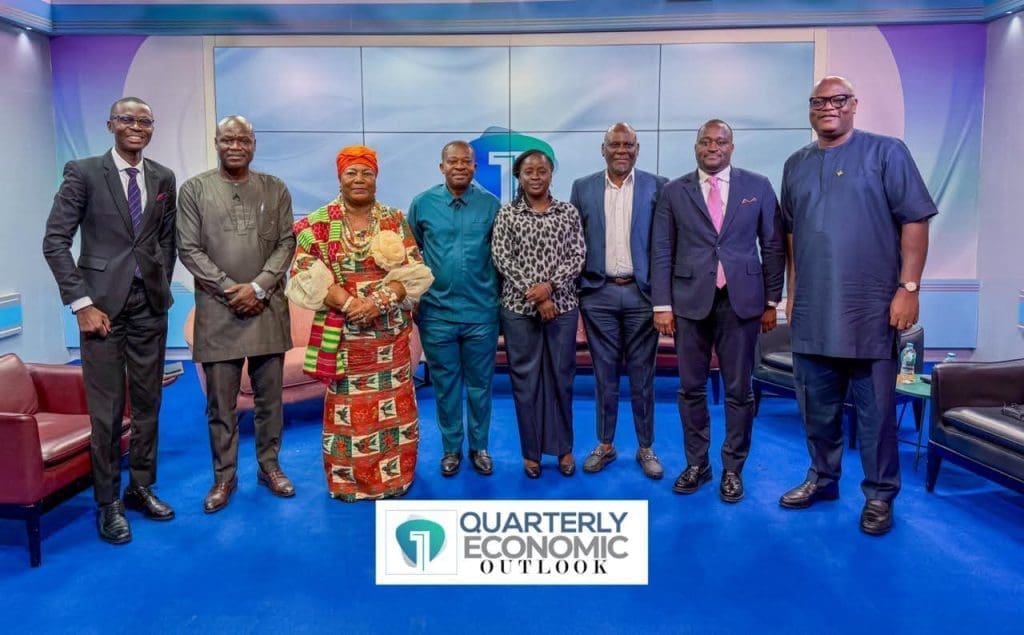
Seth Twum Akwaboah, CEO of AGI, Mark Badu Aboagye, CEO of GNCCI, Dr. Gloria Afful-Mensah, Economist and lecturer, University of Ghana and Joseph Paddy, Vice-President of GUTA
Even before the Bank of Ghana (BoG) publishes its audited financial statement, business associations and a leading academic economist have thrown strong support behind the costly policy interventions undertaken by the central bank, arguing that the financial sacrifices made by BoG were both necessary and justified in restoring stability to Ghana’s economy after one of its most turbulent periods in recent history.
At the forefront of this endorsement are the Association of Ghana Industries (AGI), the Ghana Union of Traders Association (GUTA), and the Ghana National Chamber of Commerce and Industry (GNCCI), alongside an economist and a University of Ghana lecturer.
Together, they argued that the cost of stabilising inflation, the exchange rate, and the broader financial system pales in comparison to the economic damage that would have occurred had decisive action not been taken.
They made the comments in Accra during a Quarterly Economic Outlook discussion organised by Channel 1 TV.
Their position reflects a growing consensus within Ghana’s private sector and academic circles: that macroeconomic stability, particularly the stabilisation of the cedi and inflation, was non-negotiable—even if it came at the expense of the central bank’s balance sheet.
Costly policies, critical outcomes
At the heart of the stabilisation effort was an aggressive monetary tightening programme led by the central bank.

Faced with inflation that had surged beyond 54% in 2022, the BoG moved decisively to mop up excess liquidity from the financial system.
This intervention alone came at a high financial cost, with the Bank spending over GH₵16.7 billion on Open Market Operations in 2025—nearly double the GH₵8.6 billion recorded in 2024.
The sharp GH₵8.1 billion increase underscored the scale of the intervention.
In practical terms, the central bank paid significantly higher interest rates to absorb surplus cash circulating within the banking system.
While this imposed heavy financial costs on the Bank, the outcome was striking: inflation declined sharply from crisis levels of over 54% to about 5.4% by the end of 2025, with more recent data suggesting a further moderation to around 3.2%.
This success, however, came with a structural trade-off.
By issuing its own securities at market rates without earning equivalent returns on its assets, the BoG incurred persistent operational losses.
In effect, the central bank sacrificed its own financial strength to restore price stability and protect households and businesses from runaway inflation.
Parallel to inflation control was the equally demanding task of stabilising the cedi.
To achieve this, the central bank, in collaboration with the Ghana Gold Board (GoldBod), injected more than $11 billion into the foreign exchange market.
These interventions reversed a steep depreciation trend, with the cedi strengthening from about GH₵14.70 to the dollar in December 2024 to approximately GH₵10.45 by the end of 2025.
The appreciation of the currency played a critical role in easing imported inflation, restoring a measure of predictability to the economy.
Yet, like monetary tightening, this strategy carried substantial risks, including potential valuation losses and pressure on foreign reserves.
Gold-for-forex
In addition to conventional tools, the BoG deployed innovative and unconventional policy measures.
Chief among these was the gold-for-forex initiative, implemented in partnership with the Ghana Gold Board (GoldBod).
The programme sought to reduce reliance on foreign currency by leveraging domestically sourced gold.

While it contributed to exchange rate stability and reserve accumulation, it reportedly resulted in losses estimated at about $300 million.
Gold-for-Oil programme
Similarly, the Gold-for-Oil programme—introduced to stabilise fuel prices—generated financial losses, particularly from cargoes that arrived after the policy had been suspended.
These initiatives, while effective in achieving short-term stability, exposed the central bank to commodity price risks and operational inefficiencies typically avoided in orthodox monetary policy frameworks.
Despite these costs, Ghana’s external reserves position improved, reflecting a shift in strategy from reliance on borrowed reserves to domestically accumulated assets.
By December 2025, Gross International Reserves had reached $13.8 billion, signalling a more sustainable buffer compared to earlier years when reserves were largely built through external borrowing.
AGI: Stability was essential, not optional
For AGI, the stabilisation of the cedi represents a turning point in Ghana’s economic recovery.
The Chief Executive Officer (CEO), Seth Twum Akwaboah, described the central bank’s actions as both necessary and timely, given the scale of uncertainty that had gripped the economy.
Reflecting on the crisis period, he noted that confidence among businesses had nearly coll apsed, with firms unable to plan or invest due to extreme volatility in inflation and exchange rates.
“We were in crisis, confidence level was so low, people investing their own resources became an issue.
There was so much uncertainty in the system that required that level of stability,” he said during a Quarterly Economic Outlook discussion.
According to him, the stabilisation of the cedi has provided critical relief to businesses, particularly in an import-dependent economy where exchange rate fluctuations quickly translate into higher costs for fuel, raw materials, and finished goods.
Mr Akwaboah emphasised that recent currency stability has reduced speculative pressures in the foreign exchange market, allowing genuine economic actors—manufacturers, importers, and traders—to operate with greater certainty.
He stressed that while the financial cost to the central bank was significant, the alternative would have been far worse.
Without intervention, he argued, inflation would likely have remained elevated, business confidence would have deteriorated further, and the broader economy could have faced deeper disruption.
However, he cautioned that the next phase of economic management must focus on translating stability into growth.
He called for increased credit to the productive sectors, particularly manufacturing, to support industrial expansion, job creation, and value addition.
GNCCI: Macroeconomic stability driving business confidence
The CEO of GNCCI, Mark Badu Aboagye, echoed similar sentiments, highlighting the direct relationship between macroeconomic stability and business activity.
“For business, you operate in a certain environment and that environment is the macroeconomic environment. So if that environment is good, it stimulates business activity; if it is bad, it puts people off and people will not want to invest,” he explained.
He recalled the severe challenges faced by businesses in 2022, when inflation surged to about 54% and the policy rate climbed to around 30%, placing Ghana among the most challenging economic environments globally at the time.
Mr Aboagye described the recent turnaround as both swift and impactful, noting that the sharp decline in inflation to around 3.2% has significantly improved conditions for businesses.
“The progress for me, the transition has been very swift—that is what we have been looking for—to move from that level to an inflation of 3.2%,” he said, commending economic managers for their efforts.
GUTA: Stability key for planning and trade
From the perspective of traders, the Vice-President of GUTA, Joseph Paddy, stressed that exchange rate stability is fundamental to business planning and operational efficiency.
He noted that recent improvements in the exchange rate have brought relief to traders, particularly importers who depend heavily on foreign currency for their operations.
“And even with our imported goods, we can do projections that when I go to the port to clear my goods, there is a certain rate I can use, so I don’t need to worry myself,” he said.
Mr Paddy emphasised that the ability to make accurate financial projections is critical for business survival, warning that uncertainty in the exchange rate environment often leads to business failure.
“As a businessman, if you can’t do projection in your business, you fail,” he stated.
While commending the recent stability, he urged government to focus on sustaining these gains, stressing that consistency in macroeconomic indicators is essential for long-term growth and revenue generation.
Economist: “Correction losses,” not policy failure
Providing an academic perspective, Dr. Gloria Afful-Mensah mounted a robust defence of the central bank’s actions, arguing that the financial losses incurred should be understood as deliberate policy trade-offs rather than evidence of mismanagement.
“These are not losses arising from mismanagement or policy failure,” she explained.
“They are correction losses—costs incurred intentionally to restore stability and protect the broader economy.”

She noted that the crisis demanded extraordinary policy responses, with inflation surging above 54 percent, the cedi depreciating sharply, and external reserves coming under intense pressure.
“These were not normal times. The BoG had to step in as a stabiliser of last resort to prevent systemic breakdown,” she said.
Dr Afful-Mensah outlined four key objectives that guided the central bank’s interventions: reducing inflation, stabilising the exchange rate, rebuilding foreign exchange reserves, and preserving confidence in the financial system.
Each of these goals, she noted, carried inherent financial costs.
She explained that under Ghana’s inflation-targeting framework, anchoring expectations is critical, even if it requires costly interventions.
The central bank’s success in bringing inflation down to near-target levels, she said, demonstrates the effectiveness of these measures.
On currency stabilisation, she pointed to the more than $11 billion injected into the foreign exchange market as evidence of the scale of intervention required to restore confidence and reverse depreciation pressures.
She also highlighted the role of unconventional tools such as the gold-for-forex and Gold-for-Oil programmes, noting that while they introduced new risks, they were instrumental in stabilising the economy during a period of acute stress.
Central bank as shock absorber
A central theme in Dr Afful-Mensah’s argument is the role of the Bank of Ghana as the economy’s “shock absorber.”
By absorbing the financial cost of stabilisation within its own balance sheet, the central bank effectively shielded the government and the public from immediate economic hardship.
“This approach helped avoid immediate fiscal distress and prevented additional hardship for households and businesses,” she said.
However, she acknowledged that this strategy has weakened the central bank’s balance sheet, with losses arising from high interest payments, foreign exchange interventions, and commodity-based programmes.

Despite this, she maintained that the interventions prevented far worse outcomes, including hyperinflation, a disorderly collapse of the cedi, and potential instability within the financial system.
“The central bank essentially traded its financial strength for macroeconomic stability. It prioritised national welfare over institutional profitability,” she said.
Stability at a price—but worth it
Across the board, business leaders and economists agree that Ghana’s recent macroeconomic stability has come at a significant cost—but one that was necessary.
The stabilisation of inflation, the strengthening of the cedi, and the restoration of confidence have created a foundation for economic recovery.
At the same time, these gains have been achieved through deliberate policy choices that imposed financial burdens on the central bank.
As Ghana transitions from stabilisation to growth, the challenge will be to sustain these gains while rebuilding the financial strength of the Bank of Ghana.
For now, however, the verdict from industry and academia is clear: the cost of stabilising the economy was high, but the cost of inaction would have been far greater.