Govt slaps TV stations with $84,000 annual fee

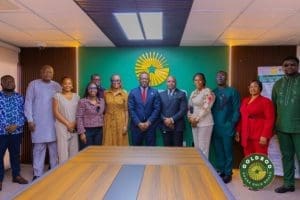
Samuel Nartey George, Minister for Communication, Digital Technology and Innovations, Joseph Bernard Allotey, and Abdulai-Awudu, GIBA President
On Monday, 7th September 2026, the Minister for Communication, Digital Technology and Innovations, Samuel Nartey George, announced the outcome of the comprehensive review of Ghana’s National Digital Terrestrial Television platform, which was completed in July
A Committee, he said, had recommended a sustainable cost-sharing framework and a graduated tariff-support mechanism to complement the subsidised national tariff of $7,000 per channel per month during the initial implementation years, with the new arrangements taking effect from January 2027, easing the burden on qualifying broadcasters while safeguarding the public’s right to information and the Government’s universal access obligations.
It is worth reading that statement slowly, because the Honourable Minister announced three things and not one. There is a tariff, the tariff is subsidised, and it is graduated during the first years of implementation.
By the time the announcement reached most of us, however, it had been compressed into a single figure, seven thousand dollars, and the two words that fell away, subsidised and graduated, are precisely the two that determine what this arrangement will actually cost a television station.
I am already hearing colleagues budget on the misunderstanding.
Let me therefore put the practical consequences on record at the outset.
No station pays $7,000 in January 2027, because the fee is phased in over four years and begins at 60%.
And if the Committee’s recommendation is followed, no station pays in dollars at all, since the dollar is a reference currency in that report and nothing more
Thereafter I wish to say something about how the figure was arrived at, because that, in my considered view, is the part of this story most worth keeping.
Where this began
In 2005 the National Communications Authority constituted a task force, of which the Ghana Independent Broadcasters Association was a member, to consider Ghana’s position ahead of the Geneva 2006 Agreement establishing the digital terrestrial broadcasting plan.
Ghana signed, and undertook to migrate from analogue to digital transmission by 17th June 2015.
In January 2010, the Minister of Communications at the time inaugurated the National Digital Broadcasting Migration Technical Committee, on which GIBA also served, and in August 2010 Cabinet approved its report as the Digital Migration Roadmap.
That document determined that, rather than have every broadcaster build its own network, the country would operate one unified national platform carrying all authorised free-to-air television stations.
The reasoning was universal access, the prevention of marginalisation and the efficient use of spectrum, and it was sound reasoning
The consequence, which few of us dwelt upon at the time, is that every television station in Ghana now depends upon a platform which it does not own and which it cannot leave.
K-Net Ghana Limited won the tender in 2015 and built the infrastructure, and the platform has been in service since 2016.
The bargain of 2016, and the condition attached to it
Under the Cabinet-approved roadmap, the NCA issued Digital Replacement Authorisations permitting existing analogue broadcasters to run their digital channels on the national platform alongside their analogue channels until Analogue Switch-Off.
That meant simulcast, which is to say running two transmission regimes side by side with the full cost of the analogue plant still on the books, and the burden fell only upon the older analogue houses.
The newly authorised digital-only stations carried nothing of the sort.
GIBA sought a meeting on the matter, and on 21st March 2016 the Ministry met the Association together with the NCA and the Digital Broadcasting Migration Committee.
The Ministry concluded that Government would bear the cost of the digital platform until the pronouncement of Analogue Switch-Off.
That was the bargain. Government further procured and installed studio-to-transmitter link equipment free of charge for the seventeen analogue broadcasters then operating, as a crash programme to begin digital switch-on, and carried the monthly recurrent charges upon those links.
The moratorium was therefore real, it was documented, and it was conditional.
The condition was Analogue Switch-Off, which did not come for years and had certainly not come at the time the moratorium was withdrawn.
The withdrawal, and the years of dispute
On 17 February 17, 2020, at a DTT stakeholders meeting, the Ministry informed broadcasters that the moratorium under which Government bore the cost of transmission services and of our links to the headend was coming to an end, with effect from 1st May 2020.
By letter of September 23, 2020 the Minister mandated K-Net to collect contribution link service fees directly from broadcasters, and by letter of November 19, 2020 the Ministry re-affirmed that position and indicated that the operator could cease providing the service to any broadcaster who had not paid by the end of that month
What followed is not in dispute. Invoices went out, stations were switched off, and some houses paid in order to keep their signal up, not because they accepted the basis of the charge but because a dark screen is an argument no broadcaster can afford.
There was no service level agreement in place, no negotiated price, and no contract of any kind between the operator and the broadcasters being invoiced.
Our objection was never that transmission should be free. It was that a public fee upon a monopoly national platform cannot properly be created by a letter, and that the authorisations we hold from the NCA already made us responsible for delivering our signals to the headend at Kanda, for which the Authority had even supplied the GPS coordinates.
Alongside that dispute, the channel fees themselves were moving.
At a DTT Broadcasters meeting on Friday, July 29, 2022, stations were notified that payment of what the Ministry itself described as subsidised channel fees, for both national and regional channels, would begin in January 2023.
The Ministry then granted a moratorium of three months, covering January to March 2023, and invoicing commenced in April.
The rate applied to a national channel was US$10,000 per month, rendered in Ghana Cedis at an exchange rate of GH¢13 to the dollar, which produced a bill of GH¢130,000 for one national channel for one month
Two features of that arrangement deserve to be remembered now. The first is that the fee was already being called subsidised in 2023, so the word itself is not new.
What is new in 2026 is that there is a published cost build-up standing behind it
The second is that those invoices were issued by the Central Digital Transmission Company Limited, while the Ministry’s own correspondence of the same period explained that the platform was being managed through K-Net pending the full operationalisation of that very company.
We were therefore being billed a public fee by an entity which, on the Ministry’s own account, had not yet been fully stood up.
I shall return to that, because it bears directly upon governance.
Parliament’s Select Committee on Communications heard these matters in March 2023 and agreed with a good deal of what the industry put before it, including that the fees ought to have been set by Parliament under the law on fees and charges, that there was no service level agreement, and that broadcasters had not been permitted to negotiate a price they were being made to pay.
Nothing changed. In April 2023, broadcasters executed a power of attorney appointing GIBA to act for them collectively, and on July 31, 2023 the Association filed suit in the High Court in Accra. An application for a mandatory injunction followed in January 2025
In December 2023, the then Minister told Parliament that television signals could be cut in 2024 if broadcasters did not pay. The fee at the centre of that warning had begun at $15,000 per month and had come down to $10,000 after it was challenged. That movement, in my view, is the whole difficulty in a single line.
A figure which can fall by a third merely because somebody objected to it was never a costing at all. It was a position taken.
It is worth recalling who said what at that moment. The Member for Ningo-Prampram, Samuel Nartey George, then in opposition on Parliament’s Communications Committee, accepted that broadcasters must pay, argued that $10,000 was on the high side, pointed to some $7,500 as the sort of figure comparable platforms charged the same stations, and told the industry that litigation would not settle the matter but a counter-offer would. Three years later, as Minister, he has landed at $7,000.
What was different this time
In February 2026, the Ministry constituted a multi-stakeholder DTT Pricing Committee under the chairmanship of Emmanuel Ofori of the Ministry, with the NCA, GBC, the NMC, GIBA and K-Net serving as institutional members
Critically, the Committee was not asked to name a fee.
It was asked first to establish the cost base, being a detailed breakdown of the operational cost, the infrastructure arrangements, the governance framework and the quality-of-service position, and only thereafter to develop a cost-sharing model.
Baseline first, price second. On this platform, in this country, that order had never once been followed.
Three findings from the Committee’s report deserve to be far better known than they presently are.
The first concerns GBC. Of the forty-two transmission sites which constitute the physical presence of the national platform, thirty-eight, including the Head End, belong to GBC.
I should be precise on this point, because it is frequently reported loosely.
It is the sites themselves which are GBC’s, being the land, the towers, the buildings and the related facilities, and not the transmission equipment standing upon them, which is State-owned platform infrastructure.
Our public broadcaster has, in other words, been hosting the national platform upon its own estate for a decade without formal recognition of that contribution, and it is to GBC’s credit that what it asked of the Committee was documentation rather than profit.
The second concerns the operating cost. The Committee did not simply accept the figures placed before it.
It caused the NCA to build the annual envelope from the bottom up and benchmarked operations and maintenance at $6.014 million, which is below even the Ministry’s own working figure of $7.25 million.
Scrutiny, in other words, did not merely test the number. It brought it down.
The third concerns the tariff itself, which is a residual and not an assertion.
The recommended annual envelope comes to approximately $11.52 million, made up of operations and maintenance, the recognised GBC ground rental, capital recovery, spectrum authorisation and a modest return on the State’s capital.
Against that envelope, broadcaster contributions at $7,000 across sixty-six channels amount to some $5.54 million, leaving Government to carry $5.98 million, being 51.9% of the whole.
That is what a subsidised national tariff means in practice, and it is a very different proposition from a figure announced with no costing behind it.
It is only fair, however, to record how that subsidy came to be there at all, because it did not arrive by generosity.
GIBA argued the case, consistently and over many years, that broadcasting in this country is not merely a commercial activity but a public service; that broadcasters carry standing obligations to inform, to educate and to warn; that our stations have been central to national development and to the deepening of our democracy through public debate, investigative journalism, election coverage and the scrutiny of the executive, the legislature, and the judiciary; and that a platform which exists to carry those services into every household cannot properly be priced as though it were an ordinary commercial utility.
That argument is what produced the Public Interest Subsidised Pricing Model which the Committee ultimately adopted, and it is what produced the graduated manner in which the fees are to be administered.
Both features rest upon a case the Association made patiently and repeatedly on behalf of its members, often when it was unfashionable to do so, and the industry should know it.
The Committee presented and signed its report at the Ministry on 9th July 2026, and the Minister undertook at that ceremony to issue a white paper upon it. That white paper has not yet been published.
It was therefore while the industry was still awaiting it that Monday’s announcement came, at the Accountability Series, carrying the headline figure ahead of the document which is meant to give it detail.
That sequence is worth noting, because a good many of the questions colleagues are now asking are questions which only the white paper can properly answer.
The graduation, and what you will actually pay
The Committee recommended a phased glide path onto the full fee.
The steps are annual, with each share applying for a full year of operation before the next takes effect. For a single national channel, the position is as follows.
Year 1, being 2027, is 60% of the approved fee, which is $4,200 per month and about $50,400 for the year.
Year 2, being 2028, is 70%, which is $4,900 per month and about $58,800 for the year.
Year 3, being 2029, is 80% which is $5,600 per month and about $67,200 for the year.
Year 4, being 2030 and thereafter, is one hundred per cent, the full cost-reflective fee, which is $7,000 per month and about $84,000 for the year
Taken together, the four transition years come to approximately $260,400 per channel.
Had the full fee applied from January 2027, those same four years would have cost $336,000, so the glide path is worth some $75,600 per channel, or about twenty-two and a half per cent, across the transition.
A station which has budgeted an $84,000 line item for its first year has therefore overstated its exposure by a third, and a house carrying two channels should double these figures throughout.
It is instructive to set this beside the transition we were offered the last time.
In 2023 the fee for a national channel was $10,000 per month, and the cushion granted was a moratorium of three months.
In 2027, the fee is $7,000 at full recovery; the first year is charged at $4,200, and the cushion runs for four years.
A station which was invoiced GH¢130,000 for April 2023 is being asked, in its first year under the new arrangement, for something in the order of forty-two per cent of that dollar figure.
Whatever else may be said of this process, the difference between three months and four years is the difference between an accommodation and a transition.
I should add that the report does not state whether the graduated relief is to be assessed per channel or per broadcaster. On a two-channel house, that distinction is worth something in the order of $150,000 across the four years, and it is one of several matters the white paper will need to settle. Nor is the relief automatic
It is framed as support for qualifying nationwide broadcasters which maintain nationwide service and presence, and the qualifying criteria and the administration of that support are expressly left to be settled at implementation.
That is a considerable measure of discretion still to be exercised.
Neither is $7,000 a flat charge upon everybody.
The Committee recommended a three-tier structure, under which commercial operators in genuine sub-urban regions outside Greater Accra, Ashanti and Western would pay roughly $2,500 to $3,000 per channel per region, and community non-profit rural services roughly $1,200 to $1,500.
The pricing deliberately asks less of broadcasters who serve the developing regions, which is a cross-subsidy and a defensible one.
Full cost recovery and why the efficiencies matter
No one should mistake a glide path for a permanent concession. This is a transition to full cost recovery, and full cost recovery arrives in year four.
Nor is the full fee the whole cost of running the platform even then, since our contributions at that point come to about $5.54 million against an envelope of about $11.52 million.
Every figure we shall be discussing for the next four years is a subsidised figure sitting inside a larger subsidised figure.
What the industry is being asked to do is to walk, in stages, from a platform which the taxpayer funds entirely to one which its users fund substantially.
It is worth working that through at the level of the whole platform, because the 51.9% is routinely quoted as though it were a fixed share, and during the transition it is nothing of the sort.
If all sixty-six channels were paying the national rate, collections would come to roughly $3.33 million in 2027, US$3.88 million in 2028, $4.44 million in 2029 and $5.54 million from 2030.
Only that last figure appears in the Committee’s envelope.
In the earlier years, the collection is materially lower, which means the State will in fact be carrying appreciably more than 51.9% while the glide path runs, closer to seventy per cent of the envelope in the first year, and more still once the regional tiers and the qualifying criteria are taken into account.
Government’s exposure during this transition is therefore larger than the headline suggests, and the industry ought to acknowledge that as readily as it quotes the tariff.
Whether the walk proves bearable depends upon something which will be very easy to forget once the invoices begin to arrive, namely that the cost of running this platform ought to be falling. Technical efficiency projects are already under way.
The solar investment at the transmission sites sits outside the tariff envelope and is funded separately by the State and development partners, so broadcasters are not being asked to pay for that capital, but we should certainly expect to see the benefit of it in the energy line, and energy across forty-two sites is not a small line at all.
Fewer diesel hours, better network management, tighter maintenance regimes and improved reliability all pull in the same direction.
It is precisely for this reason that the Committee recommended that it continue as a standing institutional body, meeting annually to validate operational savings and to recommend the tariff downwards wherever those savings prove real.
If that works as intended, the arithmetic becomes rather more interesting than mere survival.
The envelope already contains a three per cent return on the State’s capital, which is to say that a return is contemplated within the model rather than excluded from it, and is simply absorbed by the subsidy for the time being.
Should efficiency bring the operating costs down while the tariff holds at cost-reflective levels, this platform will cease to be a drain upon the public purse, will begin to finance itself, and could in time generate a genuine surplus, being money which can be put back into coverage, redundancy and capacity rather than drawn from the Consolidated Fund.
That is what a national infrastructure asset paying its own way looks like, and it is what this platform was always intended to be. It will happen, however, only if the annual review actually sits, actually verifies the savings and actually moves the figure
Some perspective on the figure
It is worth setting this tariff beside what broadcasters in our market already pay for carriage elsewhere, because seven thousand dollars sounds a good deal larger in isolation than it does in company.
A Ghanaian television station carried on the MultiTV platform pays in the region of US$5,000 to US$6,000 per month for that carriage.
Stations carried on DStv pay broadly comparable sums, in the region of US$4,000 to US$7,000 per month depending upon the arrangement.
There are of course other platforms, and a number of our houses sit on more than one of them, but I take these two because they are the platforms most familiar to Ghanaian audiences and most frequently discussed among ourselves.
Set against that, the national DTT tariff begins at about US$4,200 per month and reaches US$7,000 only in year four.
Which is to say that, even at full cost recovery, carriage on the national terrestrial platform will cost a broadcaster no more than carriage on a single commercial pay-television platform, and for the first three years it will cost appreciably less. What it buys, moreover, is not a slot on a subscription bouquet.
It is nationwide free-to-air reach into every household with a set and an aerial, including the many households which have neither a subscription nor reliable data.
I make the comparison not in order to argue that the tariff is cheap, because for a small station it certainly is not, and I have said so.
I make it because this debate has proceeded for six years as though carriage on the national platform ought to be free while carriage everywhere else is an ordinary cost of doing business. Both of those propositions cannot be true at the same time.
Why the dollar is a reference currency only
The Committee was explicit that it adopted the United States dollar solely for the purpose of computing and comparing figures within the report, and it recommended that all platform tariffs, access fees, carriage charges and related regulatory payments be determined, approved, published, invoiced and paid exclusively in Ghana Cedis, in line with the Foreign Exchange Act, 2006 (Act 723) and the directives of the Bank of Ghana, which establish the Cedi as the sole legal tender for domestic transactions.
The reasons will be obvious to anybody who has run a station in this country, but they are worth stating plainly because they will certainly be argued about.
The cost base is already in Cedis. Electricity and fuel for the transmission sites, network operations, salaries and statutory contributions, site maintenance and civil works, connectivity, routine engineering maintenance and contracted technical services are, apart from a few identified foreign exchange exposures, incurred and settled locally.
The revenue base is in Cedis as well. Advertising, sponsorship, programme sales, political advertising and public notices are all earned inside Ghana, and our spectrum authorisations and statutory fees are administered in Cedis.
There is nothing foreign about this transaction save the unit of account.
Then there is the practical consideration, which matters most. A dollar-denominated tariff is not a fixed price at all.
It is an index. It places the exchange rate risk squarely upon the broadcaster, whose income cannot move with it.
The channel fee invoices of 2023 illustrate the point precisely, a national channel fee of US$10,000 having been rendered in Cedis at GH¢13 to the dollar.
The rate has moved considerably since then, in both directions, and I make no prediction as to which way it moves next, because nobody knows.
That is exactly the point. The broadcaster carries the consequence of a movement which has nothing whatever to do with the cost of running a transmitter.
Where genuine foreign currency exposures arise, they can be passed through at Bank of Ghana reference rates at periodic review, which is the correct treatment.
What must not be allowed to happen is for the figure of US$7,000 to travel from a reference table in a Committee report onto an invoice.
What was quietly settled
Read against the record of 2020 to 2023, this report vindicates positions our industry was told for years were unreasonable.
It recommends restoring the NCA’s original authorisation framework on contribution links, under which broadcasters are responsible for their own links and may either engage the platform’s managed service provider or provide and manage their own to NCA standards, and it places upon the managed service provider a duty to notify broadcasters of faults and deficiencies in reasonable time.
It recommends that the tariff go before Parliament under the Fees and Charges (Miscellaneous Provisions) Act, 2022 (Act 1080), with Cabinet approval and appropriation for the subsidy.
It records that there shall be no retrospective charges for the period 2017 to 2026, which closes the question of arrears.
It recommends a State-owned operating company constituted under the State Interests and Governance Authority Act, 2019 (Act 990), with GBC, GIBA and the NMC represented on the board and the NCA deliberately kept off it so as to preserve regulatory independence, together with statutory guarantees for editorial independence and operational neutrality in the carriage of lawful content.
It recommends that the pricing committee continue as a standing body reviewing costs annually.
What remains outstanding
The weakest chapter, I am bound to say, is service quality. The terms of reference asked for a review of signal reliability, downtime management, coverage gaps and technical response mechanisms.
The report acknowledges the problems and states that clear performance benchmarks are needed, but it does not set any. There is no uptime figure, no restoration time, no coverage obligation, no reporting cadence and no consequence for failure.
That gap matters a great deal. From year four we shall be paying a full cost-reflective fee, and a cost-reflective fee against no defined service standard is not a price for a service.
It is a levy with a receipt. Every broadcaster will sign a contract with the new operating company once it is formed, and that contract is where the service level agreement must live, with measurable availability targets and independently verified reporting.
The industry should be watching its drafting very closely indeed.
The other outstanding matter, and to my mind an equally decisive one, is governance.
The Committee has recommended a streamlined structure under which a properly constituted DTT Network Board and a professional management team would take charge of the platform.
Until that structure is installed, we shall continue to operate a strategic national asset without any single body accountable for it, and we have seen already what that produces
The Central Digital Transmission Company Limited was issuing channel fee invoices to broadcasters in 2023 while the Ministry was simultaneously explaining, in writing, that the platform was being managed through a contractor pending that company’s full operationalisation.
A company not yet properly constituted should not be billing a national industry, and the fact that it did so is not a criticism of any individual but a demonstration of what happens when the institution comes second and the invoice comes first.
A board and management of the character recommended is what will ensure that administration is orderly, that maintenance is planned rather than reactive, that the development of the network is pursued deliberately rather than in response to failures, and that the very efficiencies upon which this entire tariff arrangement depends are in fact delivered, measured and verified.
The tariff, the subsidy and the glide path are in the end only as sound as the institution charged with managing the platform. Establishing that institution is therefore not an administrative afterthought to be attended to in due course. It is a key success factor and should be treated as one.
What I hope we keep
Not the figure. Figures get revised, and under this framework they are meant to be.
The method. Convene the affected parties. Establish the verified cost base before anybody speaks about price. Let those who will pay examine the books.
Recognise contributions which have gone unrecorded for a decade. Send the fee to Parliament because the law requires it. Denominate it in the currency in which it is actually incurred. Then sign what you have agreed, and come back in a year to test whether it still holds.
We did not get that in 2020, when a fee regime arrived by ministerial letter and was enforced by disconnection.
We did not get it in 2023, when a national channel was invoiced at US$10,000 a month after a moratorium of three months. We got it in 2026, and that is worth saying plainly.
We now await the white paper, and I hope to find in it the qualifying criteria set out plainly, the parliamentary submission made, the tariff determined in Ghana Cedis, the operating company properly established with its board and management in place, and above all the service level agreement settled.
These are not obstacles placed in the way of implementation. They are the things which will make implementation hold
For my own part, I would encourage colleagues across the industry to stay with this process.
We asked for a seat at the table for the better part of a decade, we have been given one, and the framework which has come out of it is fairer than anything previously placed before us.
It now falls to us to meet our side of the bargain, to budget honestly for the glide path, to pay what we have agreed to pay, and to bring figures rather than grievance to the annual review.
If the operator delivers the efficiencies, if Government keeps faith with the subsidy while the transition runs its course, and if we as broadcasters meet our obligations as they fall due, then Ghana will arrive at full cost recovery on a national platform which pays its own way and which serves every household in this country, including those in the districts where there is neither a subscription nor reliable data.
That is a good outcome, and it is well within reach. Let us hold one another to it.
By JOSEPH BERNARD ALLOTEY
The writer is Head of Technical Production at Channel One TV and a Broadcast and Media Production Consultant. He writes in a personal capacity.