24-hour economy to create1.7m jobs by 2028 — Goosie Tanoh

Augustus Goosie Tanoh
Ghana’s ambition to build a round-the-clock industrial economy took center stage in London on Sunday as Presidential Adviser on the 24-Hour Economy and Accelerated Export Development, Augustus Goosie Tanoh, outlined projections that the programme could deliver 1.7 million productive jobs by 2028.
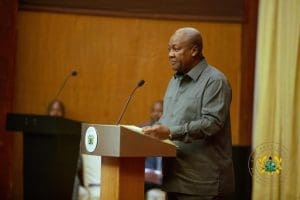
Addressing the Ghana Diaspora Townhall Meeting with President John Dramani Mahama at the Ghana High Commission, Tanoh described the initiative as a structural shift designed to move the economy beyond its traditional service-heavy base into industrial and export-led expansion.
He said the policy is already transitioning from concept to execution, with early gains visible in recently signed investment agreements.
According to him, four major deals concluded within the last ninety days already account for more than 160,000 jobs, reflecting what he described as accelerating investor confidence in Ghana’s new economic direction.
Among the flagship projects is the Buipe Solar Farm in the Savannah Region, a $1.45 billion investment expected to generate 13,000 jobs while reducing industrial energy costs through what Tanoh described as Ghana’s most competitive electricity tariff to date.
Another major initiative, the Kambonwule Oil Palm Anchor Project, valued at $300 million, is projected to create 120,000 jobs while closing Ghana’s structural deficit in vegetable oil production.
The Bioenergy and Biofuels Programme, spanning Buipe and Damanko, is expected to produce 30,000 jobs and conserve up to $450 million annually in foreign exchange, strengthening energy security and reducing import dependence.
Logistics expansion also forms a key pillar of the programme, with the Tamale Air Cargo Hub already demarcated for two operators expected to begin operations in 2027. The project is positioned to transform northern Ghana into a major export and logistics corridor.
Tanoh emphasised that official job estimates exclude indirect and induced employment, which he said typically expand total employment impact by a factor of one to four depending on sector linkages.
His remarks were delivered against the backdrop of Ghana’s improving macroeconomic indicators under President Mahama’s administration since January 2025.
Inflation, he noted, has dropped to 3.4 per cent, marking a four-year low after fifteen months of continuous decline. Monetary easing has followed, with the Bank of Ghana policy rate reduced from 28 per cent to 14 per cent.
External buffers have also strengthened, with international reserves reaching $14.5 billion, enough to cover nearly six months of imports.
On fiscal stability, public debt has declined significantly from 92.4 per cent of GDP to approximately 48 per cent, while economic growth reached 6 per cent in 2025.
However, Mr Tanoh cautioned that growth remains uneven, with services dominating output at nearly 60 per cent, while industry contributes only about 12 per cent and grows at a modest 2.3 per cent.
“That gap is what our second pillar exists to close,” he said. “And that is the work of the 24-Hour Economy and Accelerated Export Development Programme.”
He added that additional components—including the Volta Lake Transport System, the Singa Agroecological Corridor, the Asutuare Pharmaceutical and Garment Parks, and the National Poultry Programme—are already backed by signed agreements and committed private capital.
“These are signed agreements with private capital committed, in motion now,” he reiterated.
Turning to the diaspora, Tanoh highlighted the rising importance of remittances, which hit a record $7.7–$7.8 billion in 2025, up from roughly $4 billion six years ago. The United Kingdom remains Ghana’s second-largest source of remittances after the United States.
“Your country is ready for you,” he said.