
2026 mid-year review: Can stability drive growth?

Ghana’s economy may be showing signs of stability at the mid-point of 2026, but business leaders, economists and financial sector players say the next phase of recovery will depend on whether improved macroeconomic indicators can translate into cheaper credit, lower production costs, stronger manufacturing and greater competitiveness for local businesses.
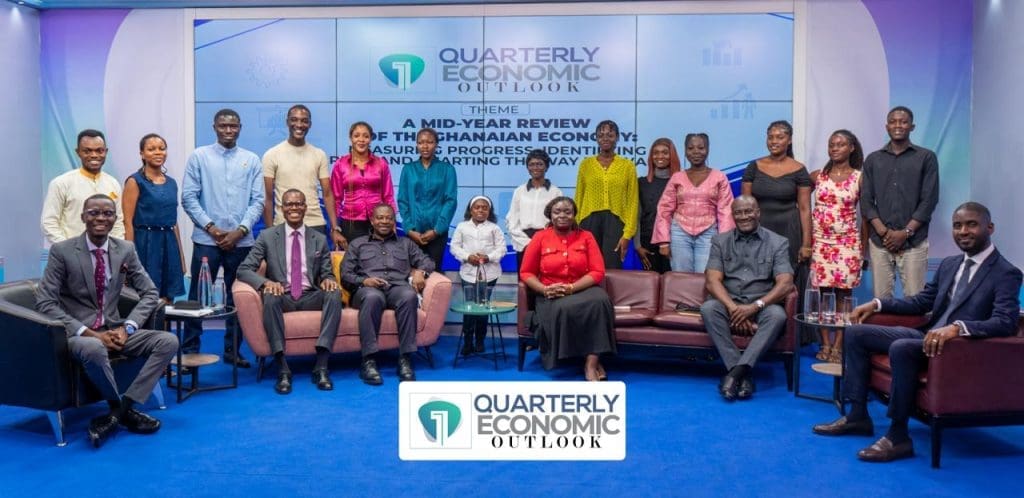
This was the dominant issue at the second edition of the Channel One Economic Quarterly, held on Thursday, July 9, 2026.
The forum, held under the theme, “A Mid-Year Review of the Ghanaian Economy: Measuring Progress, Identifying Risks and Charting the Way Forward,” brought together experts from academia, finance, trade and industry to assess Ghana’s economic performance in the first half of the year and discuss the risks and opportunities for the rest of 2026.
The Channel One Economic Quarterly is a thought-leadership platform designed to provide an independent assessment of the Ghanaian economy every quarter. It seeks to translate economic indicators into practical insights for policymakers, investors, businesses and households.
At the mid-year review, the discussion moved beyond the figures. Inflation, exchange rate stability, lending rates, freight charges, tax policy, manufacturing costs, SME financing and the 24-hour economy all came under scrutiny.
The broad conclusion was that Ghana has made progress in stabilising key indicators, but the productive sectors of the economy are still waiting to feel the full benefit.
Economist and Lecturer at the University of Ghana Business School, Prof. Agyapomaa Gyeke-Dako, acknowledged that Ghana’s economic performance in the second quarter of 2026 was weaker than the first quarter, but maintained that the overall outlook remained stable.
According to her, recent pressure on the cedi should not be interpreted as a major sign of weakness. She explained that part of the pressure came from foreign companies repatriating profits after completing their financial accounts, a pattern often seen in the second quarter.
She also pointed to tensions in the Middle East as a factor affecting oil prices and increasing demand for foreign exchange.
“You also look at what was happening with the conflict in the Middle East. We are a net importer of oil. About 20 percent of global crude passes through the Strait of Hormuz. Once there are disruptions over there, crude oil becomes limited in supply, driving up prices,” she said.
On inflation, she said the 5.3 percent rate recorded in June should not cause excessive concern because the increase was largely influenced by temporary external shocks, including fuel and transport costs.
“We are seeing an inflation rate, I think for June, at about 5.3%. I don’t think that there’s a need to worry so much about the 5.3%,” she said.
She added that while headline inflation had inched up, core inflation remained subdued, suggesting that price increases were not widespread across the economy.
For businesses, however, the concern was not only whether inflation and exchange rates were stabilising, but whether that stability was lowering the cost of borrowing.
Prof. Gyeke-Dako urged banks to reduce lending rates, arguing that falling inflation and declining money market rates provide room for cheaper credit.
“Thankfully, inflation is coming down and therefore I think that’s why we are all putting pressure on the banks now to be able to reduce their lending rates,” she said.
President of the Ghana Union of Traders’ Association, Clement Boateng, agreed that lower lending rates were necessary, but said businesses still find loans too expensive.
According to him, access to credit is not the biggest problem for businesses with proper documentation. The real challenge is affordability.
“We have always been saying that even though facilities are accessible, they are not affordable. If you have your documents and everything is in order, the banks can give you the money, but affordability is the issue because we think lending rates are still high,”
He acknowledged the concerns of banks about loan recovery, particularly the long judicial process involved when borrowers default. However, he maintained that high lending rates continue to discourage investment and expansion.
Head of Trading, Global Markets at Absa Bank Ghana Limited, Andrews Akoto, said the declining interest rate environment is already encouraging banks to position themselves for more lending.
“Essentially, with the lower interest rates, this is very accommodative, and so there will be a lot of loan growth that the banks are postured for. You would see the banks out there actually trying to write more loans,” he stated.
He said SMEs are likely to benefit from this renewed appetite for lending, but cautioned that access to money alone will not be enough.
According to him, many small businesses will need guidance to improve their structures, meet lending requirements and prepare for expansion.
“There will be a lot of hand-holding where you want to build the capacity of SMEs to be able to access these kinds of loans, or maybe grow from that small-scale enterprise to be able to access something like the alternative markets of the stock exchange,” he said.
Mr. Akoto also argued that traditional bank loans are not always suitable for businesses seeking to build factories or undertake major expansion projects.
“The kind of capital that these businesses need is long-term capital, and traditional bank loans are not fit for purpose for that kind of expansion,” he said.
He urged banks to help businesses access the capital market, where they can raise more patient capital from investors.
“A lot of the banks in Ghana, we have to now pivot away from net interest income and try to guide and handhold the business environment into the capital markets where we will be their arranger and help them access investor capital,” he said.
He noted that even during Ghana’s recent economic crisis and debt restructuring period, some businesses were able to raise funds from the debt capital market at rates better than government borrowing levels.
For the Association of Ghana Industries, the bigger issue was whether improving economic indicators can support real production.
Chief Executive Officer of the AGI, Seth Twum-Akwaboah, said Ghanaian manufacturers have the capacity to produce quality goods and compete globally, but high production costs and weak value chains continue to limit their growth.
He cited local ceramic manufacturers as evidence that Ghanaian businesses can compete internationally when they have reliable access to inputs and lower production costs.
“We have, for example, a tile factory here in Ghana, one of our members, that is exporting even to the US and Europe, and yet we are buying tiles from Italy,” he said.
He explained that some ceramic companies have become more competitive because of access to gas, which has helped reduce their production costs.
“They have been able to do so because, in fact, the ceramic industry has a certain advantage. They have an arrangement with Ghana Gas; they set up a plant to get gas directly from their source. So it reduces their cost of production,” he said.
For him, the lesson is clear: Ghana can export more if the business environment improves and the cost of production is reduced.
Mr. Twum-Akwaboah said this is particularly important for the government’s 24-hour economy initiative, which will require significant investment in factories, equipment and production systems.
“If you are doing long-term, which is a medium- to long-term facility, five years, 10 years, you need a kind of financial arrangement that interest rate is even supposed to be lower than this. And then enough moratorium, and you have enough time to actually produce,” he said.
He explained that setting up a factory takes time, and businesses need room to construct, test production, develop markets and begin generating revenue before repayment pressure starts.
“The government is doing a 24-hour economy; for you to set up a factory, go through the process, raise funds, the factory construction alone will take you six months, one year, even if you are fast,” he said.
Tax policy also emerged as a major concern, especially as Ghanaian manufacturers compete under ECOWAS and the African Continental Free Trade Area.
Mr. Twum-Akwaboah said recent VAT reforms were helpful, particularly the reduction and unification of VAT to 20 percent, which allows businesses to recover the full amount. However, he warned that Ghana’s tax rate remains high compared with some competitors in the region.
“Bear in mind that VAT in Ghana now is 20%, but VAT in Nigeria is 7%,” he stated.
According to him, this matters because companies operating across Africa can choose to produce in countries where costs are lower and export into other markets duty-free or quota-free.
He said Ghanaian manufacturers are already facing pressure from cheaper imports, partly because exchange rate stability has made some imported products more affordable.
“What we’ve been experiencing is that even though we had good stability, we’ve had all the good macros working for us, the imports, because of the exchange rate stability, were becoming cheaper at some point,” he said.
He urged government to design tax policies that support local production and reflect regional realities.
For traders, import-related costs remain another major concern.
Mr. Boateng said rising freight charges are affecting importers, especially those sourcing goods from the United Arab Emirates. He linked the problem to tensions in the Middle East, which have forced shipping companies to reroute vessels through alternative routes.
“I have had my goods locked up in the UAE since March. It was just three weeks ago that they had to make an arrangement to reroute the container, because if they say they are not doing that, the goods will be there, and I will also be sitting down here suffering,” he said.
He also raised concerns about how duties are calculated at Ghana’s ports. Although importers pay duties in Ghana cedis, the calculation is based on prevailing foreign exchange rates because goods are bought in foreign currencies.
“… We buy the goods in FX, either euro or dollar or what have you. And so therefore, that is what is used in calculating the duties and then convert it into cedis for you to pay,” he said.
He said the exchange rate applied at the ports is reviewed weekly, with the current rate around GH¢11.30 to the dollar, and stressed that sustained stability would be critical to reducing cost pressures on businesses and consumers.
The discussion showed that Ghana enters the second half of 2026 with cautious optimism.
Inflation appears broadly contained, core inflation remains subdued, interest rates are declining, and exchange rate pressures are considered manageable.
However, businesses are still dealing with high lending rates, limited access to long-term finance, rising freight charges, tax competitiveness concerns, weak value chains and high production costs.
For Ghana’s recovery to become meaningful, banks must make credit more affordable, policymakers must support local production, development finance institutions must meet the needs of industry, and businesses must be helped to access more suitable forms of capital.