Tema fishers blame low catch on climate change, illegal fishing
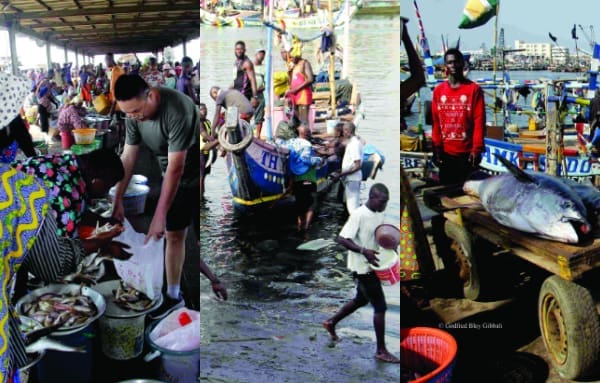
Tema Fishermen
Climate change has caused a decline in marine fish catches in Ghana.
Speaking during an interview, the Tema Awudum Chief Fisherman, Nii Odametey I, said the decline in local fish production can also be linked to overfishing, the use of illegal, unreported and unregulated (IUU) fishing practices, leading to high reliance on imports.
Records from the Bank of Ghana, Ghana Statistical Service 2008 and Food and Agriculture Organisation, show that the Fisheries sector contributes about 3.9 per cent of the country’s total Gross Domestic Product (GDP) and 11 per cent of agriculture GDP.
Fish is the most popular, accessible, and cheapest source of animal protein accounting for approximately 60 per cent of protein intake in Ghana, with annual per capita consumption estimated between 20 kg and 25 kg, which is more than the African average of 10kg.
While demand reaches over 1.1 million tonnes annually, local production is fast declining, forcing high reliance on imports.
The industry also provide direct and indirect employment for roughly 10 per cent of the population.
Artisanal fishing constitutes the largest fleet on the Ghanaian coast from Half Assini to Aflao; the same is true for our inland waterways.
The Tema canoe landing beach is famous for hosting several thousand canoes over the years due to its proximity to the Tema industrial area and the fact that it is a hub for economic activities in the country.
Commissioned in 1962 as part of the Tema harbour construction, the landing beach serves as a safe berthing area for canoes from Tema, the surrounding areas in the Greater Accra region and other seafarers from the Volta and Central regions, who take advantage of the huge market to sell their catches. Sadly, these days, some fishermen, after working so hard, return from sea with little or no catch at all.
Giving an insight into the myriad activities pertaining to the sector, the 52-year-old Chief Fisherman, said: “Just as farmers specialise in cultivating specific crops, our fishermen also specialize in catching targeted species of fish, including tunas, sharks, crabs, lobsters, groupers, red snappers and anchovies.
“Those engaged in anchovies fishing sail at midnight and berth at 7:00 am, fishermen gathering sardinella go to sea at 3:00 pm and berth at 7:00 am the next day, one group of hook and line fishermen set out to sea at 5:30 am and return at 3:00 pm while another group go on a fishing expedition for between three days to one week. The latter usually preserves their catch with ice,” he added.
According to him some fishermen sail as far as to Togo, Nigeria, the Ivory Coast and Senegal to ply their trade.
In times past, fishermen paddled canoes with sails and used landmarks like mountains and tall buildings to mark their locations or fish harvesting sites, but these days they employ outboard motors and Global Positioning Systems with efficient outcomes.
Nii Odametey noted that in spite of these improvements, the work at sea remained mostly menial, from casting and drawing nets to laying and recovering hooks.
The chores on the shore include dragging canoes to the beach and the sea, offloading fish, loading supplies, mending torn nets due to tension or rocks in the sea, cleaning outboard motors and painting canoes.
Smaller canoes carry five fishermen, whilst the larger ones carry 15 to 25 fishermen.
The chief Fisherman is not only an opinion leader, he also serves as an intermediary between fishermen, the government and other stakeholders.
He arbitrates in disputes between fishermen and other personnel in the enclave. Aside that, he officiates ceremonies involving drowning and cleansing rites among other functions.
A bumper harvest is every fisherman’s dream because it leverages improved revenue for stakeholders across the value chain. Unfortunately, the issue of dwindling catches experienced over the last two decades has become a cause for concern as fishermen and their families continue to endure poverty.
Nii Odametey expressed concern that about 90 per cent of artisanal fishermen do not use life jackets because it feels uncomfortable, restrain quick hand movements and therefore reduce work rate. He however hoped that ongoing educational efforts would motivate them to embrace personal protective equipment to enhance safety.
“Fishing like any other occupation, is fraught with accidents; despite that, we do our best to minimise their occurrences,” he stated.
Nii Odametey has served his constituents for 20 years. He recalled two separate sad incidents about three and five years ago, respectively, where two canoes and the crew onboard went missing at sea. Those tragic events, he said, bring to the fore the need to implement improved safety measures at sea to save lives and property.
He has therefore called on government, technologists and other stakeholders to collaborate with seafarers and help automate some of their processes to improve safety and efficiency in the sector.
Nii Odametey appealed for support to establish a fish farming project in Tema New Town to provide alternative employment for the fisher folks and the teeming youth in view of the challenges facing the industry.
The role of women in this important industry can not be overlooked as the wealthy ones finance fishing operations and are therefore off-takers, while others work as fish mongers and fish processors.
By GODFRED BLAY GIBBAH, Tema