
NPP seeks Supreme Court ruling on two-term presidential cap
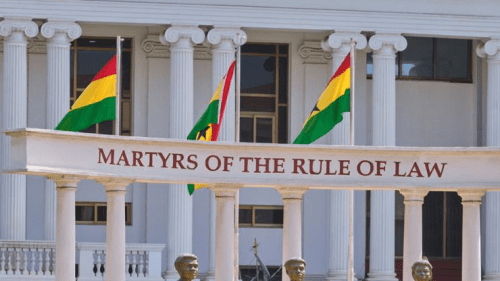
Supreme Court
The New Patriotic Party (NPP) has dragged the Attorney-General to the Supreme Court, seeking an authoritative interpretation of the 1992 Constitution’s provisions on presidential term limits amid debate over whether a former President can return to office for two additional terms after an earlier stint.
In a suit filed on July 28, 2026, the opposition party is asking the apex court to establish whether the constitutional ceiling of two presidential terms applies cumulatively, irrespective of whether the terms are served consecutively or interrupted by a period out of office.
The action, filed by the party’s solicitor, Godfred Yeboah Dame of Dame & Partners, seeks declarations on the meaning and application of Articles 58(2) and 66(1), (2) and (3)(a) of the Constitution.
At the centre of the case is the NPP’s contention that the two-term limit must be understood as a maximum of two terms in total, not two consecutive terms.
It wants the court to affirm that no individual may be elected President more than twice or occupy the office for more than two four-year terms, amounting to a maximum of eight years.
The party argues that interpreting the Constitution to restrict only consecutive terms could open the door for a person who has served one term, lost an attempt at immediate re-election and subsequently returned to power to serve two further terms.
It describes that possibility as a threat to the constitutional framework governing presidential tenure and warns against an interpretation that, in its view, would undermine the clear limits established by the Constitution.
“Plaintiff considers this proposition not only absurd but dangerous for the democracy, peace and stability of the nation,” the NPP states in its statement of case.
The party further argues that treating the two-term restriction as applying only to consecutive terms would require the courts to read words into the Constitution that are not expressly contained in its provisions.
“Acceding to this interpretation will condone and sanction manipulation of clear provisions in the Constitution as it involves inserting words into the constitutional text—it will involve amending the Constitution through judicial fiat,” the statement says.
The NPP is therefore asking the Supreme Court to settle the dispute through a definitive interpretation of the relevant constitutional provisions, rather than leave the scope of presidential eligibility open to competing readings.
Vice-presidential succession also in focus
Beyond the general two-term limit, the suit raises questions about the eligibility of a Vice-President who assumes the presidency for more than half of a predecessor’s unexpired term.
The party wants the court to declare that a person who succeeds to the presidency under those circumstances would be eligible to contest for election as President for only one term.
It is also seeking clarification on whether a person who has already served one presidential term may serve only one additional term, regardless of whether the two periods in office are consecutive.
The questions place the constitutional rules on presidential succession alongside the broader restriction on the number of times an individual may hold the country’s highest executive office.
International precedents cited
To support its position, the NPP draws on international constitutional practice, including the United States’ 22nd Amendment, which limits the number of times a person may be elected President.
It also cites constitutional developments in other African countries, arguing that attempts to alter presidential term limits have contributed to political instability in some jurisdictions.
The party further relies on the 2011 report of the Constitution Review Commission, which recommended an amendment to clarify that a person who had served two presidential terms would not qualify to stand for re-election.
The Supreme Court’s eventual interpretation could provide clarity on the constitutional limits governing presidential tenure and eligibility, particularly where a former President seeks to return to office after a break.
The suit asks the court to determine the meaning of the relevant provisions. The filing itself does not establish the legal position; that will depend on the court’s interpretation of the Constitution.