
MTTD tops list of institutions linked to bribery — GSS survey

A new Ghana Statistical Service (GSS) governance survey has found that demands for unofficial payments by public officials rose significantly in the latter half of 2025, with almost 70 percent of citizens who encountered bribery saying the request came directly from government officials.
The data, unveiled at a Governance Series event jointly organised by Three Reports and the GSS on Tuesday, August 4, 2026, paints a mixed picture of governance in Ghana—showing worsening experiences over six months but overall improvement compared with the previous year.
According to Government Statistician Dr Alhassan Iddrisu, the percentage of Ghanaians who paid bribes to obtain public services increased from 14.3 percent during January-June 2025 to 18.0 percent between July and December.
The survey further revealed that public officials became far more likely to solicit unofficial payments. The proportion of respondents who said officials requested extra money rose sharply from 50.9 percent to 69.4 percent over the same period.
“So the pressure sits at the counter. The problem now is less what citizens offer and more of what officials would ask,” Dr Iddrisu observed.
While bribery requests increased, more citizens also chose not to comply. The proportion of people refusing to pay after being asked rose from 3.0 percent in the first half of the year to 4.9 percent in the second half.
Dr Iddrisu emphasised that the six-month deterioration should not overshadow the broader annual gains recorded in 2025.
Citizen interaction with public institutions expanded from 55.7 percent in 2024 to 71.9 percent in 2025, equivalent to about 1.6 million additional contacts. Yet the overall share of people paying bribes declined from 18.4 percent to 16.8 percent, while bribes exceeding GH¢1,000 were nearly cut in half.
“The full year, which is 2025, got better compared to 2024. Both of these stories are true, and that’s the beauty of the six-monthly survey that we do, to be able to look at trends within waves and even compare between years,” Dr Iddrisu explained.
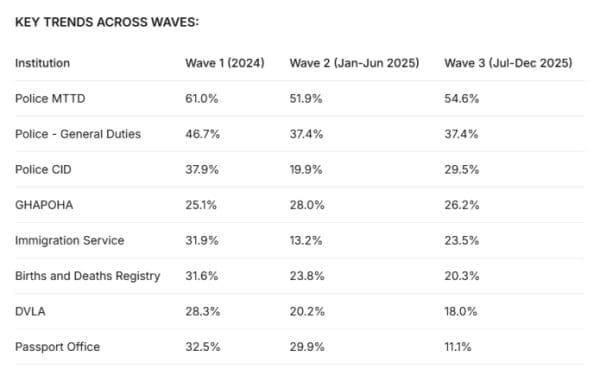
The Police Service remained the institution most frequently linked to bribery, with the Motor Traffic and Transport Department (MTTD) recording the highest incidence. More than half of respondents who dealt with MTTD officers said they made unofficial payments, although the figure fell from 61.0 percent in 2024 to 53.6 percent in 2025.
“Every one of the biggest offending public institutions improved. I must say that the police remain top of the list. Over half of those dealing with the Motor Traffic and Transport Department still reported giving a gift. But even there, the numbers moved the right way,” Dr Iddrisu said.
He added that bribery remains concentrated in a few agencies with frequent public contact, while institutions including NACOC, the National Commission for Civic Education and the Minerals Commission recorded no reported incidents.
The survey also showed improvements in public inclusion. The percentage of people who felt they had no say in governance dropped from 42.4 percent in 2024 to 29.7 percent in 2025, while those who believed they had no influence on public decisions fell from 43.2 percent to 33.0 percent.
Nevertheless, the latest six-month data indicated a slight decline in perceptions of inclusion, particularly among young people, older citizens, unemployed persons and those living with disabilities.
Cash accounted for almost all unofficial payments, representing 94.8 percent of reported bribes. Most payments were GH¢500 or below, although the incidence of payments exceeding GH¢1,000 increased between the first and second halves of 2025.
Dr Iddrisu said reducing corruption would require expanding digital public services, protecting whistleblowers and citizens who refuse to pay bribes, strengthening reporting systems and promoting wider participation in governance.
“Good governance is the foundation under every development plan we have as a country,” he said.
The survey covered households across Ghana’s 16 regions using Computer-Assisted Telephone Interviewing during the first quarter of 2026 and examined citizens’ experiences with public institutions between July and December 2025.