Mahama outlines 5 local content strategic pillars
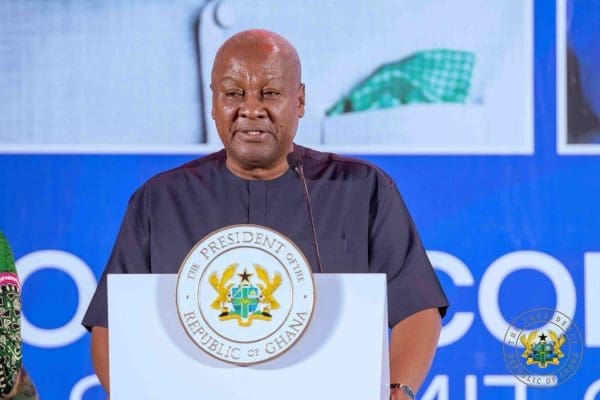
President John Dramani Mahama
President John Dramani Mahama has reaffirmed the Government’s commitment to transforming Ghana’s mining industry through a comprehensive reset agenda, emphasising enhanced local participation, industrialisation, and sustainable resource management.
Speaking at the opening of the Local Content Summit 2026 in Takoradi, President Mahama outlined Five Strategic Pillars that will guide Ghana’s approach to local content, a policy framework designed to prioritise the hiring of local workers, procurement of domestic goods and services, and the mobilisation of local financing within the mining sector.
The two-day summit, organised by the Minerals Commission, carries the theme: “Strengthening Local Content and Indigenisation: Building a Resilient Mining Sector in Ghana.”
Transforming local content
The first pillar, President Mahama stated, is for local content to evolve from simple transactional procurement into transformational partnerships.
The government is reviewing and refining mining legislation and regulatory frameworks to ensure that Ghanaian enterprises move up the mining value chain.
“From suppliers of consumables to manufacturers of critical components, from service providers to innovators, the Government will incentivise mining firms to build local capacity and not simply purchase locally,” President Mahama explained. “Equity participation, technology transfer, and knowledge sharing must become standard practice, not the exception.”
Eliminating raw ore exports
The second pillar seeks to end Ghana’s export of raw ores while encouraging the establishment of refineries and bullion infrastructure.
President Mahama emphasized that downstream processing of bauxite, manganese, and lithium must align with the global green energy transition, allowing Ghana’s mineral wealth to power industrialisation rather than sustain mere export dependence.
Building a skilled workforce
The third pillar focuses on human capital. President Mahama highlighted plans to strengthen institutions such as the University of Mines and Technology (UMAT) and technical universities, while deepening apprenticeship programs in partnership with the mining industry.
Skills development will prioritise automation, robotics, drone technology, modern exploration methods, data analytics, environmental sustainability, and renewable energy integration.
Digital, sustainable, and technology-driven mining
Under the fourth pillar, President Mahama declared that the future of mining in Ghana must be digital and technology-driven.
The government aims to establish Ghana as a hub for AI-assisted exploration, IoT-enabled asset management, blockchain-based supply chain transparency, and locally driven research and development.
“We will explore establishing a national mining innovation and research hub to institutionalise knowledge sharing and technology adaptation,” the President said, stressing that the summit should mark the start of a structured ecosystem rather than a one-off event.

Indigenous participation and ownership
The fifth pillar focuses on expanding indigenous participation in the mining sector. President Mahama encouraged the Ghanaian private sector to move beyond subcontracting toward full ownership of world-class mining operations.
He cited the Black Volta Gold Project by Engineers and Planners Limited – the first large-scale mining project fully owned by a Ghanaian company – which is expected to produce about 170,000 ounces of gold annually over a mine life exceeding 15 years.
Community-centered and responsible mining
President Mahama stressed that local content cannot be separated from responsible mining practices.
The government remains committed to strengthening development agreements and community engagement under the revised Minerals and Mining Framework.
Traditional authorities and Metropolitan, Municipal, and District Chief Executives (MMDCEs) will play a decisive role in monitoring compliance and safeguarding community interests.
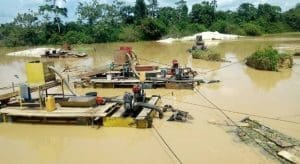
“We will continue the fight against illegal gold mining and work to formalise artisanal and small-scale mining sectors. We will increase efforts to clean our water bodies and reclaim mined-out lands,” the President added.
Govt and industry alignment
Emmanuel Armah-Kofi Buah, Minister of Lands and Natural Resources, highlighted that the Minerals Commission has developed a Mining Local Content and Local Procurement Policy Framework, making Ghanaian participation a strategic imperative. He noted that the establishment of a Special Purpose Vehicle to drive sustainable partnerships and industrialisation is well underway.
“We are moving, steadily and surely, from policy to practice,” Mr. Buah said, underscoring the government’s commitment to ensuring that local content delivers tangible economic and industrial benefits for Ghana.
The Local Content Summit 2026 signals a significant turning point for Ghana’s mining sector, prioritising local empowerment, industrial growth, and environmentally responsible practices while positioning the country as a competitive player in the global mineral industry.