Mahama calls for Africa’s economic reset
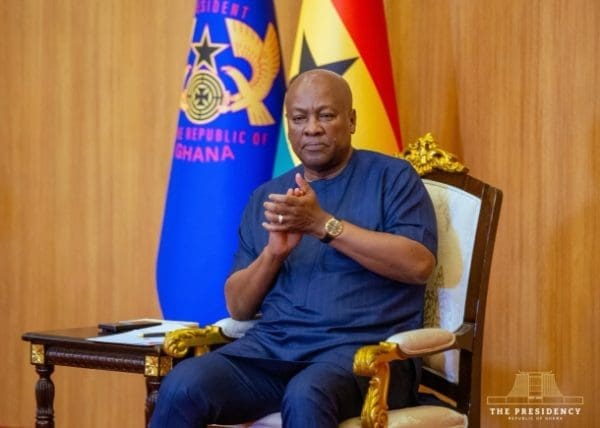
President John Dramani Mahama
President John Dramani Mahama has urged African countries to rethink their economic strategies by prioritising local processing and value addition instead of relying on the export of raw materials and the importation of finished goods.
“The time has come for Africa to chart a different course,” he said, arguing that processing the continent’s resources locally would create jobs, expand industries and accelerate economic transformation.
“We must bring part of that processing and value addition into Africa to create jobs for our young people,” he said.
Addressing the Financial Times Africa Summit in London yesterday, President Mahama said Ghana was targeting an end to raw ore exports by 2030 as part of efforts to strengthen its domestic industries.
“Seventy per cent of gold is now refined locally, and government is expanding the downstream jewellery industry,” he said.
He added that the government had introduced a policy requiring at least 50 per cent of cocoa beans to be processed locally. In the bauxite-aluminium sector, he said an alumina refinery remained the missing link and called on investors to support its establishment.
“You cannot have prosperity in the midst of poverty. That itself is a danger to investments,” the President stated.
Accra Reset: A new economic direction
President Mahama described the Accra Reset as an emerging framework for the Global South to reduce dependence on foreign aid and strengthen economic independence through domestic resource mobilisation and value addition.
Initially developed as a health-focused response to declining Official Development Assistance (ODA), the initiative has expanded into a broader economic transformation agenda.
Its priorities include ending raw mineral exports by 2030, processing at least 50 per cent of cocoa locally and mobilising $20 billion for self-financed development programmes over nine years.
The President said the initiative was driven by the need to find sustainable alternatives to declining external support.
He cited Ghana’s loss of $154 million annually following the withdrawal of funding from the United States Agency for International Development (USAID), including $74 million previously directed towards healthcare.
“The response to dwindling aid is not to learn how to improve your begging skills,” he said. “You need to respond in a different way,” he told the summit.
He said a governing council had been established for the initiative, with support from Germany, the United Kingdom (UK), Gavi, the Global Fund and the World Health Organisation.
“You cannot own the outcome when you are not part of the decision-making. We must have some control,” he said.
Mahama challenges Western investors
The President called on Western investors to move beyond their reservations about Africa, insisting that the continent offered attractive returns and growing opportunities.
“It is to their own disadvantage if investors are still skittish about Africa. The returns are good, and everybody is coming. The Indians are there, the Chinese are there,” he said.
He contrasted the cautious approach of some Western investors with the speed at which Chinese and Indian investors commit resources to African markets.
“The typical Western investor comes with a notebook and asks, ‘Do they have an independent judiciary? Is the media free?’ By the time you get to the fifth point, the Chinese have invested and the Indians have invested.”
President Mahama reaffirmed Ghana’s non-aligned foreign policy, declaring: “We are friends to all and enemies to none.”
He also announced that Ghana had successfully completed its IMF programme and transitioned to a Policy Coordination Instrument (PCI), which does not provide financing.
“It is not a bailout. It does not come with any financing, and so a lot of that financing is being provided by ourselves,” he explained.
The President said reforms under the Reset Agenda included amendments to the Public Financial Management Act and the Procurement Act, alongside the establishment of a Fiscal Responsibility Council.
These measures, he said, were intended to strengthen fiscal discipline and create room for investment.
The government is pursuing a $10-billion Big Push infrastructure programme over five years. Separately, the Finance Minister is expected to launch a $10-billion new economy plan over four years, focusing on nine job-rich sectors, including tourism, energy, agriculture, agro-processing, pharmaceuticals and textiles.
Despite global economic disruptions, President Mahama said inflation stood at about five per cent, while the currency remained stable and interest rates were declining.
“The economy is holding steady,” he said.
Global financial system under scrutiny
President Mahama criticised the international financial system, arguing that its lending arrangements imposed disproportionate costs on African countries.
“The global order was rigged against Africa.
“We borrow at eight times the interest rates at which Western nations borrow. Sometimes, we borrow to ameliorate the effects of climate change, which we did not create,” he said.
He argued that Africa’s contribution to global greenhouse gas emissions was about four per cent, yet the continent faced high borrowing costs to finance climate-related responses.
The President further cited annual outflows of about $80 billion through interest and debt repayments and another $90 billion through illicit financial flows. He also pointed to a 23.5 per cent decline in ODA in 2025.
“Africa is a very resilient continent… I wonder how Europe would have survived under those conditions, yet Africa is still on the map,” he said.
Calls for reparations and stronger Global South
On reparations for slavery, President Mahama argued that financial compensation alone would not adequately address the historical injustices of slavery, forced labour and other abuses.
“It is uncharitable to think that a simple payoff is the response,” he said.
He referred to a United Nations General Assembly vote in which 123 countries supported recognising slavery as the gravest crime against humanity, adding that Germany, France and other countries had opened discussions on the issue.
“We call it repair. It begins with acceptance,” he said, pointing to the return of artefacts as part of the process.
“Those who do not learn from the mistakes of history are bound to repeat them,” he warned.
The President maintained that strengthening the Global South would benefit the wider international community rather than threaten Western interests.
“A strong Global South is not a threat to the West. A strong Global South is an advantage.”
About the Financial Times Africa Summit
The Financial Times Africa Summit is an annual gathering of African political leaders, policymakers, investors, business executives and entrepreneurs to examine the continent’s economic and geopolitical prospects.
Organised by the Financial Times of London, the summit provides a platform for discussions on investment, trade, sustainable development and Africa’s engagement with international capital.
The 2026 edition, the 13th, was held under the theme “Mobilising Growth in a New Global Order”. It examined changing trade patterns, domestic capital mobilisation and the development of stronger regional markets in response to shifts in the global economy.
President Mahama attended the summit alongside prominent business figures, including Aliko Dangote and Mo Ibrahim.