Joblessness, high cost of living threaten democracy – Mahama
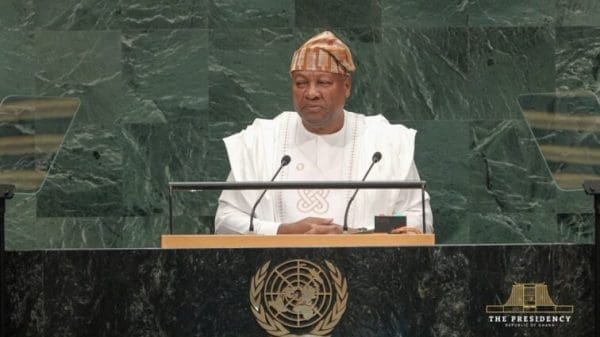
President John Dramani Mahama
President John Dramani Mahama has warned that democracy faces serious credibility challenges when citizens fail to see improvements in their living conditions, arguing that elections and political freedoms must be matched by food, jobs, healthcare, education and economic opportunity.
Addressing the 81st Session of the United Nations General Assembly in New York on Thursday, September 24, 2026, he said the growing threats to democratic governance included social and economic exclusion, the manipulation of identity, conflicts, climate injustice and a global system that leaves vulnerable countries struggling to finance development.
He said democratic systems could lose their meaning if citizens experienced them only through periodic elections without tangible improvements in their daily lives.
President Mahama argued that political freedoms must be accompanied by opportunities for people to improve their livelihoods, stressing that the strength of democracy ultimately depended on whether citizens could connect the institutions they elect with better living conditions.
The President therefore linked democratic resilience to development, saying investments in infrastructure, healthcare, education, social protection and economic opportunities were necessary to make democracy meaningful to ordinary people.
His address broadened the question of democratic governance beyond elections to include the capacity of states and international institutions to respond to inequality, climate change, conflict, displacement and the economic pressures confronting developing countries.
Democracy must deliver for citizens
President Mahama said democracy must be judged not only by the conduct of elections but also by its ability to deliver tangible social benefits.
“Citizens must experience democracy not only through the ballot box every four years, but through improved access to food, quality education, decent housing, accessible healthcare, and economic opportunity,” he said.
He maintained that democratic governments had a responsibility to translate political freedoms into practical opportunities for citizens. For him, the relationship between democracy and development was inseparable because citizens were more likely to retain confidence in democratic institutions when those institutions delivered improvements in their everyday lives.
The argument also formed part of his broader presentation of Ghana’s development agenda, which he said required investment in infrastructure, health, education, social protection and job creation. The President said the central test was whether citizens could see a clear connection between the institutions they elect and improvements in their living conditions.
Climate crisis threatens vulnerable economies
President Mahama also called on developed countries to fulfil long-standing climate finance commitments, insisting that support for vulnerable countries should come through predictable grants rather than loans that add to debt burdens.
He said Africa contributed less than four per cent of global greenhouse gas emissions but was carrying a disproportionate share of the consequences of climate change.
He cited Ghana’s experience on June 29, when torrential rainfall exceeding 160 millimetres was recorded across seven coastal regions within 24 hours, killing 39 people and leaving one person missing.
He said erratic rainfall, coastal erosion and accelerating desertification were already affecting African communities, while melting glaciers, flash floods, droughts, heatwaves, bushfires and hurricanes provided unmistakable evidence of an increasingly stressed planet.
Describing climate change as “the ultimate test of global equity”, President Mahama said mitigation support must be operationalised through predictable, non-debt-creating grants.
He argued that vulnerable economies should not be forced to borrow their way out of a crisis to which they had contributed comparatively little.
Identity must not become a weapon
President Mahama warned against the manipulation of national, ethnic and cultural identity for political purposes, saying belonging could provide people with dignity and a sense of community but could also become a source of exclusion and conflict when weaponised.
Drawing on his own multicultural background and ability to speak several Ghanaian and West African languages, he said identity could be a bridge rather than a barrier.
He cautioned that political actors could exploit identity for what he described as political expediency, transforming legitimate feelings of belonging into nativism, chauvinism, xenophobia and prejudice against people regarded as different.
Such manipulation, he said, could contribute to discrimination, displacement and conflict.
The President called for the international community to uphold the principle that every person belongs to one human family regardless of race, religion, language, skin colour or nationality. “No race is superior.
No nation is inferior,” he said, insisting that the same principle should guide responses to refugees, migrants, victims of conflict and marginalised communities.
Gaza exposes crisis of global credibility
The President also called for stronger international action over the conflict involving Israel and the Palestinians, saying the humanitarian suffering in Gaza, the West Bank and other occupied territories represented a major challenge to the credibility of the international system.
He questioned how many more civilian lives would be lost before the international community exercised what he described as decisive moral authority.
He condemned collective punishment, enforced starvation and mass displacement, describing them as violations of international law, while referring to the death of five-year-old Hind Rajab and the killing of thousands of children in the conflict.
At the same time, he reaffirmed Ghana’s condemnation of acts of terrorism by Hamas and called on all parties to respect international humanitarian law.
Ghana, he said, remained committed to recognising the State of Palestine and supporting a negotiated two-state arrangement under which Israel and Palestine could coexist peacefully and securely with guaranteed borders.
He also called for greater attention to the war in Sudan and other conflicts, arguing that civilian protection, humanitarian access and accountability should be applied consistently.
Africa demands fairer development finance
President Mahama called for a fundamental change in the way Africa’s development was financed, saying the continent was seeking equal partnerships rather than charity.
He said African countries needed long-term, affordable and accessible concessionary financing to invest in human capital, industrialisation and climate adaptation.
“Africa does not seek charity. Africa seeks equal partnership anchored in mutual respect,” he said.
He argued that short-term assistance could not adequately address the continent’s structural development challenges and called for reforms to the international financial system to give developing economies greater access to affordable financing.
He pointed to Africa’s young population, vast arable land, cultural resources and critical minerals as assets that could make the continent an important partner in addressing global challenges, including the transition to clean energy.
His call formed part of wider demands for a more equitable global financial architecture and greater African participation in decisions affecting development.
Return Africa’s human remains, artefacts
The President separately demanded the immediate and unconditional return of African human remains held in museums and institutions outside the continent, arguing that human remains should not be treated as museum objects or scientific specimens. He described restitution as a matter of human dignity and linked it to Africa’s broader demand for the recovery of cultural heritage taken during colonial rule.
He cited the case of King Badu Bonsu II of Ahanta, who was executed by Dutch authorities in 1838 after resisting colonial domination.
His head was taken to the Netherlands and preserved in formaldehyde for about 170 years before being returned to Ghana in 2009. “Human remains are not collectibles.
They are not specimens. They are our ancestors,” President Mahama said.
He argued that the return of human remains should be an immediate starting point for a broader international framework on restitution.
Legal and administrative barriers, he maintained, should not prevent African countries from recovering the remains of their ancestors.
Ghana is open for investment
Beyond his UN address, President Mahama used his New York engagements to reinforce Ghana’s investment message.
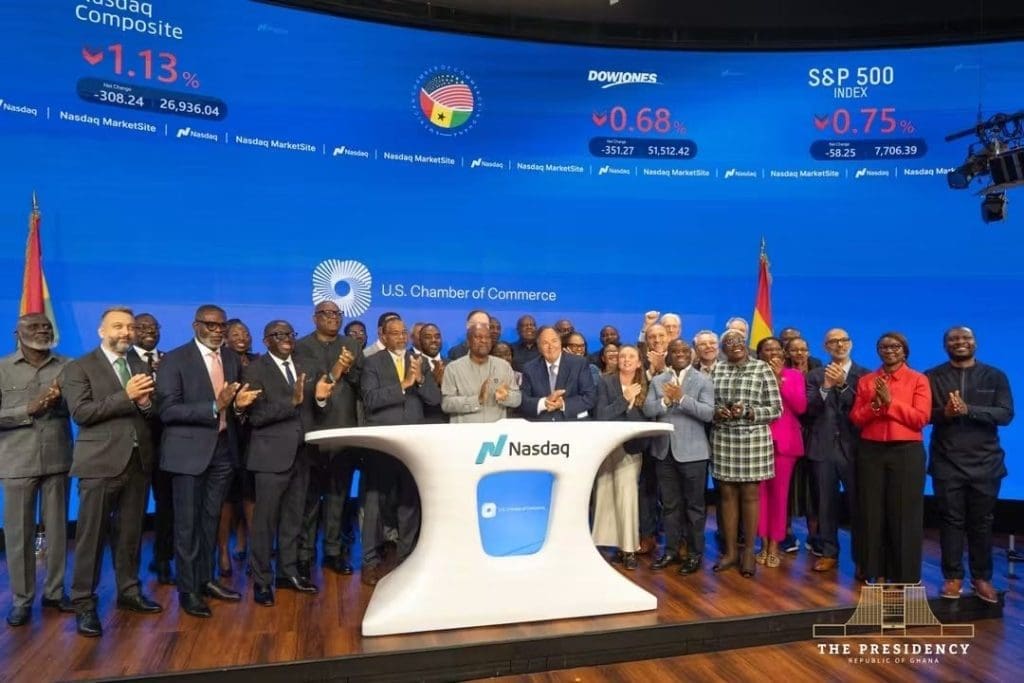
He rang the closing bell at the Nasdaq Stock Market, with Ghana featured on the Nasdaq billboard in Times Square under the message, “Ghana Is Open for Business.”
The symbolic event preceded a United States-Ghana Presidential Roundtable, where Ghana was presented as a destination for investment, partnerships and economic growth.
The Presidency has also said the President’s wider engagements during the UNGA included discussions on trade, technology, economic reforms and international support for Ghana’s development agenda.
The New York programme therefore combined the President’s appeal for reform of global systems with a push to position Ghana as an investment destination.
His message to the international community was that democracy, development, climate action, peace, human dignity and economic opportunity were interconnected challenges requiring stronger institutions and more equitable partnerships.