
Health Association trains nurses to bridge nephrology skills gap

Efforts to strengthen Ghana’s healthcare workforce and address the skills gap in specialised kidney care have received a boost following a two-day clinical training programme for dialysis professionals organised by the Health Community of West Africa Association in partnership with Essence Clinic and Medical Laboratory.
The training, facilitated by Dr. Qin Yang, a nephrologist and Medical Director of Essence Clinic and Medical Laboratory, focused on ultrasound-guided percutaneous techniques in dialysis services, was aimed at equipping nephrology nurses with specialised knowledge and practical skills to support the delivery of kidney care services.
Held on November 5 and 6, 2026, the programme brought together healthcare professionals from Korle Bu Teaching Hospital, Greater Accra Regional Hospital, Legon Hospital, Ghana Police Hospital and LEKMA Hospital.
The initiative comes against the backdrop of the need to strengthen specialised clinical capacity within Ghana’s healthcare system, particularly in nephrology nursing and dialysis care, where healthcare professionals require specific technical competencies to manage patients undergoing haemodialysis.
As the country continues to respond to the growing burden of kidney disease and the demand for dialysis services, the availability of adequately trained personnel remains important to ensuring effective treatment, patient monitoring and the management of complications associated with dialysis.
The organisers said the training was intended to contribute to addressing this skills gap by providing participants with additional clinical knowledge and practical exposure to specialised vascular access techniques.
Focus on specialised dialysis skills
A major area of focus was vascular access, an essential component of haemodialysis that enables blood to be withdrawn from a patient’s body, circulated through a dialysis machine for filtration and returned to the body.
Proper vascular access is important to the effectiveness and continuity of haemodialysis treatment. Its assessment and management require an understanding of vascular anatomy, appropriate clinical techniques and the ability to identify potential complications.
The use of ultrasound technology in vascular assessment and access procedures has become increasingly relevant in clinical practice because it allows healthcare professionals to visualise blood vessels and surrounding anatomical structures in real time.
This provides clinicians with visual guidance when identifying suitable vessels and undertaking access-related procedures.
The workshop was therefore structured to combine theoretical instruction with practical demonstrations and hands-on exercises to strengthen participants’ understanding of these techniques and their application in dialysis services.
Dr Qin Yang leads clinical training
On the first day, participants received instruction from Dr. Qin on upper extremity vascular anatomy, with particular attention to the blood vessels relevant to the establishment and management of vascular access for haemodialysis.
The training also covered the creation, assessment and maintenance of arteriovenous fistulas, which are commonly used as vascular access for patients requiring long-term haemodialysis.
Participants were taken through the importance of understanding vascular structures, assessing their suitability and recognising the clinical considerations involved in maintaining functional arteriovenous fistulas.
The sessions provided the theoretical foundation for the practical exercises on the second day, helping participants understand the anatomical and clinical principles underlying ultrasound-guided vascular access.
Practical sessions provide hands-on experience
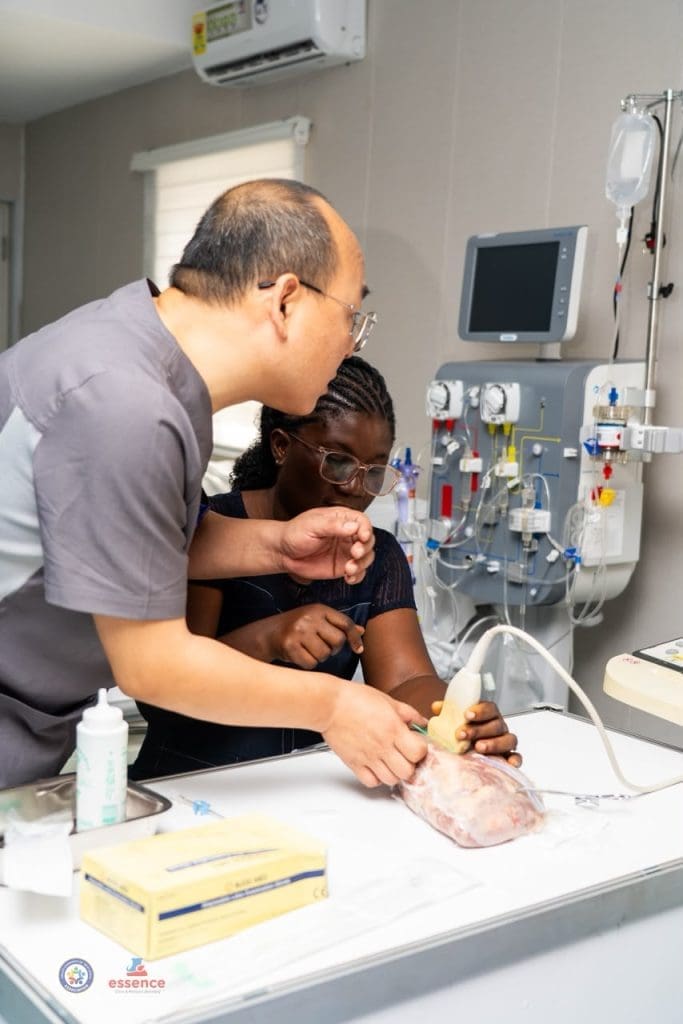
The second day of the programme focused on the practical application of ultrasound-guided percutaneous techniques, giving participants the opportunity to move beyond classroom instruction and engage with the procedures.
Under the guidance of Dr Qin Yang, participants observed demonstrations and took part in hands-on exercises involving the use of ultrasound equipment to identify and assess vascular structures.
The practical sessions covered the use of ultrasound imaging to locate blood vessels, understand needle positioning and appreciate how real-time visual guidance supports percutaneous vascular access procedures.
Participants had the opportunity to observe the techniques closely and engage directly with the practical exercises, reinforcing the knowledge acquired during the theoretical sessions.
The practical component was particularly important in helping healthcare professionals understand the relationship between vascular anatomy, ultrasound imaging and the technical application of access procedures in dialysis care.
Participants highlight importance of professional development
Some participants described the programme as a valuable opportunity to improve their knowledge and gain practical exposure to specialised clinical techniques.
Patricia Ekwam of LEKMA Hospital expressed appreciation for the training, highlighting the benefit of combining theoretical instruction with practical demonstrations in deepening healthcare professionals’ understanding of ultrasound-guided vascular access.
Sergeant Bernard D. Heer of Ghana Police Hospital also acknowledged the importance of the programme in strengthening the technical competencies of professionals involved in dialysis services.
The participants’ observations highlighted the value of continuous professional development, particularly in specialised areas of healthcare where the application of technical knowledge and clinical skills is essential to patient care.
The two-day programme ended with the presentation of certificates of participation to the trainees. The Health Community of West Africa Association says it will continue to support initiatives that strengthen healthcare professionals, encourage collaboration among healthcare institutions and contribute to improved healthcare delivery in Ghana and across West Africa.