Ghana’s public debt rises to GH¢674 billion
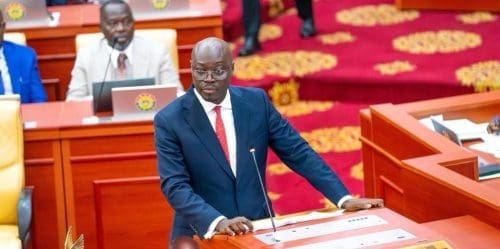
Cassiel Ato Forson, Finance Minister
Ghana’s public debt has climbed to GH¢674 billion, underscoring ongoing fiscal pressures on the economy as government borrowing continues to shape public finance management and economic policy direction.
This is equivalent to 42.2 per cent of Gross Domestic Product (GDP), driven by a combination of domestic borrowing, the cedi’s depreciation against major currencies, and legacy obligations from previous years.
According to the latest Summary of Economic and Financial Data released by the Bank of Ghana, the debt stock, which stood at GH¢641.1 billion at the end of December 2025, increased by GH¢33 billion in the first three months of 2026 alone. The external component of the debt was recorded at GH¢313.6 billion (19.6 per cent of GDP), while domestic debt stood at GH¢360.4 billion (22.6 per cent of GDP).
The cedi’s depreciation of 8.4 per cent against the US dollar between January and May 2026 has contributed significantly to the increase in the cedi value of external debt, even when the underlying US dollar-denominated obligations remained relatively stable.
Ghana’s external debt, denominated in US dollars, was US$29.3 billion as of March 2026, nearly unchanged from US$29.4 billion at the close of 2025. However, the cedi’s depreciation from GH¢10.95 to GH¢11.41 per dollar during the period increased the local-currency value of external debt by roughly GH¢13.5 billion.
The country’s Heritage and Stabilisation Fund, established to absorb shocks from commodity price volatility, stood at US$1.53 billion, equivalent to GH¢16.7 billion.
On the domestic front, debt rose by GH¢26.6 billion in the first quarter of 2026, moving from GH¢333.8 billion in December 2025 to GH¢360.4 billion in March 2026. The increase was attributed to fresh issuances of government securities used to finance the budget gap, alongside the capitalisation of interest on existing obligations.
Government financing has continued to rely heavily on treasury bills and bonds, with debt servicing remaining a major component of annual public expenditure.
In spite of the rising nominal debt stock, Ghana’s debt-to-GDP ratio improved to 42.2 per cent, remaining below the statutory 55 per cent ceiling and significantly lower than the 85 per cent peak seen during the 2022–2023 economic crisis. The decline from 53.8 per cent at the end of 2025 was largely driven by GDP rebasing, which expanded nominal output to about GH¢1,400 billion.
Fiscal performance for the first quarter of 2026 showed an overall deficit of 0.1 per cent of GDP, within the approved target range, while the primary balance recorded a surplus of 1.2 per cent. Revenue and grants accounted for 3.6 per cent of GDP, against expenditure of 3.9 per cent, with capital expenditure subdued at 0.5 per cent as fiscal consolidation efforts persisted.
Meanwhile, borrowing costs have eased, with the average lending rate declining to 16.33 per cent from 27.40 per cent a year earlier, and the 91-day Treasury bill rate falling to 4.90 per cent from 15.47 per cent. However, the large accumulated debt stock continues to impose a heavy interest burden, limiting fiscal flexibility for investment and social spending.
Over the past few years, Ghana has faced a challenging macroeconomic environment marked by inflationary pressures, currency depreciation, and tightening global financial conditions. These factors have contributed to the rising cost of servicing external debt, particularly as a significant portion of obligations is denominated in foreign currencies.