
Ghana’s economic growth hits 6.8% in August

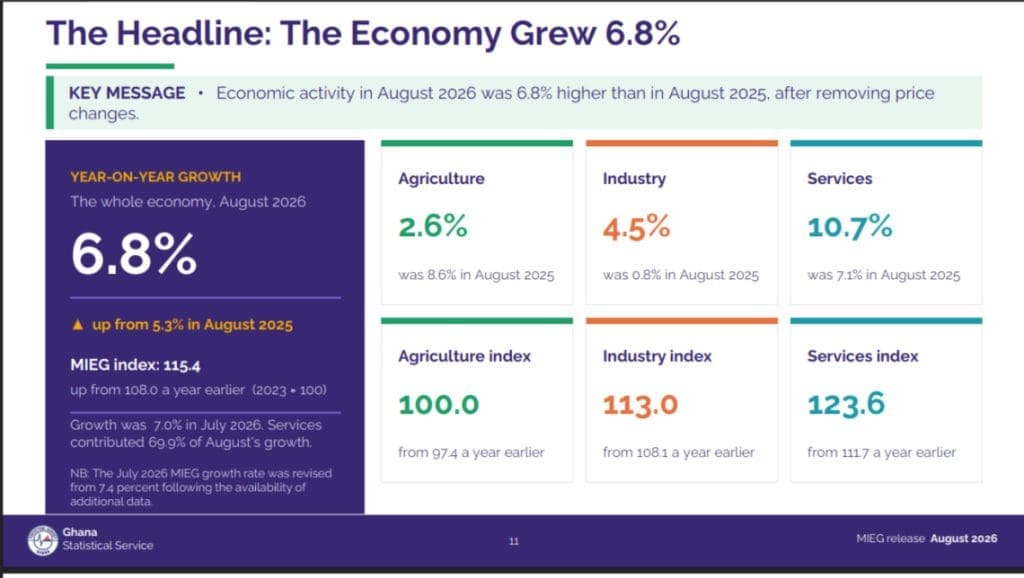
Ghana’s economic activity strengthened in August 2026, expanding by 6.8% year-on-year compared with 5.3% recorded in August 2025. This positive trend highlights Ghana economic growth, as improved performance in the services and industrial sectors offset a slowdown in agriculture.
The Ghana Statistical Service (GSS), in its latest Monthly Indicator of Economic Growth (MIEG) released on Wednesday, November 11, 2026, reported that the overall economic activity index increased to 115.4 in August 2026. This is up from 108.0 in the corresponding month last year.
The services sector remained the biggest contributor to economic expansion, recording growth of 10.7%, up from 7.1% a year earlier.
The sector accounted for 69.9% of total economic growth. The Information and Communication subsector was identified as a major driver of its performance.
The industrial sector also showed signs of stronger momentum, growing by 4.5% in August 2026, compared with 0.8% in August 2025.
The improvement was largely supported by manufacturing, alongside additional growth in mining and quarrying. Industry contributed 21.2% to the overall expansion in economic activity.
Agricultural growth, however, slowed considerably during the period. The sector expanded by 2.6%, compared with 8.6% in August 2025. Crops and livestock accounted for the main drivers of activity.
Agriculture contributed 6.8% to overall economic growth, while net taxes on products accounted for 2.1%.
The performance suggests that Ghana’s economic expansion in August was heavily concentrated in services. Industry also recorded an improvement, while agriculture experienced a significant loss of growth momentum.
The GSS explained that the MIEG tracks monthly changes in economic activity and provides an early indication of economic trends ahead of the quarterly GDP estimates.
The indicator is compiled using monthly volume indicators and administrative records covering activities included in the quarterly GDP system. In addition, it incorporates inflation adjustments based on monthly Consumer Price Index (CPI) and Producer Price Index (PPI) data.
However, the Service emphasised that the MIEG remains an experimental statistic. It is subject to ongoing improvements and revisions as additional data become available.
As part of this process, the July 2026 growth rate was revised from 7.4% to 7.0% following the incorporation of additional information.
The GSS said the August 2026 figures are provisional and announced that the next MIEG release, covering September 2026, is scheduled for December 9, 2026.