Ghana to face Uganda in World Cup play-off
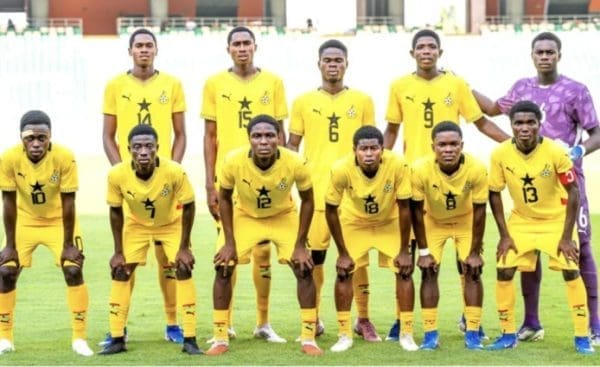
Ghana U-17
Ghana’s journey at the U-17 Africa Cup of Nations has come to an unexpected and heartbreaking end after the team was eliminated from the competition following a drawing of lots that denied them a place in the quarter-finals of the tournament in Morocco.
The Black Starlets entered their final Group stage fixture with everything to play for, and they delivered a strong and spirited performance, defeating South Africa 3-1 on Wednesday, 20 May.
The victory was expected to boost their chances of progression, and for a moment, it seemed Ghana had done enough to advance to the next round of the competition. The result meant Ghana finished the group stage with four points, the same tally as Algeria, who were their direct rivals for qualification.
What followed, however, was a highly unusual and emotionally difficult scenario that ultimately determined Ghana’s fate in the tournament. Not only did Ghana and Algeria finish level on points, but both teams also recorded identical statistics across all the standard tiebreaking criteria used in the competition.
This included goal difference, head-to-head results, goals scored, and goals conceded. In every measurable football metric used to separate teams in such situations, the two sides were inseparable.
Under normal circumstances in international football competitions, a clear sequence of tiebreaking rules is applied to ensure that teams can be separated based on performance-related criteria. In many FIFA competitions, for example, if teams remain tied after head-to-head and goal difference calculations, the next deciding factor often becomes fair play points, which evaluate disciplinary records such as yellow and red cards accumulated throughout the group stage. This system is designed to reward teams that maintain better discipline on the pitch while still keeping the outcome tied to sporting behaviour.
The decision was understandably difficult for the players, coaching staff, and supporters of the Black Starlets, who had invested significant effort throughout the group stage campaign.
The idea that a team’s tournament fate could be decided not by goals, tactics, or performance, but by chance, is one that often sparks debate among football analysts and fans alike. For Ghana, it meant the end of their hopes of competing for the U-17 AFCON title this year, despite showing resilience and improvement in their final group match.
The elimination also underscores the fine margins that often define international youth tournaments. At the U-17 level, where teams are still developing and consistency can vary, group standings can frequently end in tight scenarios. In Ghana’s case, the Black Starlets demonstrated the ability to compete strongly at the continental level, but the absence of an additional performance-based tiebreaker ultimately proved costly.
While disappointment surrounds their exit from the main tournament, Ghana’s campaign is not entirely over. The Black Starlets still have a crucial opportunity ahead as they prepare to face Uganda in a playoff match that will determine qualification for the FIFA U-17 World Cup 2026. The match carries significant importance, as it offers redemption and a chance to extend their international journey beyond the continental stage.
Uganda, their opponents in this decisive fixture, will also present a formidable challenge. Interestingly, the Ugandan team is coached by former Ghana international Laryea Kingston, adding an extra layer of narrative and familiarity to the encounter.
Kingston, who once represented Ghana at senior level, now finds himself on the opposite side, guiding Uganda in their pursuit of World Cup qualification. His experience as a player and coach adds tactical intrigue to an already high-stakes match.
The stakes for both nations are considerable. Africa will be represented by 10 countries at the FIFA U-17 World Cup 2026, which is scheduled to take place in Qatar from November 19 to December 13.
The expanded representation reflects the growing strength and competitiveness of African youth football on the global stage, and qualification for the tournament is seen as a major milestone for emerging football talents.
For Ghana, qualification would mark a return to the U-17 World Cup for the first time since 2017. The Black Starlets, historically one of Africa’s most successful youth teams, have a proud legacy in the competition, having won the FIFA U-17 World Cup on multiple occasions in the past.
However, in recent years, the team has struggled to consistently qualify for major youth tournaments, making this current campaign particularly significant for the development of the next generation of Ghanaian football talent.
The disappointment of missing out on a quarter-final place at the U-17 AFCON will undoubtedly be difficult to process, especially given how close Ghana came to progressing. The players will likely reflect on the campaign with mixed emotions—pride in their victory against South Africa and overall competitiveness, but frustration at the margins that ultimately eliminated them from contention.
Coaching staff and football administrators will also likely review the tournament regulations and Ghana’s overall performance in detail. Situations like this often prompt broader discussions about whether competition rules should include additional tiebreaking criteria, such as fair play records, to avoid reliance on random draws. Many football stakeholders argue that outcomes at major tournaments should be determined strictly by on-field performance rather than chance, especially when youth development and national pride are at stake.
Despite the disappointment, the Black Starlets still have an important mission ahead. Their focus will now shift entirely to the playoff against Uganda, where determination, preparation, and mental resilience will be key.
A place at the FIFA U-17 World Cup remains within reach, and the team will aim to channel the frustration of their elimination into motivation for the next challenge.
The upcoming match represents more than just qualification; it is also an opportunity for Ghana to reaffirm its place among the elite youth football nations in Africa. Success would not only extend their international campaign but also provide valuable experience for the young players, many of whom are at the early stages of their football careers.
As Ghana reflects on the narrowest of exits from the U-17 Africa Cup of Nations, attention now turns to recovery, regrouping, and preparation for what comes next. The tournament may have ended in disappointment, but the journey toward future success is still ongoing.