CHRAJ: Over 458,000 children out of school due to child labour

Child labour
The Commission on Human Rights and Administrative Justice (CHRAJ) has cautioned that child labour continues to prevent thousands of children in Ghana from accessing education, despite existing constitutional safeguards and international agreements aimed at eliminating the practice.
In a statement issued on June 12, 2026, to mark the 2026 World Day Against Child Labour, the Commission noted that “the fulfilment of children’s rights is among the most fundamental measures of a society’s commitment to human dignity and social justice.”
CHRAJ further explained that child labour remains a significant obstacle to education and child development, stating that it “continues to deprive many children of their right to education, protection, development and a safe and dignified childhood.”
The Commission observed that the problem persists even with legal protections enshrined in Ghana’s 1992 Constitution, the Children’s Act, 1998 (Act 560), and key international instruments such as the United Nations Convention on the Rights of the Child and the African Charter on the Rights and Welfare of the Child.
It described the situation as “deeply concerning,” pointing out global estimates that about 138 million children are engaged in child labour, with nearly 54 million involved in hazardous work.
Citing Ghana Statistical Service data, CHRAJ revealed that over 1.1 million children aged between 5 and 17 were engaged in economic activities in 2023, while more than 458,000 were not attending school.
“Alarmingly, over 458,000 of these children were not attending school,” the statement noted, adding that this reflects “the difficult reality that many children continue to miss out on education and opportunities that could shape a better future and help end the cycle of poverty.”
The Commission called for renewed national action under the theme “Red Card to Child Labour: Fair Play for Children, Decent Work for Adults,” emphasising that child labour is both a social challenge and a violation of fundamental rights under national and international law.
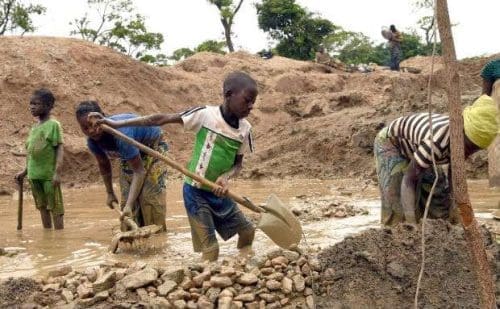
It urged stronger interventions to address conditions that expose children to exploitation, warning that continued inaction could widen inequality and hinder long-term national development.
More on child labour
Approximately 21% of children aged 5–17 in Ghana are involved in child labour, with 14% engaged in hazardous work, primarily in agriculture, fishing, mining, and domestic services.
Prevalence and Sectors
Child labour in Ghana affects nearly 1.9 million children, with higher rates in rural areas, particularly in northern regions where up to 44% of children are involved in work.
The main sectors include:
- Agriculture: Cocoa farming, palm oil production, rice cultivation, herding livestock, and fishing. Children often handle sharp tools, carry heavy loads, and are exposed to agrochemicals.
- Mining: Artisanal and small-scale gold mining (“galamsey”) exposes children to unstable pits, mercury, and dangerous machinery.
- Services: Domestic work, street vending, and the kayayei phenomenon, where young girls carry heavy loads in urban markets, often facing sexual exploitation.
- Other industries: Textile manufacturing, construction, and quarrying.
The worst forms of child labour include forced labour, commercial sexual exploitation, trafficking, and involvement in illicit activities such as drug production