Christian Council backs GoldBod, demands accountability
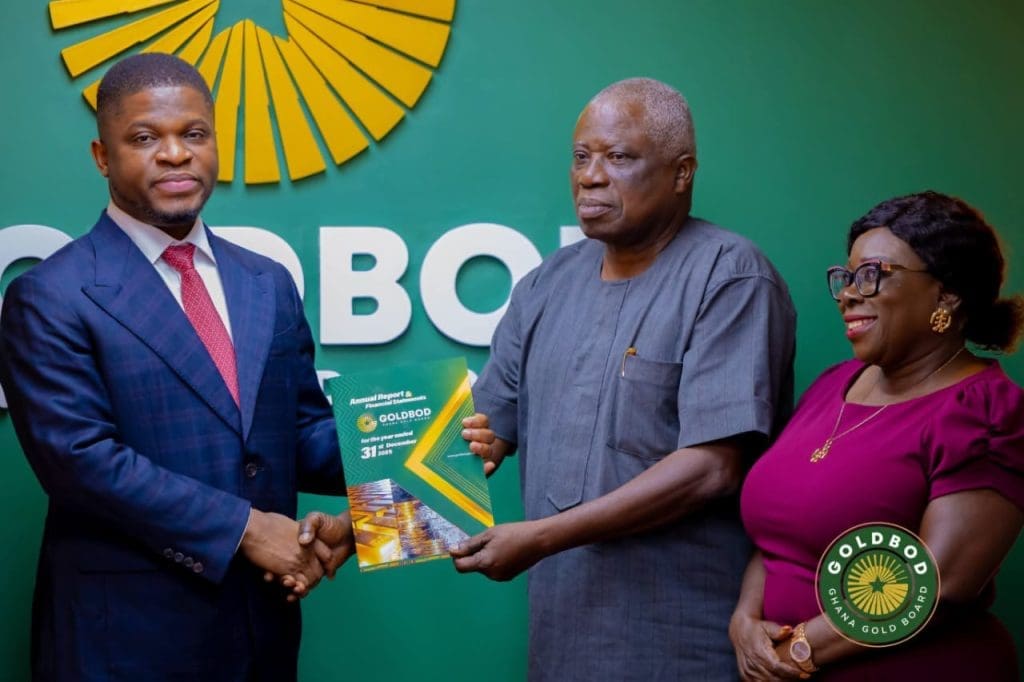
Christian Council with GoldBod CEO Sammy Gyamfi
The Christian Council of Ghana (CCG) has thrown its support behind the national objectives of GoldBod but demanded stronger financial accountability, independent oversight, transparent reporting and responsible sourcing to safeguard public resources and prevent the formal gold trade from legitimising illegal mining.
The Council said domestic gold purchasing, the formalisation of artisanal and small-scale mining, improved foreign-exchange management and increased local value addition were legitimate national objectives that deserved support. However, it cautioned that the success of those objectives must be demonstrated through verifiable evidence, prudent expenditure, responsible sourcing and effective safeguards to protect the public interest.
In a position paper titled “CCG Position on the GoldBod Public Debate: Truth, Accountability, Responsible Gold Governance and the National Interest,” dated October 19, 2026, the Council called for a comprehensive reconciliation of the financial accounts of GoldBod and the Bank of Ghana’s Domestic Gold Purchase Programme (DGPP) to establish the actual financial implications of the initiative.
The Council’s position follows consultations with GoldBod management on September 7, 2026, and the Minority Leader, Alexander Afenyo-Markin, and his delegation on October 6, 2026, to understand the competing arguments surrounding GoldBod and the central bank’s gold purchasing programme.
It said GoldBod management outlined the institution’s mandate, operations, financial performance and development plans, while Mr Afenyo-Markin raised concerns about the programme’s financial implications, transaction costs, exchange-rate exposure, institutional oversight, illegal mining and environmental degradation.
The Council, however, stressed that the engagements were stakeholder consultations intended to understand the different positions and did not constitute forensic audits, judicial inquiries or statutory investigations. Consequently, it said the concerns raised by the Minority Leader had not been independently verified during the meetings.
IMF’s US$1.7bn losses and GoldBod’s accounts
On the controversy surrounding the financial performance of the domestic gold purchasing programme, the Council drew attention to the International Monetary Fund’s (IMF) estimate of losses of approximately US$1.7 billion, equivalent to 1.5 per cent of Gross Domestic Product (GDP), associated primarily with the Bank of Ghana’s DGPP operations in 2025.
It said the IMF had identified service and assay fees, off-taker discounts and exchange-rate spreads among the factors contributing to the losses.
However, the Council cautioned against attributing the entire US$1.7 billion estimate to GoldBod as a corporate operating loss, explaining that the figure related primarily to the central bank’s programme operations during the period under review.
It said the distinction was important because the financial performance of GoldBod as an institution should not be confused with the broader fiscal implications of the Bank of Ghana’s domestic gold purchasing policy.
The Council also drew attention to GoldBod’s published 2025 audited financial information, which reported GH¢5.55 billion in revenue, an operational surplus of GH¢909.71 million and an overall surplus of GH¢5.44 billion.
The financial statements also showed that the institution received GH¢4.55 billion in Government seed capital.
According to the Council, the figures must be properly interpreted because revenue, operational surplus, overall accounting surplus, Government capital injections and the wider fiscal cost of a public policy programme represent different financial measures.
It warned against using any of those figures in isolation to establish the overall financial success or failure of the domestic gold purchasing programme.
Demands comprehensive financial reconciliation
To resolve the conflicting interpretations of the programme’s financial performance, the Council called for a comprehensive reconciliation of GoldBod’s corporate accounts and the Bank of Ghana’s programme accounts.
It said the exercise should establish the actual financial position of the initiative, including the volumes and values of gold purchased and sold, pricing and exchange-rate methodologies, transaction fees, financing costs, Government transfers and the net fiscal exposure.
The Council also urged the responsible authorities to publish the special audit of the Domestic Gold Purchase Programme once completed and when its publication was legally permissible.
It said the audit should be accompanied by an official response and an implementation plan outlining measures to address any weaknesses, irregularities or shortcomings identified.
Beyond the special audit, the Council called for regular quarterly disclosures to improve public understanding of the programme’s operations and financial performance.
It said such disclosures should provide consistent information on gold purchases and sales, average purchase and selling prices, fees and commissions, financing and exchange-rate costs, changes in gold inventories, Government support and export proceeds.
The Council maintained that regular publication of such information would help establish a clearer picture of the programme’s costs, benefits and contribution to the national economy.
Backs parliamentary scrutiny
The CCG also defended parliamentary scrutiny of GoldBod and the Domestic Gold Purchase Programme, describing it as a legitimate and necessary component of public accountability.
It urged relevant parliamentary committees to conduct evidence-based hearings involving GoldBod, the Bank of Ghana, the Ministry of Finance, auditors and other stakeholders.
The Council said such engagements should provide an opportunity for the institutions responsible for implementing the programme to explain their decisions, respond to concerns and provide documentary evidence to support their financial and operational claims.
It cautioned political actors and public institutions against using inflammatory language, selective quotations and conclusions that went beyond the available evidence.
According to the Council, the raising of questions does not automatically establish wrongdoing, just as institutional denials or positive financial figures do not necessarily resolve every concern.
It called for proven errors, weaknesses in internal controls or misconduct to be addressed through lawful procedures and proportionate corrective measures, rather than through premature conclusions about culpability.
Warns against legitimising illegal gold
Beyond the financial controversy, the Council raised concerns about the integrity of gold entering the formal purchasing and export channels, insisting that increased domestic gold purchases must not undermine efforts to combat illegal mining.
It said all gold entering formal purchasing channels must be lawfully produced and responsibly sourced, warning that gold extracted through illegal or environmentally destructive mining must not be legitimised simply because it has entered the formal market.
The Council called for independently tested traceability systems capable of establishing the origin of gold, distinguishing between licensed and unlicensed sources and ensuring that suspicious consignments were rejected.
It said effective traceability was essential to preventing the formalisation of illegally mined gold and protecting the credibility of Ghana’s gold trade.
The Council also urged GoldBod and the relevant regulatory authorities to publish measurable environmental indicators to demonstrate the extent to which mining activities were being managed responsibly.
These indicators, it said, should cover water quality, restoration of forests and farmlands, controls on hazardous substances and the reclamation of degraded mining sites
It stressed that the economic benefits of gold production and increased foreign-exchange earnings must not be achieved at the expense of rivers, forests, agricultural livelihoods, public health and the wellbeing of mining communities.
Calls for national interest above politics
The Council said the controversy surrounding GoldBod should be approached with truthfulness, integrity and a commitment to protecting the national interest rather than partisan political considerations.
It maintained that its position was non-partisan and evidence-based, guided by the principles of truth, accountability, justice, peace, unity, human dignity and environmental stewardship.
It urged Government, Parliament, political parties, regulators, private-sector actors, civil society organisations and mining communities to place the national interest above political divisions.
The Council said the national objectives behind domestic gold purchasing and increased local participation in the gold value chain deserved serious consideration, but their implementation must be supported by transparent financial management, independent verification and responsible environmental governance.
It called for a system in which the benefits of Ghana’s mineral resources were maximised without compromising public accountability, institutional integrity and the sustainability of the country’s natural resources.