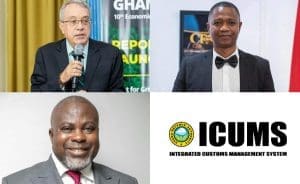
World Bank hails ICUMS for GH¢1.2bn monthly revenue surge
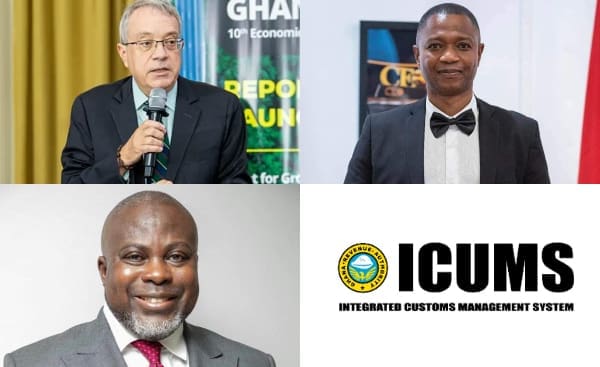
Robert Taliercio O'Brien, World Bank’s Country Director in Ghana, Nick Danso Adjei, Ghana Link Services Ltd Chairman, and Anthony Kwasi Sarpong, GRA Commissioner General
The introduction of the Integrated Customs Management System (ICUMS) has more than doubled monthly Customs revenue from the Tema Port, with collections rising from about GH¢500 million–GH¢600 million before the system to between GH¢1.2 billion and GH¢1.4 billion after its implementation.
The sharp increase, according to the World Bank, reflects improved compliance, reduced revenue leakages and evasion, and greater efficiency in customs administration following the digital transformation of the country’s principal port.
The development is highlighted in the World Bank’s 10th Economic Update, titled Reset for Growth: Sustaining Macroeconomic Recovery and Unlocking Transport for Transformation, published in August 2026.
Revenue surge
The report compared Customs’ monthly revenue performance during the 15 months preceding the introduction of ICUMS, covering January 2019 to March 2020, with collections after the system became operational.
During the pre-ICUMS period, monthly Customs revenue from the port generally ranged between GH¢500 million and GH¢600 million.
However, revenue rose sharply to approximately GH¢1.2 billion in April 2020, the first month of ICUMS operations.
From April to December 2020, monthly collections remained significantly higher, fluctuating between GH¢1.2 billion and GH¢1.4 billion.
The report said government figures subsequently showed that ICUMS-supported Customs revenue had reached approximately GH¢1.2 billion per month, while cumulative collections exceeded GH¢120 billion during its first five years of operation to 2025.
The World Bank attributed the gains largely to enhanced compliance and reduced opportunities for evasion enabled by the digital system.
Less human interference
ICUMS, operated by Ghana Link Network Service Ltd, has automated several processes that were previously conducted manually, reducing human intervention while improving efficiency and transparency in Customs operations.
The system represents an evolution of Ghana’s customs management architecture, which moved from manual processes to automated customs data systems and subsequently the Ghana Customs Management System before the introduction of ICUMS.
Unlike earlier systems, ICUMS integrates customs administration with security and trade facilitation functions, making it considerably more difficult to falsify documents while enabling faster scrutiny and processing of declarations.
The digital platform has also helped reduce delays and improve the transparency of the customs clearance process.
Technology-driven inspections
The transformation has been reinforced by the use of scanning and other non-intrusive inspection technologies.
These include X-ray systems, GAMA systems, trans-infrared spectroscopy, field Raman spectroscopy and backscatter systems, which enable Customs officers to examine consignments beyond their visible surfaces without physically opening them.
The technologies, according to the report, have improved the ability of officers to identify the contents and potential risks associated with consignments while facilitating faster clearance of legitimate goods.
The increased use of non-intrusive inspection is expected to strengthen both revenue protection and port security by enabling Customs to scrutinise cargo more efficiently.
Agencies connected
Beyond revenue collection, ICUMS has strengthened collaboration among state agencies involved in the clearance of goods.
The report said relevant state agencies have access to the platform, allowing them to participate in joint inspections and share information in real time.
The system also uses traders’ compliance records to determine the level of scrutiny required for their consignments.
Under the tiered arrangement, importers are assigned to different channels according to their compliance history.
Traders in the Red Channel are subjected to stringent checks, while those in the Yellow Channel, having demonstrated a higher level of compliance, undergo moderate scrutiny.
Highly compliant traders are placed in the Green Channel, where they face minimal checks, while trusted traders in the Blue Channel can have their goods released even before they arrive at the port.
The arrangement is designed to reward compliance while allowing Customs to concentrate its resources on higher-risk transactions.
Faster cargo clearance
The digital reforms have also improved the movement of containers through the port.
The World Bank said the Single Window System and Truck Appointment System had reduced container turnaround time at Terminal 3 to about three days, which it described as a marked improvement over the West African regional average.
The gains, it said, demonstrate the potential for digital governance to improve efficiency across Ghana’s wider logistics network, although the current benefits remain largely concentrated around the geographical area served by the Tema Port.
Wider economic impact
The World Bank said the impact of ICUMS extends beyond Customs administration, arguing that faster clearance and reduced administrative bottlenecks have created a more business-friendly trading environment.
For businesses, quicker clearance can reduce port-related costs, improve cash flow and strengthen the competitiveness of Ghanaian importers and exporters.
For government, the reduction in opportunities for corruption, smuggling and revenue evasion provides a stronger basis for domestic revenue mobilisation.
The additional revenue generated through improved Customs administration can, in turn, provide fiscal space for investment in infrastructure, social services and other development programmes.
The report therefore presents the Tema Port’s digital transformation as a potential model for extending technology-driven reforms across Ghana’s logistics and trade ecosystem.
With ICUMS at the centre of Customs modernisation, the World Bank said Ghana had an opportunity to deepen trade facilitation, strengthen international trade relationships and use more efficient border processes to support sustained economic growth.