$819m cocaine, meth busts taint Ghana as transit gateway
Cocaine and meth
Ghana’s reputation as a destination for legitimate trade and investment is facing a disturbing new challenge as the country increasingly features in major international illicit drug trafficking cases, with multimillion-dollar consignments being shipped from Ghana to foreign destinations.
The scale of the seizures between 2025 and 2026 is raising concerns about Ghana’s vulnerability to international drug cartels and the extent to which some Ghanaian nationals are facilitating the use of the country as a transit point.
Three major drug seizures during the period — two intercepted in Ghana and two seized after shipments originating from Ghana reached foreign countries — involved narcotics with a combined estimated street value of about US$819 million.
The figure comprises approximately US$350 million worth of cocaine seized in Ghana in March 2025, US$208 million worth of methamphetamine intercepted in Australia in 2026 and nearly US$261.45 million worth of cocaine seized in France in 2026.
The worrying dimension, however, is not only the value of the drugs seized but what the successful interception of such shipments reveals about the possibility of other consignments escaping detection.
If consignments worth hundreds of millions of dollars can be assembled, concealed and shipped through Ghana, with some only being discovered after arriving in Europe or Australia, it raises fundamental questions about the country’s vulnerability as a transit corridor for international drug trafficking networks.
Drugs allegedly not produced in Ghana
What makes the development particularly disturbing is that the narcotics involved are not known to be produced in Ghana on the scale suggested by the seizures.
The pattern instead points to Ghana potentially being exploited as a transit, consolidation and export point by international criminal networks.
That would mean that foreign drug cartels are using Ghana’s ports, businesses, transport networks and other legitimate commercial channels to move narcotics to lucrative markets abroad.
More troublingly, the cases suggest that such operations cannot be undertaken without local assistance.
The involvement of Ghanaian nationals, whether through deliberate participation, facilitation, concealment or the provision of legitimate-looking commercial cover, would give international criminal networks access to local knowledge and infrastructure needed to move large consignments.
The implication is that Ghana is not merely confronting a problem of drug consumption or street-level trafficking.
It could also be confronting a growing transnational organised crime problem.
Foreign seizures damaging Ghana’s image
The most embarrassing aspect of the emerging pattern is that some of the biggest shipments associated with Ghana are not intercepted by Ghanaian authorities.
Instead, the drugs are detected by foreign law-enforcement agencies after leaving the country.
This creates an international perception that Ghana is the source or point of origin of the shipments, even where the drugs may have entered the country from elsewhere.
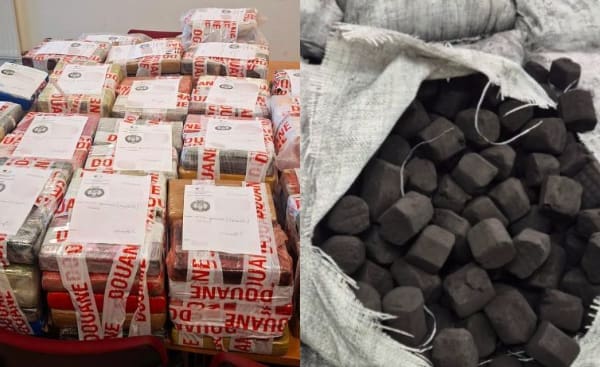
In the case of the French seizure, for instance, nearly 3.9 tonnes of cocaine were intercepted at the northern port of Dunkirk after arriving from Ghana.
French authorities estimated the street value at approximately €225 million, equivalent to about US$261.45 million.
The cocaine was concealed inside a container carrying plastic waste.
The shipment was reportedly destined in part for Antwerp, highlighting the international nature of the trafficking network and the role of Ghana as a link in a much wider supply chain.
The French judicial police had targeted the criminal network allegedly behind the shipment before the seizure, and an investigation was subsequently opened into organised narcotics importation and participation in a criminal association.
For Ghana, such cases carry consequences beyond the immediate criminal investigation.
Repeated seizures of large drug consignments identified as having been shipped from Ghana can affect the country’s reputation among foreign governments, customs authorities, financial institutions, shipping companies and legitimate businesses.
$208m meth shipment to Australia
A separate case involving Australia provides another indication of the sophistication of the trafficking networks allegedly operating through Ghana.
Australian authorities intercepted approximately 320 kilogrammes of methamphetamine concealed in bags of charcoal in two shipping containers from Ghana.
The consignment had an estimated street value of US$208 million.
The Australian Federal Police launched an investigation after Australian Border Force officers detected anomalies in the containers at Sydney’s Port Botany.
The containers were X-rayed and officers discovered a white crystallised substance which tested positive for methamphetamine.
Further forensic examination established that the shipment contained approximately 320 kilogrammes of the drug.
The drugs were removed before the consignment was delivered to a storage facility, where subsequent investigations led to further arrests and the seizure of bags allegedly used to conceal the narcotics.
The investigation eventually resulted in charges against several suspects, while Ghana’s Narcotics Control Commission also charged five persons in connection with the trafficking operation.
The use of coconut charcoal shipments as concealment demonstrates how criminal networks can exploit legitimate exports to disguise highly valuable narcotics.
It also exposes legitimate Ghanaian businesses involved in international trade to reputational and regulatory risks if their products, containers or supply chains are infiltrated by traffickers.
Ghana seizure exposes local network
The problem is not confined to drugs leaving Ghana.
On March 4, 2025, the National Intelligence Bureau intercepted approximately 3.3 tonnes of cocaine allegedly being transported from the Western Region towards Accra.
Acting on intelligence, officers stopped a tipper truck at Pedu Junction in Cape Coast and discovered sacks of cocaine concealed beneath sand.
The truck was travelling from Takoradi towards Weija.
Initial field testing by the Narcotics Control Commission confirmed the substance as raw cocaine, with the first seizure weighing 2,974 kilogrammes.
Further investigations led officers to a suspect’s residence on March 8, where they found 13 additional sacks and another bag of suspected cocaine weighing 345.07 kilogrammes.
Laboratory tests by the Narcotics Control Commission and the Ghana Standards Authority subsequently established a total weight of 3,319.68 kilogrammes, with purity levels ranging between 50 per cent and 70 per cent.
The cocaine was valued at more than US$350 million on the street.
Investigators reportedly believed the consignment had entered Ghana by sea through fishing vessels, further highlighting the vulnerabilities that criminal networks could exploit along Ghana’s extensive coastline.
Airport arrest adds to concern
Another case in February 2026 involved the arrest by the Narcotics Control Commission of a senior manager of a manufacturing company over an alleged attempt to smuggle cocaine out of Ghana.
The suspect, whose name had not been officially disclosed, was allegedly attempting to conceal the narcotics in a consignment of packaged gari.
He was arrested at Kotoka International Airport following an intelligence-led operation.
The case is particularly significant because it allegedly involved the use of a legitimate commercial product to disguise an illicit shipment.
It reinforces concerns about criminal networks exploiting ordinary businesses and export channels to move narcotics without immediately attracting suspicion.
Security threat beyond drugs
The growing presence of international drug trafficking networks poses a threat that goes far beyond the narcotics themselves.
Mrugs trafficking is closely associated internationally with organised crime, money laundering, corruption, document fraud, illicit financial flows and violence.
A country that becomes an established transit point can attract criminal organisations with financial resources capable of corrupting officials, infiltrating legitimate businesses and developing networks across ports, airports, transport systems and financial institutions.
For Ghana, the potential security implications are therefore significant.
Large international criminal organisations operating from or through the country could seek to establish permanent networks, recruit local facilitators and use proceeds from narcotics trafficking to finance other criminal activities.
The longer such networks operate undetected, the greater the risk that they become embedded in legitimate economic activity.
Threat to Ghana’s international reputation
The reputational consequences could also be substantial.
International customs and law-enforcement agencies are likely to subject shipments from countries repeatedly associated with major narcotics seizures to greater scrutiny.
That could translate into longer inspections, increased compliance costs and delays for legitimate Ghanaian exporters.
Businesses could face additional questions from foreign partners and financial institutions about the integrity of their supply chains.
Ghana’s reputation as a safe and reliable trading partner could consequently suffer if the country becomes regularly identified as a departure point for major narcotics shipments.
The danger is that legitimate Ghanaian exporters could pay the price for the activities of criminal networks.
A container carrying genuine Ghanaian agricultural or manufactured products could attract heightened scrutiny simply because Ghana has acquired a reputation for being used to move drugs.
The seizures may only be the visible part
Perhaps the most disturbing question arising from the seizures is how many consignments have successfully passed through Ghana without detection.
The US$819 million value attached to the three major seizures represents only drugs that authorities intercepted.
It does not represent the total volume that may have moved through the country.
Every successful seizure demonstrates that at least one shipment was detected.
But it also raises the possibility that other shipments may have escaped detection and reached their intended markets.
The absence of seizures cannot therefore automatically be interpreted as the absence of trafficking.
It could, in some cases, mean that criminal networks have become better at concealing their activities.
Need for stronger intelligence and border controls
The emerging pattern requires a coordinated response involving intelligence agencies, the Narcotics Control Commission, Customs, the Ghana Ports and Harbours Authority, the Ghana Revenue Authority, the police, immigration authorities and international law-enforcement partners.
Greater scrutiny of high-risk consignments, stronger intelligence-sharing and closer monitoring of suspicious trade patterns will be critical.
Authorities must also strengthen oversight of legitimate businesses and export channels without creating unnecessary barriers for genuine traders.
Particular attention will be required for commodities and shipping arrangements that can easily be used to conceal narcotics, including waste, charcoal, agricultural products and other containerised exports.
The use of intelligence-led operations is already producing results, as demonstrated by the cocaine seizure in Ghana and the international investigations linked to shipments from Ghana.
But the scale of the foreign seizures suggests that the country cannot afford to rely solely on interceptions after shipments have left its territory.
Protecting Ghana from becoming a cartel corridor
The central concern is that Ghana could gradually evolve from being an incidental transit point into an established corridor for international drug cartels.
That transformation would have serious consequences for national security, the economy and the country’s international standing.
The three major seizures between 2025 and 2026, involving an estimated US$819 million worth of narcotics, should therefore be treated as more than isolated criminal cases.
They are warning signs of the enormous financial incentives available to traffickers and the sophistication of the networks seeking to exploit Ghana’s geographical location, commercial infrastructure and legitimate trade channels.
The challenge for Ghana is to ensure that its ports, airports, roads, businesses and export systems remain instruments of legitimate commerce rather than gateways for international organised crime.
Failure to contain the problem could see the country face not only increased drug trafficking but also corruption, money laundering, organised crime and heightened international scrutiny.
The fact that major shipments associated with Ghana have already been intercepted in France and Australia should serve as a wake-up call.
Ghana must ensure that it does not become known internationally as a convenient departure point for narcotics destined for foreign markets.
The fight, ultimately, is not only about stopping cocaine or methamphetamine. It is about protecting Ghana’s borders, institutions, legitimate businesses, international reputation and national security from the corrosive influence of transnational organised crime.