
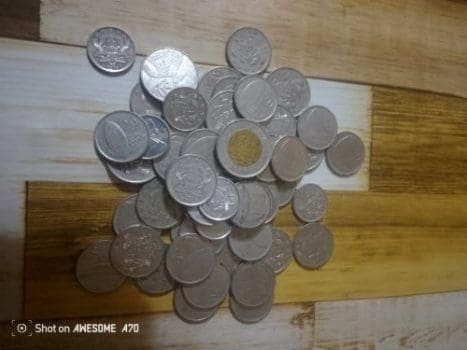
At a busy roadside market in Accra, a woman stretches out her hand to pay for tomatoes with coins, but the trader shakes her head.
“Mengye coins o”, to wit- “I don’t take coins.” A trotro mate nearby insists on rounding up the fare.


Another says to the passenger who has coins worth GH₵5.50 which is his regular transport fare, “the coins are too much, mix it up with some notes.”
Imagine how embarrassing that would be, particularly with the fact that the mate is a bit uncouth.
What should be a routine transaction turns awkward, sometimes confrontational.
Slowly, quietly, coins, legal tender, are being pushed to the margins of daily life.
This is the less discussed side of Ghana’s cashless journey.
While digital payments promise convenience and efficiency, they are also reshaping behaviour in ways that raise uncomfortable questions about fairness, access, and who truly benefits from the transition.
The promise and power of cashless convenience
Ghana’s embrace of cashless payments has brought undeniable gains.
Mobile money has transformed everyday commerce, making it easier to pay bills, send money across distances, and reduce the risks associated with carrying large sums of cash.
For businesses, digital payments simplify record-keeping and reduce theft.
For regulators, they offer traceability and improved revenue monitoring.
In many respects, the cashless push represents progress.
But convenience, when unchecked, can quietly become coercion.
When legal tender becomes unwelcome
It is important to draw a clear distinction: Ghana cedi notes remain widely accepted and continue to function smoothly in daily transactions.
Though the GH₵1 note almost disappeared causing its rejection at some point, it’s stable now. About that, when did you last come across a GH₵2 note?
From markets to transport services to retail shops, paper currency still holds unquestioned value.
The problem is more specific and more troubling.
It is the coins that are increasingly being rejected.
Despite coins being recognised as legal tender, their rejection has become increasingly normalised.
Traders complain that coins pile up and are difficult to recirculate.
Transport operators argue they slow down transactions, all these scenarios reinforce the idea that coins are a nuisance rather than money.
The result is subtle but significant pressure on consumers to round up prices, forfeit small change, or default to mobile money, even when they would prefer or depend on cash.
When a society informally decides that certain denominations are no longer worth accepting, the value of money is no longer defined by law alone, but by convenience.
The uneven cost of progress
Cashless systems are often celebrated as inclusive, yet their burdens are unevenly distributed.
Low-income earners, market traders, transport users, the elderly, and many rural residents still rely heavily on physical cash.
Network outages, transaction fees, phone battery issues, and digital illiteracy can turn a supposedly seamless system into a barrier.
For those barely getting by, consistently losing “small change” is not trivial.
Over time, it becomes a quiet transfer of value, one that favours sellers and service providers at the expense of the most vulnerable consumers.
A system moving faster than its safeguards
The problem is not Ghana’s move toward a cashless economy.
It is the speed at which behaviour is changing compared to policy enforcement, infrastructure development, and public education.
If coins remain legal tender, their rejection should not be casually accepted.
If digital payments are to dominate the future, then systems must be reliable, affordable, and accessible enough to carry everyone along.
A cashless economy should expand choice, not eliminate it.
Finding balance, not extremes
Cash and cashless systems must coexist, at least for now.
Progress lies in balance.
Banks must actively support coin circulation and deposits.
Regulators must clarify and enforce legal tender rules fairly.
Businesses must recognise that efficiency should not come at the cost of exclusion.
And consumers must be empowered to understand their rights in everyday transactions.
An economy should not advance by quietly leaving some people behind.
Beyond convenience
The rejection of coins in Ghana is more than an inconvenience; it is a signal.
It reveals how economic transitions, when driven primarily by convenience, can erode inclusion if left unexamined.
As Ghana races toward a digital future, the harder questions must be asked: Who benefits? Who absorbs the cost?
And what kind of economy are we building when even money struggles to be accepted?
In this same vein, let us respect the Ghana credit notes.
By this, I mean, let us keep them well – fitted nicely in our purses and wallets or neatly folded in your bag, just as we do with foreign currencies.
Remember, if we keep crumbling the notes, using wet hands to handle them, it’d be the cause of your fight (unnecessary) with a trotro conductor, a trader, or your yoghurt seller.
Ghana’s currencies, no matter the denomination, are still or should be accepted as a legal tender.
By Hellen Grace Akomah