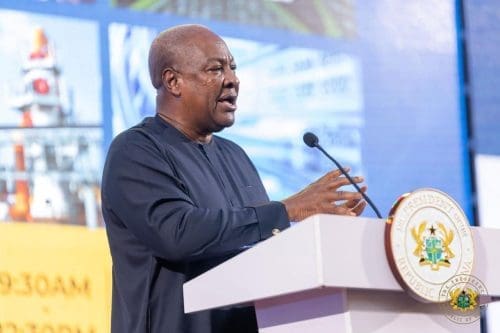
President John Dramani Mahama has stated that Ghana’s current engagement with the International Monetary Fund (IMF) should be the 17th and final bailout the country seeks, stressing the need for long-term economic discipline and structural reforms.
Speaking at a public forum, Mahama noted that Ghana’s repeated reliance on IMF support reflects deep-seated challenges in economic management.


He argued that while IMF programmes may provide temporary relief, they should not become a recurring solution to the country’s fiscal problems.
According to him, successive governments must commit to policies that strengthen domestic revenue mobilisation, control public spending, and promote sustainable economic growth.
He emphasised that without strong institutions and fiscal discipline, Ghana risks remaining trapped in a cycle of debt and external assistance.
He said “We’ll emerge from the extended credit facility with the IMF towards the middle of this year.
“It is my hope that this will be the very last time we will ever go for a bailout from that international monetary institution.”
Mahama added that “It must be the 17th and the last time that Ghana goes for a bailout from the IMF.”
“We’ll continue our collaboration with the IMF under Article 4 and other instruments,” he explained. “But it will definitely be the last time we go on our knees to beg for a bailout.
Mahama also called for bipartisan cooperation on economic reforms, saying national development should rise above partisan interests. He urged political leaders to be honest with citizens about the sacrifices required to stabilise the economy and prevent future bailouts.
Ghana is currently implementing an IMF-supported programme aimed at restoring macroeconomic stability, addressing debt challenges, and boosting investor confidence.
The programme follows years of economic pressures marked by rising debt levels, currency depreciation, and high inflation.
Mahama’s comments have reignited public debate on Ghana’s economic direction and the effectiveness of past and present IMF programmes, with many observers calling for sustained reforms to ensure the country does not return to the Fund again.