President John Dramani Mahama has announced a major shift in government policy on the management of improperly acquired public lands, declaring that completed buildings on such lands will no longer be demolished but that occupants will be compelled to pay the true market value of the land to the state.
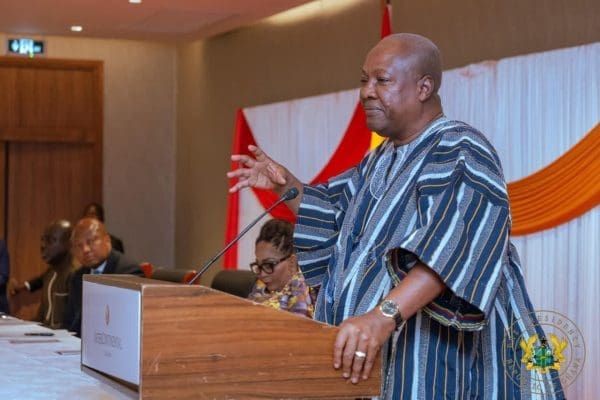
The President made this known while addressing members of the Ghanaian diaspora during a meeting in Lusaka, Zambia, as part of discussions on ongoing reforms in land administration.


He revealed that a government-appointed committee tasked with reviewing the status of public lands across the country has already submitted its report, uncovering widespread irregularities in the allocation of state lands.
Improper leases cancelled
According to President Mahama, several leases that were still undergoing processing have been cancelled after being identified as improperly issued.
He described some of these transactions as cases where “public lands were just distributed and looted,” pointing to systemic abuse within the land administration framework.
Prime state lands sold cheap, resold at huge profit
He cited instances where individuals allegedly acquired prime government lands in Accra for as little as GH¢150,000, only to resell them later for as much as US$2 million, depriving the state of substantial revenue and distorting the property market.
Despite the scale of the abuse, the President said the government had taken a pragmatic decision regarding lands where development has already been completed, and buildings are occupied.
He explained that demolishing such structures would impose unnecessary hardship on occupants and potentially trigger prolonged legal battles.
“It would be difficult to say, look, we’re going to break this house and take the land back,” President Mahama said, stressing that the focus would instead be on restitution rather than destruction.
Pay the true value to regularise ownership
Under the new policy direction, occupants of completed buildings on improperly acquired public lands will be required to pay the actual market value of the land to regularise their ownership.
“In those cases where they have processed the title, we are asking them to pay the true value of the land,” he stated.
Balancing public interest and social realities
The decision represents a significant policy recalibration aimed at balancing public interest with economic and social realities.
For homeowners, the new rule offers relief from the fear of demolition, protecting investments made in good faith and preserving housing stock, particularly in urban centres where property values are high.
It also provides a clear pathway to regularising land titles, which enhances security of tenure and access to financing.
For the government, the policy opens an avenue to recover lost revenue from undervalued land allocations without incurring the high economic and political costs associated with demolitions.
By compelling payment at market value, the state stands to mobilise significant funds while reinforcing the principle that public lands cannot be acquired cheaply and resold for private gain.
The approach also reduces the risk of lengthy court disputes that often accompany demolitions and land repossession, allowing the state to focus on reforming systems rather than litigating past abuses.
However, the policy is not without its drawbacks. Critics argue that allowing occupants to pay and retain the land could be perceived as rewarding illegality, potentially encouraging speculative behaviour if not backed by strict enforcement and transparency.
There are also concerns about how market value will be determined and whether politically exposed individuals may receive preferential treatment.
Blockchain to clean up lands registry
The President acknowledged that deeper reforms are required to prevent a recurrence of such abuses.
In this regard, he announced plans to introduce blockchain technology to digitise records at the Lands Registry.
He noted that Ghana continues to grapple with widespread cases of double sales, particularly involving family and stool lands.
According to him, digitisation will make land transactions more transparent by enabling prospective buyers to verify ownership, track transaction histories, and reduce fraud.
The use of blockchain technology, he said, would strengthen public confidence in land administration and support long-term reforms.
A test of political will
President Mahama’s announcement signals a broader attempt to clean up Ghana’s land administration system while avoiding social disruption.
Whether the policy succeeds will depend largely on effective valuation mechanisms, transparent implementation and the political will to apply the rules uniformly across all categories of landholders.