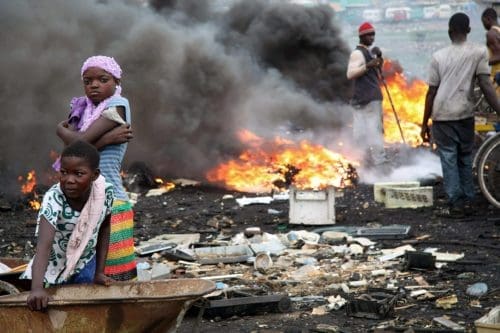
Air pollution in Ghana’s major cities is on the rise, with new research showing levels of harmful fine particles far above safe health limits. Experts warn that this trend poses a growing threat to public health, particularly in densely populated urban areas.
The study, led by Dr Dan Westervelt, Lamont Associate Research Professor at Columbia University’s Lamont-Doherty Earth Observatory, analysed 20 years of satellite data, weather patterns, and ground-level readings.


It found persistently high concentrations of fine particulate matter (PM2.5) in Accra, Kumasi, and Tamale—five to ten times higher than the World Health Organisation’s (WHO) guideline of five micrograms per cubic metre.
PM2.5 refers to dust and smoke particles small enough to penetrate deep into the lungs and enter the bloodstream, contributing to heart disease, lung damage, stroke, and asthma.
Dr. Westervelt told the Ghana News Agency that Accra recorded the highest pollution levels, driven by heavy traffic, industrial activities, household burning, and emissions from diesel-powered generators.
Kumasi and Tamale were also heavily affected, impacted both by local pollution sources and by dust transported from the Sahara during the Harmattan season.
The study, funded by the Clean Air Fund, found that Tamale experienced the strongest Harmattan peaks, with PM2.5 concentrations sometimes exceeding 100 micrograms per cubic metre.

“The health implications are alarming,” Dr Westervelt said. “Our report estimates that more than 16,000 adults died prematurely in 2023 alone due to long-term exposure to PM2.5.”
He urged authorities to implement stricter measures to reduce emissions from transportation, waste burning, and industrial activity.
He also recommended increased public awareness campaigns and real-time air quality monitoring to help residents avoid exposure during periods of high pollution.
Without swift intervention, Dr Westervelt warned, air pollution will continue to shorten life expectancy, strain the health system, and hinder Ghana’s progress toward cleaner, healthier cities.
Air pollution remains one of Ghana’s deadliest public health threats. In 2023, it claimed over 32,000 lives, according to the State of Global Air 2025 report by the Health Effects Institute (HEI) and the Institute for Health Metrics and Evaluation (IHME).
The report showed that air pollution was responsible for nearly 14% of all deaths in Ghana, making it the country’s second leading risk factor after high blood pressure.
The WHO had previously estimated that about 28,000 Ghanaians died prematurely from air pollution in 2019. By 2025, the figure had risen by more than 4,000, highlighting a troubling upward trend.
The Air Quality Life Index 2025 report also noted that polluted air is reducing the average Ghanaian’s life expectancy by nearly 0.8 years, or roughly nine months.
Globally, air pollution continues to claim around 7.9 million lives each year, with Ghana carrying a comparatively high burden.