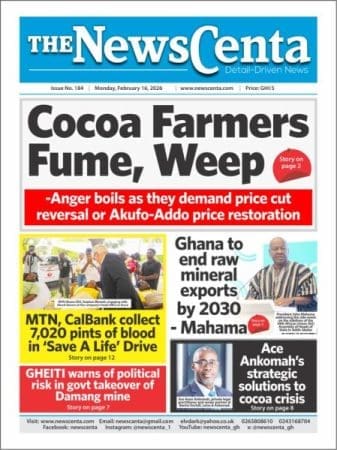
The cocoa crisis deepened in Parliament as the Minority caucus mounted a fierce challenge against the Mahama administration’s decision to slash producer prices, accusing the government of mismanagement, policy inconsistency, and political deception, while neighbouring Côte d’Ivoire maintains its producer price, shielding its farmers from similar shocks.
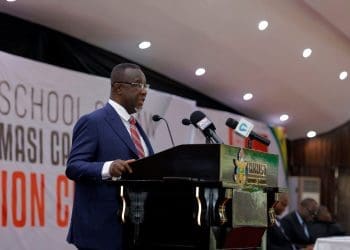
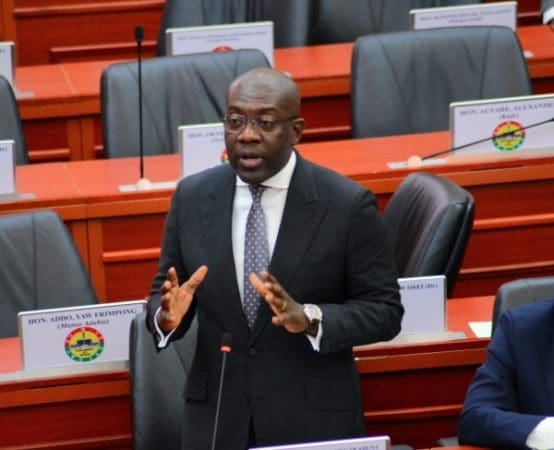
The Minority’s demand for an immediate reversal of the price cut was formally delivered on the floor of Parliament by Kojo Oppong Nkrumah, the Member of Parliament for Ofoase-Ayirebi, following a statement read by the Minority Leader condemning the government’s handling of the cocoa sector.

The price reduction, which cut the farmgate price from GH¢3,625 per 64kg bag to GH¢2,587, has triggered widespread anger across cocoa-growing regions, with farmers describing the decision as economically devastating and socially destructive.
The Ranking Member on the Committee of Economy and Development, Kojo Oppong Nkrumah, speaking on behalf of cocoa-growing communities, urged Cabinet to urgently reconvene—not to defend the decision—but to reverse it entirely.
He argued that the National Democratic Congress government had shown it could act swiftly to cut prices and must now show the same urgency to restore them.
“Just as Cabinet convened on an emergency basis to announce a reduction in the prices, we are asking Cabinet to reconvene and restore the bag price to GH¢3,625,” he told the House, framing the issue not as technical economics but as a humanitarian crisis.
“For those of us from cocoa-growing villages, this is not a matter of FOB percentages, 70 percent, 90 percent, or technical jargon. This is a matter of life and death for many cocoa farmers,” he declared.
To humanise the impact, Oppong Nkrumah recounted a call he received from a purchasing clerk, Kofi, from a community in his constituency. Kofi had already mobilised and deposited 200 bags of cocoa at the old price for evacuation. Following the price cut, farmers were informed that because COCOBOD had not evacuated the cocoa, the beans would now be purchased at the new, lower price.
The result, he said, was an instant loss of nearly GH¢200,000 for one small-scale local buyer.
“How many of us here—Members of Parliament, ministers of state—can suffer a loss of GH¢200,000 and survive?” Oppong Nkrumah asked. “This is not theory. This is real life. This is the destruction of livelihoods.”
He warned that the consequences would extend far beyond individual farmers, stressing that nearly one million Ghanaians depend directly on cocoa for their livelihoods. Cutting over GH¢1,000 from every bag, he argued, translates directly into rural poverty, collapsing household incomes, school dropouts, loan defaults, and economic stagnation in cocoa-growing communities.
Beyond the immediate hardship, the Minority also raised alarm about the long-term collapse of confidence in the cocoa policy framework.
Kojo Oppong Nkrumah warned that young people would lose interest in cocoa farming entirely, accelerating rural-urban migration and undermining the future of the sector. He further argued that trust in government policy had been fundamentally damaged.
“Who will believe new financing models? Who will trust local financing ideas when, in the same cocoa year, farmers were promised GH¢3,625 and then had it cut to GH¢2,500 before the season even ended?” he asked.
Drawing a historical contrast, he referenced the 2018–2019 cocoa season, when global cocoa prices fell sharply on the international market. Despite the downturn, the government at the time refused to cut producer prices and instead maintained and even increased farmer earnings, arguing that the farmer must be protected regardless of global volatility.
“We sat in Cabinet meetings where it was clearly stated that no government should look cocoa farmers in the eye and reduce their prices,” he said, noting that prices rose from about GH¢475 to over GH¢3,100 despite external market pressures.
The Minority rejected the government’s justification that the current crisis is driven by “external factors” and global price volatility, describing it as political deflection.
They accused the ruling NDC of blaming international conditions while ignoring domestic mismanagement, poor trading decisions, weak financial controls, and policy incoherence within the cocoa sector.
They further contrasted the situation with Côte d’Ivoire, the world’s largest cocoa producer, which has maintained its producer price framework despite global market fluctuations—protecting farmer incomes and preserving sector stability.
The Minority argued that the crisis is therefore not inevitable, but the result of governance failures rather than global forces.
The debate also revived campaign-era promises by NDC leaders, who, while in opposition, publicly argued that cocoa farmers were entitled to as much as GH¢6,500 per bag, describing lower prices as exploitation.
Oppong Nkrumah pointed out the contradiction: the same political actors who promised GH¢6,500 now defend a price of GH¢2,587.
“They promised GH¢6,500. They didn’t even achieve GH¢3,600. And now, they want to cut it to GH¢2,500. This is not reform. This is betrayal,” he said.
In his concluding appeal, Oppong Nkrumah framed the crisis not as a partisan contest, but as a national moral failure, urging the government to act in the interest of farmers rather than political survival.