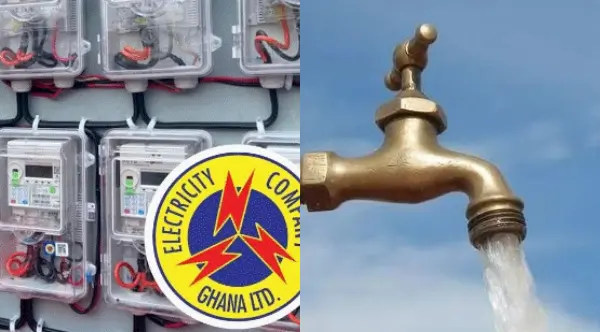
Ghanaians entered the New Year facing higher utility bills as the Public Utilities Regulatory Commission (PURC) implemented fresh increases in electricity and water tariffs, intensifying pressure on household budgets and production costs across the economy.
Effective January 1, 2026, electricity tariffs have risen by 9.86%, while water rates have been adjusted upward by a steep 15.92%, following the Commission’s completion of its 2026–2030 Multi-Year Tariff Review (MYTO).


The latest adjustments apply to the first quarter of 2026 and form part of a broader regulatory framework that will see tariffs reviewed quarterly throughout the year.
While the PURC insists the increases are necessary to sustain utility operations and attract investment, the hikes come at a time when many households and businesses are still grappling with the cumulative effects of earlier increases and a prolonged cost-of-living crisis.
Utilities costs rise after a difficult 2025
The new tariffs build on a challenging 2025, during which electricity tariffs increased cumulatively by 18.34%, while water charges rose by 4.02%.
Those increases, combined with high food prices, transport costs and subdued wage growth, significantly eroded disposable incomes.
For many families, the additional adjustments announced for 2026 represent another squeeze on already strained finances.
Small businesses, artisans and informal sector operators, who rely heavily on electricity and water for daily operations, say higher utility bills directly translate into reduced margins or higher prices for consumers.
Manufacturers and agro-processing firms, already contending with high input costs and tight financing conditions, warn that rising electricity and water tariffs will further undermine competitiveness and increase the cost of locally produced goods.=
Impact on production and prices
Industry players argue that electricity remains one of the most critical inputs in Ghana’s production chain, from manufacturing and mining to hospitality and services.
The 9.86% increase across all customer categories is expected to raise operating costs, forcing businesses to either absorb the additional burden or pass it on to consumers through higher prices.
Water-intensive industries, including food and beverage producers, pharmaceuticals, textiles and construction, are also bracing for the impact of the 15.92% hike in water tariffs.
For these sectors, higher water costs could affect production volumes and pricing, with knock-on effects for employment and inflation.
Economists note that sustained increases in utility tariffs often have second-round effects on the broader economy, as higher production costs feed into general price levels.
With inflation still a concern and household purchasing power under pressure, the latest utility hikes risk exacerbating economic hardships, particularly for low- and middle-income earners.
PURC explains the rationale
In a statement, the PURC said the tariff adjustments were the outcome of months of investment hearings, stakeholder consultations and regional public forums held across the country.
According to the Commission, the review considered the investment needs of power and water utilities, expected generation and production inputs, and key macroeconomic indicators such as inflation, the cedi–US dollar exchange rate and the cost of natural gas.
For the electricity sector, the PURC explained that the approved tariffs reflect a projected generation mix dominated by thermal power at 78.79%, with hydro contributing 20.9% and renewables accounting for 0.31%.
The review also factored in an increase in the Weighted Average Cost of Gas to US$7.8749 per MMBtu, alongside improved targets for reducing transmission and distribution system losses.
Macroeconomic assumptions underpinning the tariffs include an inflation rate of eight per cent and an exchange rate projection of GH₵12.01 to the US dollar.
The Commission said operational expenses and the regulated asset base of electricity utilities were assessed to ensure cost recovery and financial sustainability over the next five years.
Water sector adjustments and new inclusions
On the water side, the PURC said the 15.92% increase over the 2026–2030 period was based on projected production and sales volumes, non-revenue water levels and expected capital investment requirements.
Non-revenue water, which represents losses through leakages and illegal connections, is projected to decline to 43% under the new framework.
The new tariff structure will see residential consumers paying more across all consumption bands, while non-residential, commercial, industrial users and public institutions will also face higher rates.
Service charges, however, are expected to remain largely unchanged.
For the first time, the MYTO incorporates tariffs for mini-grids serving island and remote communities.
The cost of supplying these areas at uniform national rates has been included in the revenue requirement of the Volta River Authority, a move the PURC says will support streamlined implementation and equitable access to electricity.
Quarterly reviews to continue
The Commission emphasised that quarterly tariff reviews will continue, allowing for adjustments to variables beyond the control of utility companies, including fuel costs, exchange rate movements and changes in the generation mix.
While this mechanism is intended to protect utilities from financial shocks, consumers fear it could result in frequent increases that make planning and budgeting difficult.
As 2026 begins, households and businesses alike are bracing for the impact of higher utility bills, with many calling for stronger social protection measures, efficiency gains within utility companies and broader economic reforms to ease the burden on consumers.
For now, the latest tariff hikes underscore the delicate balance between sustaining essential services and protecting livelihoods in an economy still searching for relief from rising living costs.