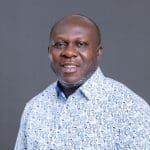
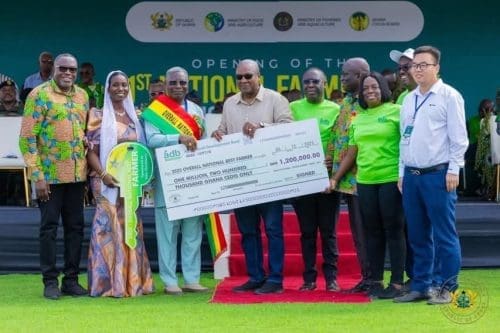
Ghana’s 2025 National Best Farmer, Opanyin Abraham Kwaku Adusei, has urged the government to accelerate investment in irrigation infrastructure as the country seeks to boost food production and strengthen food security.
Speaking after receiving the top national honour at this year’s Farmers’ Day celebration, the 82-year-old farmer said vast agricultural potential—particularly in the Afram Plains—risked being underutilised without a reliable year-round water supply.


Opanyin Adusei, who has spent nearly 55 years in agriculture, said the nation could not continue relying solely on rainfall if it was determined to feed its growing population, reduce food import dependence, and achieve the objectives of the “Feed Ghana, Eat Ghana, Secure the Future” agenda.
He emphasised that irrigation remained the single most transformative intervention needed to unlock large-scale food production capacity, especially in communities endowed with fertile land but constrained by erratic rainfall.
Reflecting on his journey, the 82-year-old farmer recalled entering the sector in 1968 immediately after graduating from the University of Cape Coast.
His dedication earned him several district-level awards before rising to national and international prominence.
In 2009, he won the Eastern Regional Best Farmer Award, and in 2022, he was recognised as the National Best Crop Farmer.
The following year, he was adjudged the National Best Cocoa Farmer before winning global acclaim in 2024 as the World’s Best Cocoa Farmer at the ICCO’s annual conference in Amsterdam, cementing his reputation as one of Ghana’s most accomplished agriculturists.
He said being named the 2025 National Best Farmer was one of the greatest honours of his life.
Dedicating the award to Ghanaian farmers, he praised their resilience and contribution to feeding the nation, powering industries and sustaining economic growth.
He expressed appreciation to the Ministry of Food and Agriculture, the Ministry of Fisheries and Aquaculture Development, the National Farmers Day Planning Committee and the sponsors of this year’s awards, as well as his family, traditional authorities and the communities that have supported him over the decades.
Speaking on behalf of farmers across the country, Opanyin Adusei stressed that irrigation infrastructure must be treated as a national priority.
He said the Afram Plains—where he cultivates cocoa, mango, 30 acres of cashew and several other crops—was one of many agricultural zones with immense productivity potential but limited by the absence of dependable irrigation systems.
Unlocking this potential, he argued, would significantly increase food supply, raise farmer incomes and reduce the nation’s heavy food import bill.
He welcomed assurances from the Minister of Food and Agriculture that irrigation has been prioritised under the Feed Ghana Programme, describing the commitment as timely and necessary.
He also commended President John Dramani Mahama for pledging to construct a bridge over the Afram River and improve road networks within the Afram Plains, saying these projects would open up the enclave, reduce post-harvest losses, improve market access and stimulate local economic growth.
For his prize, Opanyin Adusei received a GH₵1.2 million cash award from the Agricultural Development Bank, a brand-new tractor from Sino Machinery and a range of additional packages. The First Runner-Up position went to 48-year-old Mr Osumanu Kadri from the Greater Accra Region, while Mr Charles Gyato, 63, from the Oti Region was named Second Runner-Up. Mr Reuben Asare from the Kintampo North District in the Bono East Region was crowned National Best Youth Farmer, and Madam Grace Owusua of Asante Akyem North in the Ashanti Region received the National Best Female Farmer award.
Opanyin Adusei reaffirmed his belief that with strategic investments in irrigation, transport infrastructure and mechanisation, Ghana’s agricultural sector could achieve far higher levels of productivity. Such investments, he said, would secure the nation’s food future and cement the legacy of hardworking farmers whose labour continues to sustain the country.