
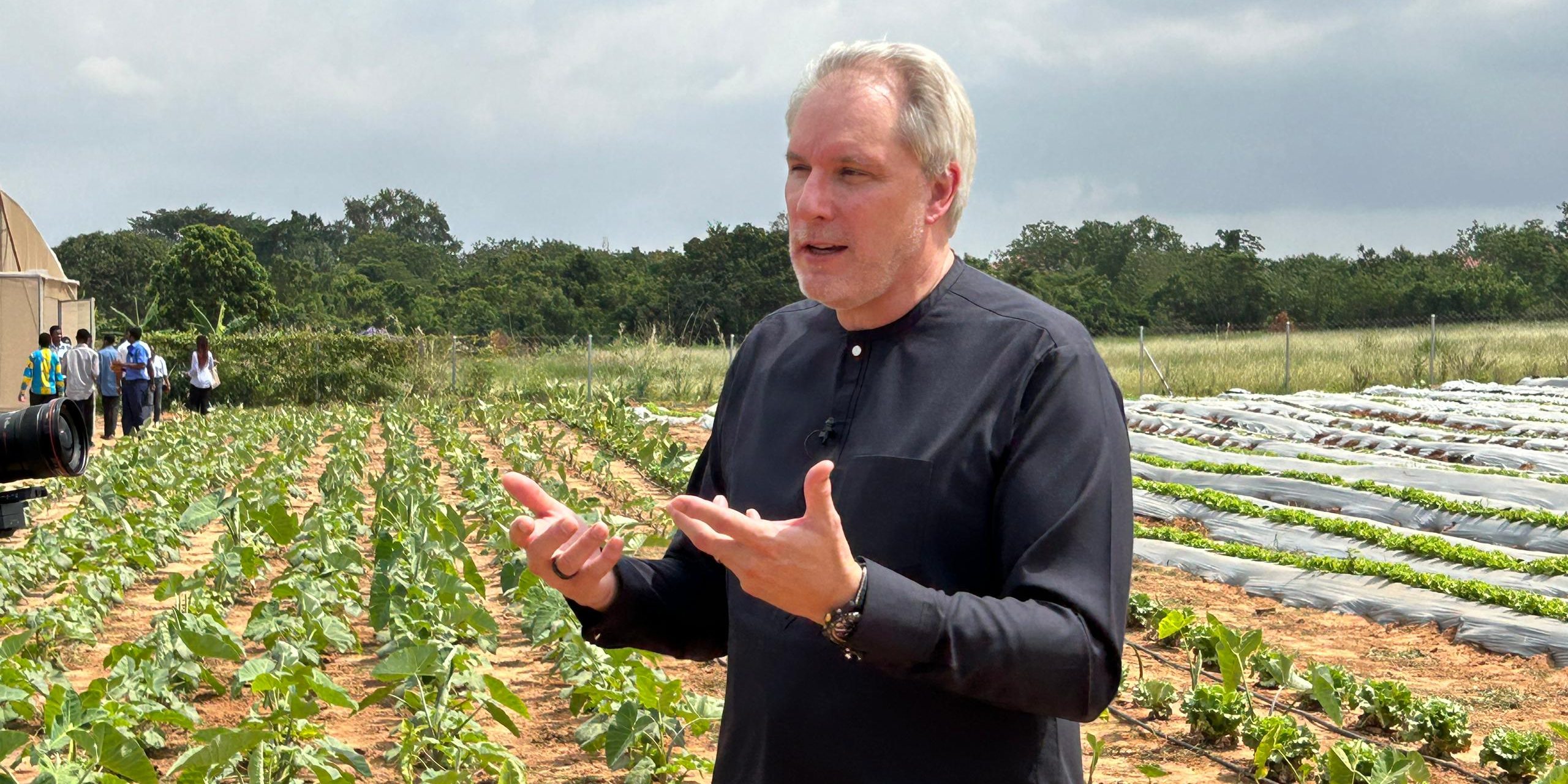
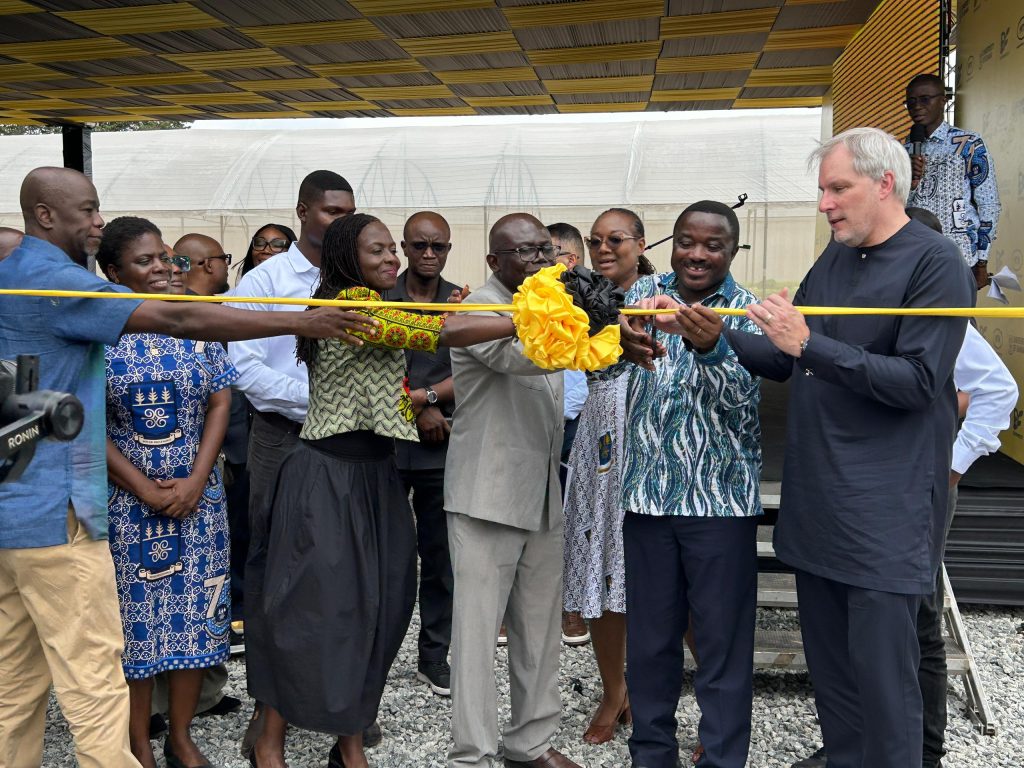
MTN Ghana, in partnership with the University of Ghana (UG) and Defarmercist, has officially opened the Vegetable Hub of Excellence, a modern agricultural training and production facility designed to transform the way young people engage in farming.
Speaking at the ceremony, Chief Executive Officer of MTN Ghana, Stephen Blewett, described the project as “an amazing initiative” that merges classroom learning with hands-on experience.


He noted that the hub brings together academic theory and practical fieldwork by providing training rooms, greenhouses, and expansive demonstration fields where students can apply what they learn.
Beyond the physical infrastructure, MTN has integrated advanced technology into the hub’s operations.
According to him, the company has installed solar systems and digital tools that support precision agriculture, including smart water-management systems.
According to him, discussions are also underway to explore digital platforms that will enable farmers to sell their produce directly to consumers through e-commerce channels.
“What is really encouraging is seeing young people embrace farming. As the President has stated, we must be able to stand on our own feet—not only producing enough food for Ghana, but also for the rest of Africa and the world. When you add technology to farming, it becomes attractive to the younger generation,” he said.
He emphasised that protecting and supporting farmers is essential for national food security, especially as Ghana prepares to celebrate Farmers’ Day.
Initiatives like the Vegetable Hub of Excellence, he added, play a crucial role in nurturing the next generation of agripreneurs.
Stephen Blewett also highlighted the importance of agritech partnerships, explaining that technology reduces the uncertainties traditionally associated with farming.

With digital systems, farmers can monitor weather conditions, prevent pest and animal attacks, and improve distribution channels—thereby minimising the risk involved when investing in seeds and inputs.
Technical Advisor to the Minister of Agriculture, Kwasi Etu-Bonde, stated that the hub aligns with the government’s commitment to modernising agriculture and creating employment opportunities for the youth.
The hub, he said, complements government initiatives such as the Feed Ghana Programme, which aims to make agriculture more attractive through training, technology and support for young entrepreneurs.
He lamented persistent challenges in the agricultural sector, including climate change, low technology adoption and heavy competition from imports, but stressed that innovation-driven projects like the hub offer practical solutions.
Speaking on behalf of the Vice-Chancellor, Pro-Vice Chancellor, at the Office of Research, Innovation and Development (ORID), Prof. Felix Ankomah Asante described the hub as a powerful testament to what strategic partnerships can achieve.
He noted that the initiative reflects a shared vision to elevate Ghana’s agricultural sector by merging innovation, education, and community impact.
Prof. Asante emphasised that the hub presents a promising future for young people who often struggle to see agriculture as a viable career path.
He pointed out that many farmers—especially women—still lack access to modern technologies, skills, and market opportunities that could improve their livelihoods.
The hub, he said, represents a bold step toward changing this narrative by providing equitable access to training and tools that bridge the gap between classroom learning and field practice.
According to him, the facility creates a unique model where students and young farmers can gain confidence, competence, and practical experience at every stage of the agricultural value chain.
Adding to the significance of the partnership, Co-founder of Defarmercist Group Limited, Charles Agyemang, said the collaboration with MTN and the University of Ghana is anchored on a simple vision—ensuring that every student who graduates from the university possesses employable agricultural skills.
He explained that the hub provides a practical arena where students can learn hands-on cultivation techniques and modern farming methods that prepare them for commercial agriculture.
“It’s not easy for an agriculture graduate to apply for a conventional job. So we want to ensure they come out with real skills that enable them to start production immediately,” he noted
He added that the facility is not only for University of Ghana students but is open to others who want practical training.

He stressed the enormous economic potential in horticulture, explaining that the high volume of vegetables consumed daily—paired with unstable supply—creates profitable market opportunities for young people who master the skills offered at the hub.
MTN Ghana’s Chief Corporate Services and Sustainability Officer, Adwoa Afriyie Wiafe, underscored sustainability as the backbone of MTN’s mission and operations.
“Sustainability is our commitment and our purpose. Our vision—digital solutions for Africa’s progress—can only be achieved through sustainable action,” she emphasised.
She highlighted MTN’s flagship environmental pledge: achieving net zero carbon emissions by 2040.
She stated that the new Vegetable Centre of Excellence, fully powered by solar energy, reflects this commitment in practice.
She noted that the centre is already reshaping teaching and learning, with students exposed to modern, technology-driven agriculture.
The facility is expected to serve as a model for modern agriculture in Ghana, inspiring more young people to consider agribusiness as a viable and rewarding career path.