The message was delivered in different voices, from different disciplines, and through different lived experiences, yet it echoed with striking consistency: creativity does not become wealth by accident.
Across music, film, visual arts, fashion, writing and digital content, Africa’s creative economy is overflowing with talent, originality and cultural capital.

What it lacks, the speakers argued, is not brilliance, but structure, strategy, legal awareness and the courage to think beyond limitation.
The central message running through the voices of all four speakers was unmistakable and urgent: creativity becomes wealth only when it is treated deliberately as an asset—strategically positioned, legally protected, commercially structured, and patiently cultivated over time.
Talent alone is not enough. Passion, without planning, is fragile. Visibility, without ownership, is dangerous.
And expression, without strategy, often enriches everyone except the creator.
In Africa’s fast-rising creative economy, the difference between survival and sustainability lies in mindset, discipline, and the courage to think beyond art as emotion and towards creativity as enterprise.
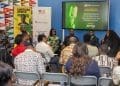
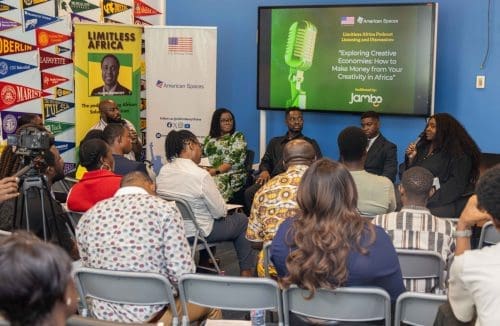
This message formed the intellectual backbone of a compelling creative economy forum organised by the Limitless Africa Podcast, facilitated by the American Center in collaboration with Jambo Spaces, and moderated by award-winning copywriter and events management expert Kofi Akrofi Ayeh.
The forum brought together growth strategists, legal practitioners and creative professionals and entrepreneurs to interrogate one of the most pressing questions facing Africa’s youthful population: how do creatives turn ideas into income, and income into long-term wealth?
What emerged was a powerful narrative about mindset, strategy, law and discipline—one that reframes creativity not as passion alone, but as enterprise.
The danger of small dreams
For Therese Jones, a growth strategist and co-founder of Jambo Spaces, the biggest obstacle facing African creatives is not funding, exposure or even systems—it is self-imposed limitation.
A first-generation Ghanaian born in the United States and now living and working in Ghana, Jones has spent years helping creatives position themselves for growth.
She said that the first thing she tries to remove when working with African creatives is the belief that their dreams must be modest, local or constrained by circumstance.
“There is something in our culture where we are taught not to dream too far,” she explains.
“We are told to accept what we are given, not to push boundaries. That mindset is one of the worst things that can happen to a creator—especially if you want to succeed beyond Ghana’s borders.”
In her view, many African creatives unknowingly internalise ceilings placed on them by society, economics and history.
They create within limits they never consciously chose.
The result is work that is expressive but cautious, talented but under-positioned.
Her advice is blunt: break the rules—but do it deliberately.
“Whatever you were told you shouldn’t do—question it. Try it. Push against it,” she says. “That’s how you find growth.”
For Jones, creativity thrives where fear is confronted.
The refusal to experiment, to offend, to stretch beyond what is familiar, often leads to stagnation.
And stagnation, she warns, is fatal in a global creative economy that rewards originality and boldness.
Creativity is not meant to please everyone
One of the most damaging myths Jones confronts is the belief that success requires universal acceptance.
Drawing on her experience managing the artist Molly, she argues that creatives fail when they try to appeal to everyone.
“You’re not here to please everybody,” she says. “You’re here to find the people who will eat what you serve.”
Many creatives, she explains, interpret rejection as proof of failure. Comments like “I don’t like this” or “I wouldn’t buy that” are often taken as final judgments on the value of the work. Jones insists this is a misunderstanding of how markets work.
“If people don’t like what you’re doing, it doesn’t mean it has no value,” she says. “It means you haven’t found your people yet.”
In a global economy built on niches, tribes and subcultures, mass appeal is no longer the primary currency.
What matters is clarity of audience. Creatives who understand who they are creating for—and why—are better positioned to monetise their work.
From emotion to strategy
While passion fuels creativity, Jones argues that emotion without strategy leads to frustration.
Many African creatives dream of global success but fail to map practical pathways to the rooms they want to enter.
“Creatives don’t always come into this with a business mindset,” she explains.
“They’re not thinking about strategy—about access, positioning, or relationships.”
Dreaming big, she stresses, must be matched with deliberate action.
That often means doing uncomfortable things: intentional networking, cold outreach, showing up in unfamiliar spaces, and following up without fear of rejection.
She recalls a simple tactic that shaped her early career—attending events and emailing people she barely met.
“I would email someone and say, ‘I met you at this party last night,’” she says.
“They probably didn’t remember me, but they would respond anyway. That opened the door.”
This approach, she notes, dismantles the myth that creatives must wait to be discovered or endorsed by gatekeepers.
“You don’t need permission. You don’t need an introduction. You don’t need to wait for someone to validate you.”
Choosing the right partners
Another recurring trap Jones highlighted is the obsession with attaching oneself to powerful or famous people.
In her experience, this mindset often leads to exploitation rather than growth.
“People get taken advantage of because they’re waiting for someone successful to believe in them,” she explains. “Meanwhile, there are people already in your life who would go into rooms and speak on your behalf—if you let them.”
She reframes the role of managers and collaborators, insisting they are not employees but business partners—individuals capable of translating creativity into commercial language.
“When I walk into a room with a bank or an institution, they don’t care that your art is the best in the world,” she said.
“They care about value. They care about fit.”
Trust, she emphasises, is central. Creatives must be willing to listen when partners challenge assumptions or propose uncomfortable changes.
Growth, she insists, rarely happens without friction.
Understanding value beyond music
Jones acknowledges that conversations about monetising creativity often centre on music, largely because it has clearer systems for tracking value through royalties and intellectual property frameworks.
“Music doesn’t have a perfect system,” she noted, “but it’s still the most structured creative industry when it comes to tracking value.”
Film, visual arts and digital content often struggle with valuation, distribution and revenue tracking.
Yet she believes the internet has fundamentally altered the landscape.
“When you have access to the internet, you’re no longer just in Ghana. Your audience is global,” she said.
She urged creatives to move beyond admiration and begin studying infrastructure—how international artists position their work, where it is shown, who supports it, and how value flows.
“Most creatives admire people abroad, but they don’t study the details,” she observes.
To illustrate this, she cites Ghanaian visual artist Anthony Azekwoh, whose online sharing of an artwork titled The Friday sparked sustained engagement, evolved into a series, and generated over $30,000 in sales and opportunities.
“That didn’t happen by accident,” she said. “It happened because he used the internet intentionally.”
Creating attention instead of waiting for it
Jones’ experience managing Molly’s music career reinforces a core lesson: waiting for the “right deal” can stall growth indefinitely.
“At some point, we realised that if no one was paying attention to us, we had to create the attention ourselves,” she disclosed.
Through experimentation—short videos, low-budget content, personality-driven clips—they slowly built traction.
“Making money didn’t come from one big plan. It came from trying things every day,” she explained.
Creativity as product, not emotion
For Nana Kofi Asihene, a creative polymath, the shift African creatives must make is psychological: creativity must be treated as a product.
“When you treat what you create as a product, you start thinking differently—about pricing, protection, and consumption,” he explained.
Using the analogy of rice production, he noted that producers do not simply grow rice and hope buyers appear.
They identify markets, advertise and distribute strategically. Creatives, he argued, must do the same.
“You are not your work. Your identity is not the same as the product you create,” he added.
Emotional attachment, he warns, often prevents creatives from making smart commercial decisions.
Sometimes, letting go of full ownership or accepting a smaller share unlocks greater long-term value.
“You may not have $100,000 to produce a feature,” he explained. “But if someone brings $90,000, you do the work, get your name on IMDb, and suddenly new doors open.”
Hustling long and playing the long game
Asihene urged creatives to combine passion with realism.
“We need to hustle like we are on the street. We know where we are coming from. We need to eat,” he advised.
Not every deal is perfect, he concedes, but indirect value—credibility, exposure, portfolio building—can be leveraged strategically.
“People didn’t just start creating last week,” he reminded participants. “Some have been doing this for years.”
Persistence, he argued, remains the most underrated currency in the creative economy.
The legal foundation of creative wealth
For Mrs. Sarah Norkor Anku, a leading Intellectual Property Attorney, creativity only becomes economically meaningful when it is legally protected.
“An idea without protection remains just an idea,” she stated.
While copyright arises automatically once a work is expressed in tangible form, many creatives fail to register their works, leaving them exposed during disputes.
“We often only talk about ownership when there is a problem,” she observed.
Registration transforms creativity into a tradeable asset—capable of being licensed, sold, inherited or used as collateral.
Contracts: Where value is quietly lost
Mrs. Anku warns that poorly drafted contracts are among the biggest threats to creative wealth insisting that duration, ownership, territory, royalties and termination clauses must be explicit.
“Copyright is a bundle of rights. You must know which ones you are giving away,” she explained.
Without clarity, creatives sign away control unknowingly—and suffer quietly, she pointed out.
Creativity as a living asset
Kwabena Frimpong Mensah, a private legal practitioner specialising in dispute resolution and intellectual property reinforced this warning, urging creatives to treat their work as a living asset, not a finished product.
“See your work as soil. Something you plant into, water and nourish,” he stressed.
He highlights the dangers of contracts that grant labels “absolute discretion,” locking artists into years of uncertainty while recouping costs endlessly.
“Every cost will be charged back to you,” he cautioned.
Some creatives, he noted, only discover years later that they owe hundreds of thousands of dollars despite public success.
Legal literacy as economic power
For Mensah, legal understanding is non-negotiable.
“Opportunities come with conditions. If you don’t understand the structure, you may be shocked later,” he cautioned.
Creativity, he said must be grown deliberately, “Otherwise, someone else will harvest it.”
A new creative future
As the forum closed, one truth stood firm: Africa’s creative economy will not thrive on talent alone.
It will be built by creatives who combine imagination with strategy, expression with structure, and passion with protection.
In Africa’s creative economy, expression is only the beginning—ownership, intention and courage are what turn creativity into money.
The event was expertly moderated by award-winning copywriter and events management expert, Kofi Akrofi Ayeh.
It was organised by the Limitless Africa Podcast under the theme “How to Make Money from Creativity in Africa”, and facilitated by the American Center in collaboration with Jambo Spaces.
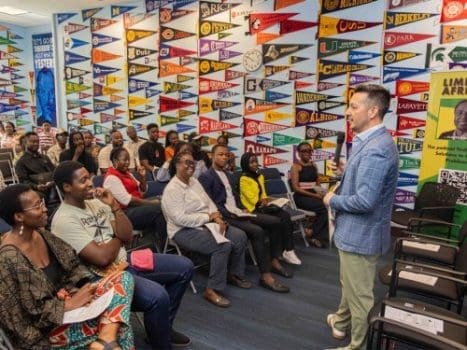
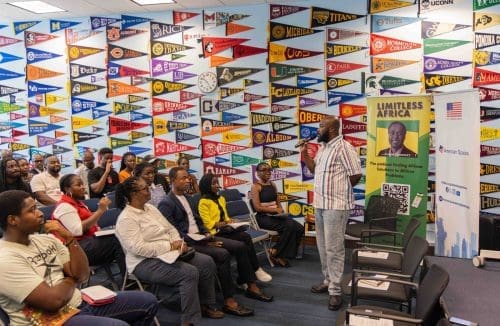
Participants were formally welcomed by Mathew Asada, Press Attaché at the United States Embassy in Accra, who introduced San Francisco as one of the host cities for the 2026 FIFA World Cup, highlighting opportunities for African creatives to engage with global platforms.
The programme concluded with closing remarks delivered by Dana Diamond, Public Diplomacy Associate at the U.S. Embassy in Accra, who reaffirmed the Embassy’s commitment to supporting creative innovation, cultural dialogue, and entrepreneurship across Africa.