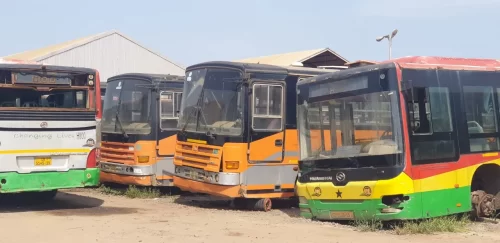
Metro Mass Transit Limited (MMTL) has been weighed down by a container of idle spare parts left at the port for more than two years, a situation its Managing Director (MD), Kale Cezar, says has deepened the company’s operational and financial strain.
In an interview with the Daily Graphic, Cezar revealed that the container, supplied by Dutch manufacturer VDL, was imported under a previous management but never cleared, attracting charges and delaying the return of critical buses to the roads.
“That (container) full of steppers was given to us by VDL Company. Our predecessors actually brought that container,” he said.
He explained that once the issue came to management’s attention, steps were taken to resolve it. This required prolonged engagement with several state institutions, including the Ghana Revenue Authority (GRA), to establish why the container had remained at the port for so long and what conditions had to be met for its clearance.
Following months of administrative processes and follow-ups, Cezar said Metro Mass was finally close to resolving the matter.
“If the government could waive some direct taxes and VAT on our imports, it would greatly help our operations,” he added.
Despite inheriting more than 185 operational buses, the MD said the company currently operates between 120 and 130 buses. However, he noted that revenue performance had improved significantly under the current administration.
While the previous management mobilised between GH¢8.5 million and GH¢9 million monthly, Mr Cezar said the company now generates over GH¢15 million each month, even with fewer buses in operation.
He attributed the surge largely to tighter controls and the near-complete rollout of electronic ticketing systems, which have helped plug long-standing revenue leakages.
“They introduced an IT solution for collecting tickets, but it was only utilised for about 40 to 50 per cent of the company’s operations.
“Now, we are (doing) almost 100 per cent,” Cezar said.
According to him, the expanded electronic ticketing system has drastically reduced losses that previously undermined efficiency.
Although much of the revenue is currently directed towards settling accumulated debts, the company is now able to meet key obligations, including salaries, pension payments and structured debt servicing.
Cezar said he assumed office at a time when Metro Mass was saddled with severe financial, operational and welfare problems. Some workers, including conductors and frontline staff, were earning as little as GH¢770 monthly.
He said management introduced a 20 per cent salary increase and later established a new minimum wage of GH¢1,300 for the lowest-paid workers, while restoring regular salary payments by the third week of every month.
The MD also disclosed that the company inherited significant statutory and non-statutory debts, including unpaid pension contributions, tax arrears, fuel debts and several court judgments arising from breached contracts under previous administrations.