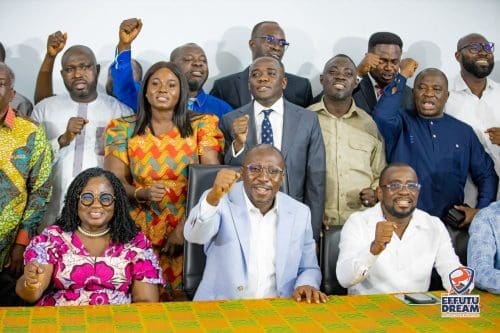
The Minority Caucus in Parliament has launched a blistering attack on the Majority and the government following the withdrawal of the proposed lithium agreement from Parliament, describing the move as a clear admission of policy failure, poor preparation and a lack of transparency in the handling of a strategic national resource.
Addressing journalists at a media engagement in Accra, the Minority said the government’s decision to pull the agreement after months of public defence revealed deep inconsistencies and raised serious questions about the competence and credibility of officials responsible for managing Ghana’s critical mineral resources.


According to the Minority, the withdrawal lays bare a troubling pattern in the government’s approach to the lithium deal — one marked by contradiction, confusion and apparent disregard for due process.
They accused the Majority of attempting to force an agreement through Parliament without adequately justifying its terms, only to retreat when sustained public and parliamentary pressure made the deal untenable.
Contradictions at the heart of govt’s position
The caucus recalled that while in opposition, members of the current governing side were vocal critics of an earlier lithium arrangement, warning that Ghana risked being short-changed. However, after assuming office, the same officials returned with what the Minority described as a weaker agreement that offered the country less protection, reduced value and diminished leverage over its own resources.
“What makes this episode particularly disturbing,” the Minority said, “is that the Majority went to the floor of Parliament to vigorously defend the agreement, projecting confidence and insisting it was sound, well-negotiated and in the national interest — only to turn around and withdraw it.”
The Majority has since argued that the agreement required further consultation, a justification the Minority dismissed as an after-the-fact rationalisation rather than a genuine policy reconsideration.
“To us, this is not consultation. It is confusion,” the caucus stated.
‘Backdoor’ withdrawal raises transparency concerns
The Minority further accused the government of withdrawing the agreement in a manner that undermined parliamentary integrity. They alleged that following intense scrutiny of the Minister for Lands and Natural Resources, Emmanuel Armah-Kofi Buah, and mounting public criticism, government officials opted to quietly pull the agreement rather than subject it to open debate and accountability.
Describing the move as a “backdoor withdrawal,” the caucus argued that it reflected a lack of respect for Parliament and an unwillingness to transparently defend decisions involving a resource as strategic as lithium.
“If government truly believed in the merits of this agreement, why was it unable to proceed with open, credible justification?” the Minority questioned.
Due diligence in doubt
The withdrawal, the Minority warned, raises fundamental concerns about whether due diligence was conducted, whether the terms were properly negotiated and whether the national interest was genuinely prioritised over expediency.
“This is how countries get short-changed,” the caucus cautioned, arguing that agreements involving critical minerals require coherence, discipline and a clearly articulated policy framework — not trial-and-error decision-making that exposes the country to long-term losses.
They stressed that lithium and other strategic minerals are not ordinary commodities and should not be treated as such.
Instead, they said, such resources must be governed by robust safeguards that ensure transparency, value for money, strong local content, environmental protection and alignment with Ghana’s long-term industrial development goals.
Call for stronger parliamentary oversight
The Minority said the episode should serve as a warning to both Parliament and the public that extractive agreements, particularly those tied to critical minerals, demand far stricter scrutiny.
They insisted that Parliament must not be reduced to a rubber stamp for poorly prepared policies that could compromise the country’s economic future.
The caucus pledged to intensify oversight and resist any attempt to reintroduce the lithium agreement without clear explanations, improved terms and full transparency.
“Ghana cannot afford policy confusion when it comes to strategic minerals,” the Minority said, warning that how the lithium issue is handled will shape not only investor confidence but the country’s industrial trajectory for decades to come.