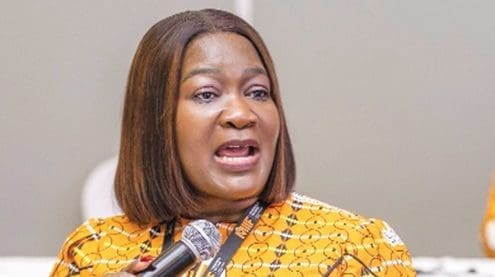
What began as a routine change in leadership at the Minerals Income Investment Fund (MIIF) has escalated into one of the most dramatic internal crises ever witnessed at a Ghanaian state-owned investment institution.
Since the appointment of Mrs. Justina Nelson as CEO in January 2025, MIIF has been engulfed in fear, resignations, firings, and a deep institutional fracture, culminating in a mass exodus that has gutted the Fund’s core workforce.

The upheaval coincides with revelations that MIIF attempted to rewrite its already signed audited financial statements—a move the Auditor-General has strongly condemned as “improper.”
But long before the controversy became public, insiders at the Fund sensed the brewing storm.
Accusations of mismanagement and staff resistance
Mrs. Nelson assumed office following the abrupt removal of former CEO Mr. Edward Nana Yaw Koranteng and immediately launched a narrative accusing the previous leadership of mismanaging the Fund.
Her task was to prepare the financial statements for the 2024 fiscal year, which she hoped would substantiate her claims.
However, the figures told a different story. MIIF employees, many of whom had spent years building the Fund into a profitable and well-governed institution, provided evidence of strong financial performance, growing asset values, and sustained profitability. Their diligence and integrity directly contradicted the CEO’s narrative.
Sources reveal that any staff member who openly questioned Mrs. Nelson’s narrative quickly became a target. Professional disagreement became a liability, as employees unwilling to compromise their integrity faced dismissal or were pressured to resign.
Numbers refuse to bend
The Finance Department finalised the 2024 draft financial statements, which clearly indicated MIIF’s profitability and proper management.
Multiple sources report that Mrs. Nelson repeatedly pressured the department to rewrite the figures to support claims of mismanagement.
The finance team refused, standing firm on professional ethics—a decision that triggered a series of retaliatory actions by the CEO.
Firing of the finance manager
The first major confrontation came with the dismissal of Finance Manager Ms. Linda Bartels-Poku, who had gone on approved leave.
Despite following company policy and covering her own travel expenses, her leave days were abruptly reduced without explanation.
When she pressed for clarification, none was given, and she was fired without a hearing or disciplinary process.
Sources confirm that Ms. Bartels-Poku’s refusal to manipulate the financial statements was the real reason for her dismissal.
She has since filed a lawsuit at the High Court, challenging her termination and seeking damages.
CFO resigns amid crisis
The dismissal sent shockwaves through MIIF’s leadership.
Chief Financial Officer Mr Seidu Sumaila condemned the action in a sharp email, calling it unjustified and professionally unacceptable.
He had previously resisted attempts to doctor the financial statements. Soon after, he resigned, dealing a devastating blow to the institution, given his expertise and institutional knowledge.
Mass exodus and institutional collapse
Since Mrs Nelson assumed office, MIIF has lost over 15 of its approximately 35 staff members, including the Chief Investment Officer, Head of Legal, IT Officers, Corporate Affairs personnel, and senior finance staff. Former employees describe the environment as “toxic,” “intimidating,” and hostile to professional integrity.
One senior officer noted, “Once you challenged the false narrative, you were gone. The institution we built was collapsing from the inside.”
Auditor-General rebukes MIIF
The internal purges coincided with the public revelation that MIIF attempted to rewrite audited financial statements.
The Auditor-General described the act as unethical, misleading, and wholly improper. Ironically, those who resisted internal pressure to falsify data are precisely the staff members who were dismissed or forced out.
A fund in crisis
MIIF, established to safeguard Ghana’s mineral revenues and generate long-term wealth, is now a cautionary tale of leadership failure, institutional intimidation, and ethical collapse.
With a gutted workforce, ongoing legal battles, and a loss of public confidence, the pressing question remains: how will the President respond to a sovereign fund in freefall?
Ghanaians, investors, and international partners are watching closely.
At MIIF, the crisis is no longer about financial statements—it is about trust, integrity, and the survival of a national institution.