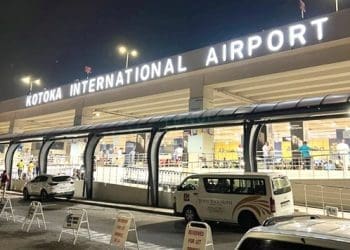
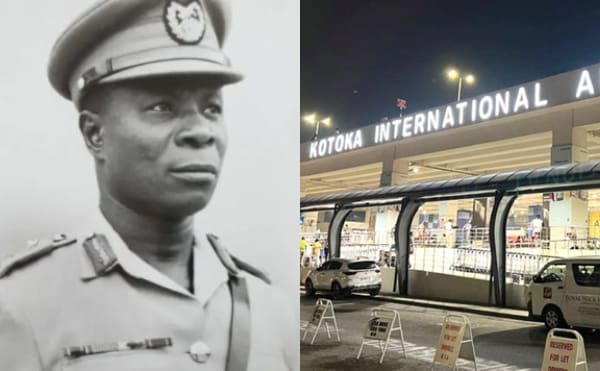
Kotoka International Airport (KIA) is Ghana’s main international gateway and the country’s busiest airport. It is located in Accra and serves as a major hub for domestic, regional, and international travel.
The airport was originally built during the colonial era and was known as Accra Airport before Ghana gained independence in 1957. It was later expanded to meet the growing aviation needs of the newly independent nation.


The airport began as a military airbase used by the British Royal Air Force during World War II. After the war, it was handed over for civilian use. In 1956, Ghana’s first president, Kwame Nkrumah, launched a project to convert and expand it into a modern civilian terminal. The work was completed in 1958, and it opened as Accra International Airport, serving as Ghana’s primary international gateway.
This changed after the February 24, 1966 coup d’état, when a group of military officers, including Lieutenant Colonel (later Lieutenant General) Emmanuel Kwasi Kotoka, overthrew President Nkrumah’s government while he was abroad. The coup leaders formed the National Liberation Council (NLC), with Kotoka becoming a prominent member and briefly a leading figure hailed by some as a liberator from what they described as Nkrumah’s increasingly authoritarian rule.
Kotoka’s role ended tragically on April 17, 1967, when he was assassinated during an attempted counter-coup led by junior officers at the Burma Camp military base in Accra.
To honour his memory and role in the 1966 events, the military government passed the General Kotoka Trust Decree in 1969 (later becoming an Act in 1971).
One of its explicit objectives was to rename Accra International Airport to Kotoka International Airport in his honour—without charging any costs to the trust fund established in his name. The renaming took effect in 1969.
The decision reflected the political climate at the time, where the 1966 coup was still viewed positively by those in power.
Over the decades, however, the name has sparked ongoing debate: some see it as commemorating a “liberation” from one-party rule, while critics view it as glorifying a military overthrow and argue that Ghana’s main international gateway should carry a more unifying or neutral name (such as Accra International Airport or even one honouring Nkrumah).
Over the years, the airport has undergone several major upgrades. The most significant expansion was the commissioning of Terminal 3 in 2018, which increased passenger capacity and improved Ghana’s status as a regional aviation hub in West Africa.
Despite its importance, the name of the airport has remained controversial, with critics arguing that it should not honour a figure associated with a military overthrow, while others view it as part of Ghana’s historical record.
- Infrastructure growth: The airport was initially designed to handle 500,000 passengers annually, but has since undergone massive expansion, including the construction of Terminal 3, which increased capacity to 5 million passengers.
- Proposed reversion: As of February 2026, the government has announced plans to rename the facility back to Accra International Airport to better reflect national identity and recognise the people who provided the land.
Today, Kotoka International Airport remains central to Ghana’s economy, tourism, and international relations, handling millions of passengers annually.