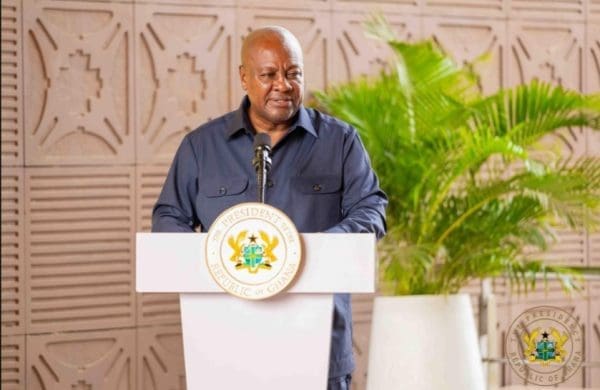
A recent survey conducted by the Institute of Economic Affairs (IEA) has revealed that 68 per cent of Ghanaians approve of President John Dramani Mahama’s performance in office, signalling strong public support as the country approaches critical political milestones.
The survey, which assessed citizen perceptions across governance, economic management, and social policies, indicates that Ghanaians are largely satisfied with Mahama’s handling of national issues. Key areas highlighted include efforts to stabilise the economy, initiatives to improve infrastructure, and programs to enhance social welfare.
Public confidence in Mahama remains strong despite ongoing economic challenges. The findings, released in a press statement on February 11, 2026, show that 68% of respondents approve of how President Mahama is handling his job, while 22% disapprove and 10% remain undecided.
The survey, conducted in December 2025, sampled over 1,000 Ghanaians from all regions of the country.
The IEA explained that the survey was carried out to assess public opinion on the President’s performance one year after the 2024 general election, as well as to gauge views on pressing socioeconomic issues, including the rising cost of food and consumer goods, unemployment, and illegal mining.
President Mahama assumed office on January 7, 2025, amid high public expectations and significant economic and governance challenges, such as high debt levels, a rapidly depreciating currency, inflation, and concerns about the size of government.
While some key economic indicators appear to be improving, the survey shows that many Ghanaians remain worried about the cost of living. About seven out of ten respondents (71%) said they are very concerned about the prices of food and other essential goods.
Unemployment and illegal mining also featured prominently among public concerns. Nearly half of respondents (46%) cited unemployment as a major national issue, while 30% highlighted illegal mining as a serious challenge.
The IEA noted that although President Mahama enjoys a solid base of support, the presence of a notable minority who disapprove or remain undecided indicates that continued efforts are needed to address citizens’ concerns and strengthen public confidence.
The survey reflects a nuanced public mood: strong approval for President Mahama’s performance coexisting with persistent anxieties over economic pressures affecting households across Ghana.