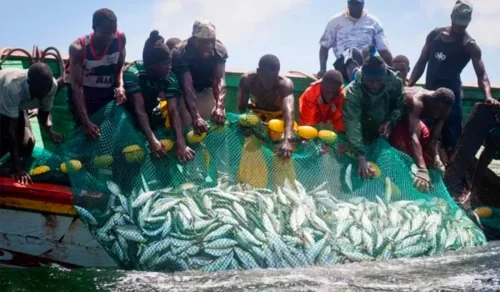
Ghana’s tuna industry has marked a major milestone as the country’s purse seine and pole-and-line tuna fleets have been certified as sustainable under the globally recognised Marine Stewardship Council (MSC) standard.
The achievement places Ghana among a growing group of West African nations meeting international benchmarks for responsible fishing, strengthening the region’s reputation in the global seafood market.


The certification was granted after an extensive 18-month assessment conducted by Control Union (UK) Ltd. The review examined the fisheries’ impact on the marine environment, the health of targeted tuna stocks, and the effectiveness of existing management measures.
According to the MSC, the Ghana Tuna Association (GTA)’s success demonstrates what is possible through strong industry leadership supported by coordinated government oversight.
The certified fleets operate in the Atlantic High Seas and within the Exclusive Economic Zones of Ghana, Côte d’Ivoire, Benin and Liberia.
They primarily target skipjack (Katsuwonus pelamis) and yellowfin tuna (Thunnus albacares), while also managing additional catches through responsible, food-chain-wide processes.
A key part of the fisheries’ qualification was their comprehensive management plan for the use of Fish Aggregating Devices (FADs).
The plan includes enhanced conservation strategies, improved fisher training, protected FAD trials, and strengthened catch monitoring.
These efforts are supported by long-standing cooperation with the International Commission for the Conservation of Atlantic Tunas (ICCAT) and the International Seafood Sustainability Foundation (ISSF).
A proud moment for Ghana’s tuna sector
Frank Alimoa, President of the Ghana Tuna Association, described the certification as a landmark achievement.
“This is a proud moment for Ghana’s tuna sector and a significant step towards a more sustainable future,” he said. “By achieving MSC certification, we are demonstrating our strong commitment to sustainability, the continued development of the Ghana tuna industry, and our responsibility to help leave a healthier ocean for future generations.”
A boost to West Africa’s growing sustainability efforts
Michael Marriott, MSC’s Program Director for Africa, the Middle East and South Asia, praised the Ghana Tuna Association and its partners for their dedication.
“MSC certification is about more than a label – it is a commitment to robust and proven improvements over time,” he stated. “We look forward to ongoing engagement as these fisheries continue their sustainability journey. The world needs to recognise those fishers who are committed to improving their environmental practices.”
The certification builds on the momentum gained in November 2024, when the GAZSEN and Grande Blue vessels harvesting Atlantic tuna off Senegal became the first fishery in West Africa to achieve MSC certification.
Ghana’s newly certified tuna fleets now join this growing group, strengthening the region’s role in promoting responsible, environmentally conscious fishing practices within the global tuna industry.