
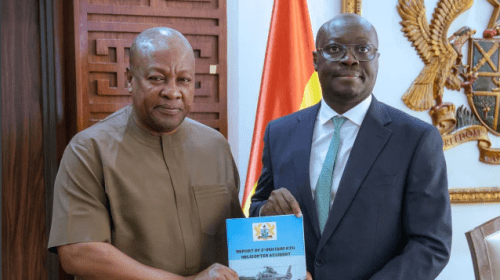
President John Dramani Mahama is facing growing public scrutiny after being dragged before the Right to Information (RTI) Commission for refusing to respond to a request for information on ex-gratia payments nearly two months after the lawfully mandated deadline.
The referral, filed by a Ghanaian journalist, has placed the President at the centre of a transparency controversy that critics say undermines his stated commitment to accountability and open governance.

The journalist’s RTI request, submitted on 7 October 2025 to both the Office of the President and the Ministry of Finance, sought clarity on the status of Article 71 emoluments covering the period 2021 to 2025—the final term of the Akufo-Addo administration. However, despite the clear provisions of the RTI Act, neither President Mahama nor Finance Minister Cassiel Ato Forson has acknowledged or responded to the request.
Under Section 23(1) of the RTI Act, public institutions are obliged to determine an application and communicate their decision within 14 days. Nearly 60 days later, silence still prevails.
After the initial deadline expired, the journalist followed due process by filing an internal review request on 24 October 2025, as provided under Section 32 of Act 989.
Yet as of 4 December 2025—more than a month since the internal review application—both the Presidency and the Finance Ministry have offered no explanation, no extension, and no indication of compliance.
According to the applicant, this pattern of silence constitutes a “deemed refusal” under Section 23(5) of the RTI law.
In his petition to the RTI Commission, filed under Sections 65(1) and 65(2) of Act 989, the journalist describes the behaviour of the two institutions as a “failure, refusal, neglect, or omission” to honour their statutory duties.
He argues that the conduct of the President and the Finance Minister has breached multiple sections of the RTI Act, as well as Article 21(1)(f) of the Constitution, which guarantees the right of every citizen to access information.
The application asks the Commission to take decisive action.
The journalist is seeking an order compelling the Chief of Staff and the Finance Minister to determine the two-month-old request and release the full set of information demanded.
He is also asking the Commission to formally declare that both institutions have violated the law by ignoring the request and the subsequent internal review application.
In addition, he is requesting the imposition of administrative penalties under Section 71 of the RTI Act on both the Chief of Staff and the Finance Minister for what he describes as their “wilful and unjustifiable disregard” for their legal obligations.
He further wants the Commission to impose a strict seven-day timeline for disclosure should it rule in his favour.
The journalist argues that the refusal by the highest office in the land to respond to a legally valid request represents a serious constitutional breach.
In his submission, he warns that when the Presidency itself fails to comply with transparency laws, it sends a dangerous national signal—that accountability is optional, and the right to information can be ignored whenever inconvenient.
He insists that in a democracy, the President and the Ministry of Finance must set the example, not lead the erosion of public confidence.
“In a democratic state, transparency, accountability, and openness are not optional virtues; they are binding constitutional obligations,” the applicant stated, urging the RTI Commission to assert its authority.
He called on the Commission to protect the constitutional right to information and ensure that the rule of law prevails, arguing that nothing short of full enforcement will restore trust.
With the matter now formally before the RTI Commission, pressure is mounting on President Mahama to explain why his office—tasked with upholding and exemplifying constitutional governance—has refused to provide information the law unequivocally requires him to disclose.
The silence from Jubilee House has only intensified the criticism, suggesting an administration uneasy with transparency on a matter as sensitive as ex-gratia payments.
Whether the Commission will enforce the law against the nation’s highest office remains to be seen, but the case has already sparked renewed debate about government openness and the seriousness with which the new administration treats citizens’ right to know.