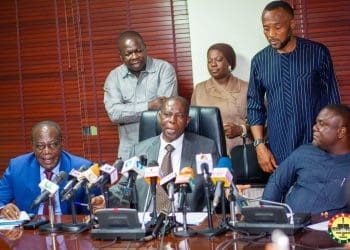

Prominent private legal practitioner Martin Kpebu has intensified calls for Special Prosecutor Kissi Agyebeng to step down, accusing him of a “failure of duty” and a serious breach of public trust.
Speaking on Joy News’ PM Express, Kpebu argued that the OSP’s handling of the former Finance Minister, Ken Ofori-Atta’s case is deeply flawed.


According to Kpebu, Agyebeng admitted to having intercepted a letter Ken Ofori-Atta wrote to both the incoming and outgoing Chiefs of Staff before he travelled.
Rather than publicly disclosing this critical information, Kpebu contends that the Special Prosecutor did not inform Ghanaians through a press conference.
He argued that a public alert could have prevented Ofori-Atta’s departure.
He said “the most salient” point is that “by now, the Special Prosecutor himself should have resigned.”
Kpebu said the OSP had “finally come to confess… on November 5” that before former Finance Minister Ken Ofori-Atta travelled, “he, Kissi Agyebeng, intercepted the letter Mr Ofori-Atta wrote to both the incoming Chief of Staff and the outgoing ones.”
Kpebu claims that after recognising the gravity of the situation, Agyebeng approached several security agencies — including the National Investigations Bureau (NIB), National Security, and the Ghana Immigration Service — but failed to secure cooperation.
“He said he intercepted the letter, then he ran to the National Investigations Bureau (NIB), but he didn’t get help, then ran to National Security, but didn’t get help there either, and finally he ran to the Ghana Immigration Service and still didn’t get help,” he added.
For Kpebu, the biggest failure was not necessarily the lack of institutional support, but Agyebeng’s silence and refusal to publicly blow the whistle.
Kpebu has accused Agyebeng of “extreme incompetence” for allowing Ofori-Atta to leave Ghana under investigation, calling into question the OSP’s commitment to its mandate.
He demanded that Kissi Agyebeng resign immediately, arguing that his continued tenure undermines public confidence in the fight against corruption.
Kpebu insisted that the OSP should have been more transparent and proactive. He argues that by keeping the intercepted letter private, Agyebeng failed in his duty to the public.
Kpebu’s demand highlights growing public frustration over how high-stakes corruption cases are handled.
This is not the first time Agyebeng has faced calls for removal.
Also, prominent political analyst and governance advocate PV Jantuah Boateng Dadson stirred national debate after calling for the scrapping of the OSP, arguing that the institution has fallen short of its mandate and has become a burden instead of a solution to Ghana’s corruption fight.
Speaking on national governance and anti-corruption efforts, Jantuah asserted that the OSP — originally established to investigate and prosecute corruption-related offenses independently has failed to deliver the transformative accountability Ghanaians were promised.
Jantuah argued that the OSP operates within a political and institutional ecosystem that makes true independence nearly impossible.
According to him, corruption enforcement in Ghana remains selective, politically influenced, and lacking the teeth required to hold powerful actors accountable.
He pointed to high-profile corruption controversies and stalled investigations as evidence that Ghana’s anti-corruption architecture remains weak despite reforms.