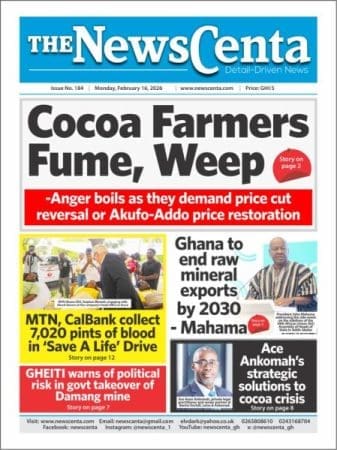
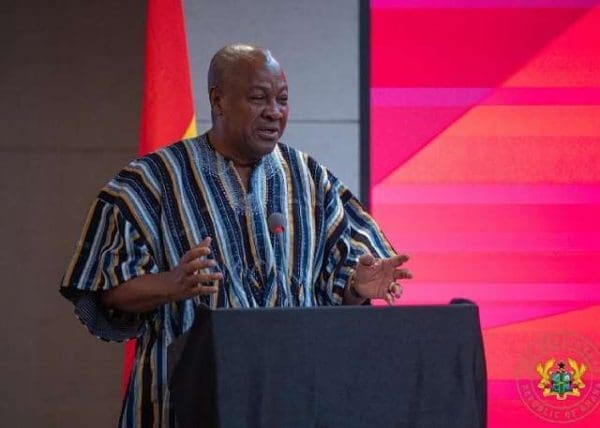
President John Dramani Mahama has said Ghana must use the current turbulence in the global cocoa market as a turning point to reduce its dependence on raw material exports and accelerate value addition across its agricultural sector.
“Recently, we’ve had a crisis with cocoa. It hasn’t affected only Ghana; it has affected all cocoa-producing countries,” he said.
“It shows how unstable raw material exports are if you don’t process and add value. We must take advantage of this crisis to make a pivotal change in how we handle our raw exports.”
The President was speaking at the opening of the Ghana Tree Crops Investment Summit and Exhibition at the Accra International Conference Centre on February 17, 2026.
His remarks come amid one of the most severe liquidity challenges to hit Ghana’s cocoa sector in decades, following sharp swings in global prices.
International cocoa prices surged to historic highs of over $10,000 per tonne in 2024 before falling significantly as production forecasts improved, leaving producing countries grappling with volatility.
Ghana, the world’s second-largest cocoa producer after Côte d’Ivoire, depends heavily on cocoa for foreign exchange and rural livelihoods.
More than 800,000 farm households rely on the crop, which supports millions more through transportation, trade, and processing.
President Mahama said the instability exposed structural weaknesses in economies that export raw commodities without processing them.
The four-day summit, themed “Sustainable Growth Through Tree Crop Investments: Resetting and Building Ghana’s Green Economy,” seeks to attract investment into processing and value addition for six priority crops: cashew, shea, oil palm, coconut, rubber and mango.
In a personal reflection, the President revealed he is himself a cocoa farmer, using his experience to underscore the real-life impact of policy decisions.
“Nana Kwebu Ewusi gave me 50 acres of land, and I planted cocoa on the 50 acres, so I am a cocoa farmer,” he said. “So when the price is reduced by the government, it affects me too. I want to be able to empathise with farmers so that when we take any policy decision, we know that it has an effect on farmers and we feel it ourselves.”
His comments follow recent adjustments in the farmgate price of cocoa, which was reduced from GH¢3,625 to GH¢2,587 per bag in response to international market volatility.
The decision sparked concern among farmers already contending with rising input costs and uncertain incomes.
President Mahama stressed that pricing decisions and reforms within the cocoa sector must reflect the realities facing farmers, noting that producer price announcements have direct consequences for rural livelihoods, children’s education and household welfare.
He reaffirmed his administration’s commitment to strengthening the sector through improved pricing mechanisms, investment in productivity and policies aimed at ensuring farmers receive fair returns for their produce.
Aligning national policy with the lived experiences of farmers, he said, would be critical to safeguarding the future of Ghana’s cocoa industry while repositioning it toward greater value addition and long-term sustainability.