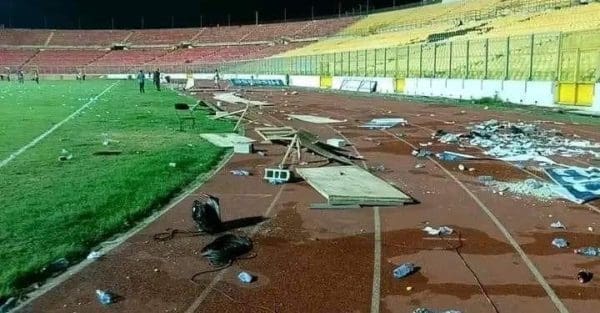
Football fans and sports officials in Ghana’s Ashanti Region have been left reeling after 3,955 seats were damaged at the iconic Baba Yara Sports Stadium during recent regional inter‑schools football competitions and Technical and Vocational Education Training (TVET) sporting events — a development described as one of the worst episodes of vandalism in recent memory at the nation’s largest football venue.
The damage, which occurred over a series of Milo inter‑schools football fixtures, saw spirited matches between senior high school sides and TVET teams descend into mayhem off the pitch, with spectators and participants alike contributing to the destruction of stadium seating.


Officials of the National Sports Authority (NSA) for the Ashanti Region confirmed the extent of the destruction, which has dealt a significant blow to a facility that serves as the spiritual home of Ghanaian football in the north and centre of the country.
Patience Sharon Adams Mensah, the NSA’s Ashanti Regional Public Relations Officer, said the Ghana Education Service (GES) has already begun efforts to repair the broken seats, and that schools identified as being involved in the incidents have been notified.
“Since this is state property, anyone who damages it is liable to repair it, and it is an offence to break state property,” Mensah said, emphasising that organisers of the events must take responsibility for facilitating repairs or covering the cost of replacement.
The vandalism has prompted renewed calls for stricter stadium oversight, improved crowd management at school sporting events, and greater accountability for organisers and school authorities.
Ghana’s football cathedral under strain
The Baba Yara Sports Stadium — originally known as the Kumasi Sports Stadium — is Ghana’s largest football arena, with a seating capacity of about 40,528.
It is revered as one of the nation’s premier football venues, hosting home fixtures for powerhouse club Asante Kotoko SC as well as electrifying matches for the Ghana national team, the Black Stars.
Named in honour of the legendary Baba Yara, one of Ghana’s most celebrated wingers from the 1950s and 1960s, the stadium has staged countless memorable encounters, from Ghana Premier League clashes to African Cup of Nations games and FIFA World Cup qualifiers.
Its lush pitch and passionate crowds have long earned it the moniker of Ghana’s football cathedral.
However, in recent years the stadium has faced mounting challenges. Structural wear and infrastructure issues have drawn concern from both local administrators and international governing bodies.
In 2024, the Confederation of African Football (CAF) withdrew the stadium’s approval to host international matches due to technical concerns, including an unsuitable playing surface and infrastructure deficits.
The decision forced several high‑profile matches to be relocated to alternative venues, much to the disappointment of local fans.
A test for fans and officials alike
The latest incident underscores the urgency of addressing not only physical upgrades to the stadium but also improving security and spectator behaviour at grassroots football events.
School competitions have long been celebrated for their ability to uncover rising talent and ignite community support for the sport, but the chaos at Baba Yara has exposed weaknesses in event management and fan discipline.
For many, the scenes of broken seats are a sobering reminder that even Ghana’s most cherished football institution is vulnerable to damage when crowd control and event oversight are lacking.
As repairs begin and questions mount over how to protect the stadium for future use, supporters and stakeholders alike are calling for a coordinated effort between sporting bodies, schools, and government authorities to ensure that Ghana’s football heritage is preserved — and respected — for generations to come.