

The historic courtesy visit by the Asantehene, Otumfuo Osei Tutu II, to the headquarters of the Ghana Police Service on Tuesday, January 6, 2026, has been widely interpreted as more than a ceremonial engagement.
It marked a profound moment of reflection, recalibration and recommitment to a shared national objective: safeguarding peace and security through mutual respect between state authority and traditional leadership.


At a time when Ghana continues to grapple with complex security challenges—ranging from chieftaincy disputes and land conflicts to illegal mining and community-level crime—the Asantehene’s presence at the Police Headquarters carried deep symbolic and practical significance.
It underscored the enduring relevance of traditional authority in modern governance and the necessity of structured collaboration between chiefs and law enforcement.
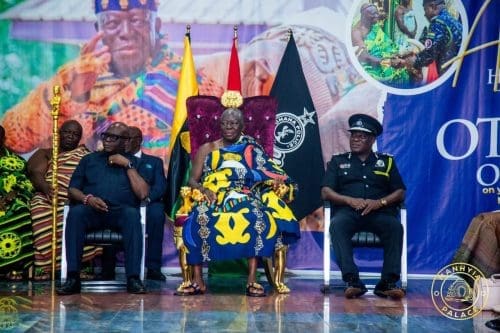
A clear warning on chieftaincy disputes
Central to Otumfuo Osei Tutu II’s address was a firm caution to the Ghana Police Service against unnecessary involvement in chieftaincy disputes.
The Asantehene warned that police interference in traditional matters, particularly when it goes beyond the enforcement of law and order, risks inflaming tensions and compromising the neutrality of the Service.
He cited instances where police commanders have allegedly issued directives restricting the movement of chiefs who had been duly gazetted, describing such actions as inappropriate and institutionally damaging.
“Some people get involved in chieftaincy matters when it is not necessary. I could not see how a chief could be gazetted, and a police commander would issue an instruction and say don’t allow him to go,” Otumfuo said.
“The police are supposed to protect such a chief against persons who have not been validly nominated or enstooled.”
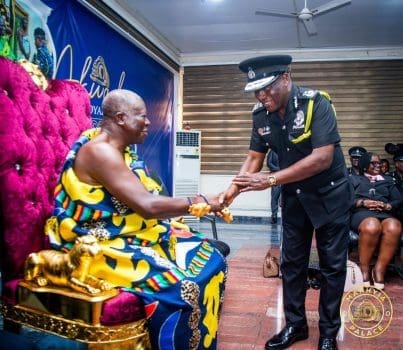
The Asantehene cautioned that when the police are perceived to be taking sides in chieftaincy disputes, it undermines public confidence and creates long-term challenges for the institution itself.
“If you take sides, it creates problems for the whole institution and creates problems for the police,” he added.
His remarks resonated strongly within a national context where chieftaincy disputes have, in some cases, escalated into violence, often drawing the police into sensitive cultural terrains ill-suited for purely enforcement-driven approaches.
Why the visit matters
This visit was historic not only because it was the Asantehene’s maiden visit to the Police Headquarters, but also because it symbolised a deliberate effort to redefine the relationship between traditional authority and state security institutions.
By stepping into the heart of Ghana’s modern policing structure, Otumfuo Osei Tutu II sent a powerful message: that peace, order and justice in Ghana cannot be sustained through law enforcement alone, nor can tradition operate in isolation from the modern state.
The Asantehene emphasised that society cannot “outsource morality entirely to the state and expect peace,” stressing that traditional values, norms and authority structures remain critical in shaping social behaviour and preventing crime at the community level.
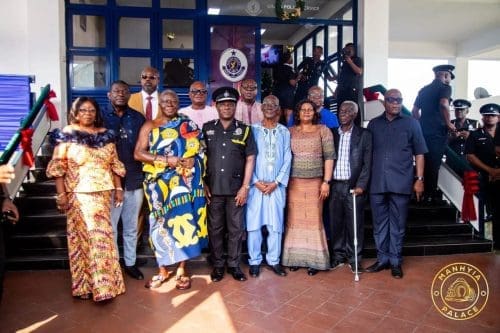
Chiefs as allies in community policing
Beyond caution, Otumfuo Osei Tutu II used the occasion to propose a forward-looking framework for collaboration.
He called for deeper, institutionalised cooperation between traditional authorities and the Ghana Police Service, urging the Inspector-General of Police (IGP), Mr Christian Tetteh Yohuno, to formally recognise chiefs as allies in community policing.
“I have come to join you for deeper institutionalised collaboration between traditional authorities and the Ghana Police Service,” he said. “Let chiefs serve as allies in community policing.”
The Asantehene advocated for a policing philosophy rooted in dialogue, cultural intelligence and mediation, rather than confrontation and force.
“Let officers be trained to understand the customs of the people they protect. Let dialogue precede deployment and mediation proceed confrontation. This is not softness but intelligence,” he stated.
According to Otumfuo, when traditional authority respects legal authority, communities become more stable.
Conversely, when the police show respect for local customs and traditions, cooperation deepens, intelligence flows improve, and crime prevention becomes more effective.

How police–traditional collaboration can help fight crime
The Asantehene’s proposals highlight a practical pathway to addressing crime and insecurity in Ghana. Chiefs, as custodians of land, culture and community norms, possess intimate knowledge of local dynamics—knowledge that is often inaccessible to formal security agencies.
Effective collaboration can enhance early warning systems, allowing traditional leaders to alert police to brewing conflicts before they escalate.
It can also improve intelligence gathering, as community members are more likely to share information through trusted traditional channels.
In areas plagued by land disputes, illegal mining or chieftaincy tensions, chiefs can help de-escalate situations through customary mediation, reducing the need for heavy police deployment.
When police operations are informed by cultural context, the risk of missteps that provoke resistance or violence is significantly reduced.
Training police officers in local customs, as proposed by the Asantehene, can further strengthen trust, improve conflict resolution and reduce confrontations that stem from cultural misunderstandings.
IGP acknowledges the power of traditional leadership
Inspector-General of Police, Mr Christian Tetteh Yohuno, warmly welcomed the Asantehene and acknowledged the critical role traditional leadership has played in maintaining peace and security in Ghana.
He praised Otumfuo Osei Tutu II’s mediation efforts in major national conflicts, including the Dagbon chieftaincy dispute, the Yendi crisis and the protracted Bawku conflict, noting that these interventions had helped restore peace and stability.
The IGP said the Asantehene’s engagements had yielded practical recommendations that continue to guide security operations.
“It is worth noting that chiefs, as custodians of land, culture and customs, remain indispensable partners in maintaining law and order,” Mr Yohuno said.
He highlighted the Ashanti Region as a clear example, where Otumfuo’s interventions in land and chieftaincy disputes have reduced violence, restored sanity and made policing more effective.
Tackling modern security threats together
On illegal mining, Mr Yohuno said the Asantehene’s directive urging chiefs to take firm action against the practice in their jurisdictions demonstrated the continued relevance of traditional leadership in addressing modern security challenges.
Illegal mining, which often fuels environmental destruction, crime and social unrest, cannot be tackled by enforcement alone.
The involvement of chiefs, who control customary land and wield moral authority, remains crucial to achieving sustainable results.

The IGP also commended Otumfuo for his consistent support to the Ghana Police Service, particularly the Ashanti Regional Police Command, through counselling, guidance and encouragement.
Revisiting Ghana’s policing history
Mr Yohuno used the occasion to reflect on history, noting that long before the advent of European-style policing, African societies—especially the Ashanti Kingdom—had sophisticated systems of law, order and justice.
He referenced the Ahenfie policing system administered through the Ashanti Courts, describing it as one of the earliest forms of organised policing that ensured social order, dispute resolution and community safety through deeply respected customs.
According to the IGP, colonial policing did not erase these indigenous systems but blended with them, shaping contemporary policing structures in Ghana.
A landmark moment for national security
The visit brought together the Asantehene, top police officials and other traditional leaders, and has been widely described as a landmark moment in the relationship between the Ghana Police Service and traditional authority.
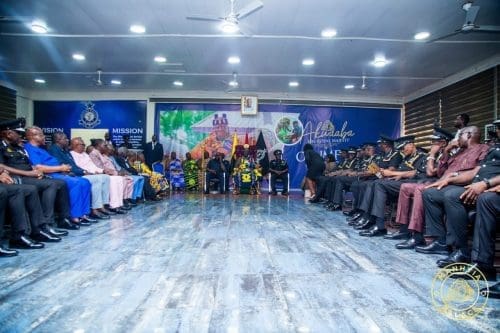
More importantly, it opened a renewed conversation about how Ghana can build a security architecture that is both modern and culturally grounded—one that recognises that sustainable peace is achieved not only through force of law, but through legitimacy, trust and shared responsibility.
As Ghana confronts evolving security threats, the message from the Asantehene’s historic visit is clear: when the police and traditional leaders walk together, crime is easier to prevent, conflicts are easier to resolve, and communities are safer and more stable.