Ghana’s economic management faces a critical test in April 2026, when the International Monetary Fund (IMF) conducts its next review of the country’s US$3 billion loan-supported programme, with the Bank of Ghana placing renewed emphasis on data transparency, policy discipline and credibility ahead of the assessment.
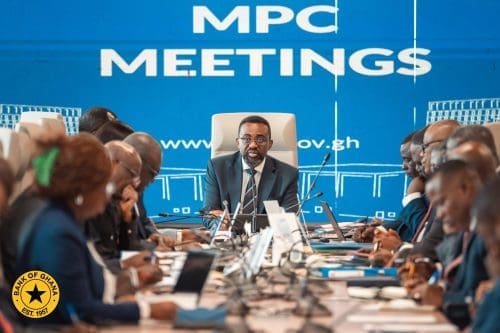
At the opening of the 128th Monetary Policy Committee (MPC) meeting in Accra on Monday, Governor of the Bank of Ghana, Dr Johnson Pandit Asiama, described the impending IMF review as a defining moment that would determine whether the country’s recent macroeconomic gains can be sustained without undermining policy credibility.

The IMF review, which will be based on end-December 2025 data, is expected to serve as a litmus test for Ghana’s reform programme, measuring not only headline economic improvements but also the depth of institutional discipline underpinning them.
“The upcoming IMF review in April 2026 will be based on end December 2025 data. This Committee is, therefore, among the first, and indeed the very first, to rigorously assess the indicators central to programme performance,” Dr Asiama told members of the Committee.
According to the Governor, the Fund’s assessment will focus on key performance benchmarks under the programme, including inflation dynamics, reserve accumulation, strict adherence to the zero central bank financing rule, and the management of legacy fiscal activities that have historically undermined macroeconomic stability.
Dr Asiama stressed that the credibility of Ghana’s data reporting and the consistency of policy implementation would be decisive in shaping the IMF’s judgment, with far-reaching implications for investor confidence and continued international support.
“Ensuring the integrity and credibility of our data, and adherence to programme commitments, will be critical when these indicators are subjected to rigorous scrutiny,” he said, urging MPC members to carefully interrogate available data and assure its trustworthiness, particularly against the backdrop of the country’s improving macroeconomic indicators.
While acknowledging favourable domestic and external conditions, including declining inflation, a strengthened reserve position, the appreciation of the cedi, higher global gold prices and resilient global growth projections, the Governor cautioned against complacency. He warned that premature relaxation of discipline could reverse hard-won gains and weaken confidence in the reform programme.
He therefore called for careful sequencing of policy adjustments, sustained foreign exchange stability, and deliberate positioning of the Gold for Reserves domestic purchase programme to ensure its long-term sustainability and credibility.
The IMF, in its most recent fifth review of Ghana’s programme, had described the country’s performance as broadly satisfactory, despite delays in implementing some complex structural reforms.
The Fund noted that macroeconomic stabilisation was gaining momentum, citing strong economic growth and a return to single-digit inflation for the first time since 2021.
“The fiscal and external positions have improved, and good progress has been made on debt restructuring,” the IMF said, pointing to renewed confidence in the economy and improved market sentiment.
In particular, the Fund commended the Bank of Ghana for bringing inflation back within its target range and rebuilding international reserve buffers, even as it cautiously eased the monetary policy stance.
It also acknowledged progress in strengthening financial stability through the continued implementation of banks’ recapitalisation plans and the initiation of recapitalisation processes for key state-owned banks.
However, the IMF warned that vulnerabilities remain within the financial sector and the broader macroeconomic framework.
Looking ahead, it identified the need to further strengthen central bank independence, discontinue quasi-fiscal activities, deepen foreign exchange markets and gradually reduce the Bank of Ghana’s footprint in the economy as key reform priorities.
The Fund also called for stronger governance frameworks in state-owned banks, full utilisation of the bank resolution framework, and the development of contingency plans for institutions that fail to recapitalise.
It further urged the authorities to ensure cost-effective resolution of legacy financial sector issues and to implement robust supervisory strategies to improve credit and operational risk management.
While acknowledging that recent gains reflect strong programme ownership, favourable external developments and improved investor confidence, the IMF cautioned that only steadfast and disciplined implementation of reforms would fully restore macroeconomic stability and place Ghana’s debt on a sustainable path.
As the April 2026 review approaches, the spotlight will increasingly turn to the credibility of Ghana’s data, the consistency of policy execution and the resolve of authorities to stay the course, making the IMF assessment a decisive moment for the country’s economic recovery trajectory.