Following a disputed Kumasi High Court decision, wife of the late Charles Kwadwo Fosu, aka Daddy Lumba, Akosua Serwaa Fosu, has officially lodged an appeal to challenge the ruling.
A significant legal dispute has advanced to the Kumasi Appeal Court, centering on the admissibility of a marriage certificate and the correct interpretation of Ghana’s evidence law in a recent High Court decision.


The appeal, filed by legal representative William Kusi Eso, seeks to overturn what he describes as fundamental errors in the lower court’s judgment.
The case, which originated at the High Court, has reached the appellate stage following dissatisfaction with the initial ruling.
At the heart of the appellant’s challenge are two critical legal issues. First, the appellant contends that the High Court improperly ruled on the admissibility of a marriage certificate—an issue deemed central to the dispute.
Given the involvement of parties connected to an Abusua (family lineage), the document likely relates to matters of inheritance, property rights, legitimacy, or other family-based claims.
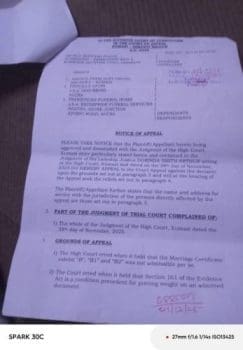
Second, the appellant argues that the trial court misapplied statutory provisions governing evidence. The notice of appeal suggests that the High Court’s decision may have stemmed from an incorrect interpretation of the nation’s evidence law—an error which, if established, could render the judgment unsafe and justify its reversal.
Proper application of evidence rules is essential to ensuring fairness, particularly in cases involving sensitive family and succession matters.
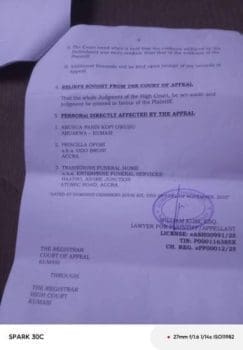
The individuals at the center of the dispute are named as Abusua-Panin Kori Owusu and Priscilla Ofori, also known as Odo Broni.
The explicit reference to “Abusua” highlights the traditional context of the matter, suggesting an intersection between Ghana’s customary family structures and the formal legal system. It is within this framework that the appellant seeks relief.
Counsel for the appellant, William Kusi Eso, has formally requested that the Court of Appeal set aside the High Court’s ruling.
The appeal seeks a declaration affirming the admissibility of the marriage certificate, along with an award of costs in favor of the appellant.
With the necessary documents now served on both the Court of Appeal and the High Court, the appellate process has officially commenced.
Judges at the Kumasi Court of Appeal will review the trial record to determine whether the rules of evidence were applied correctly and whether the marriage certificate should have been considered valid and relevant.
The outcome of this appeal carries significant implications—not only for the parties directly involved, but also for how courts interpret evidence in cases where statutory law and customary family practices intersect.
Legal observers are closely monitoring the proceedings as the appellate court prepares to examine the legal and factual complexities surrounding the disputed marriage certificate.
As the matter unfolds, the decision from the Court of Appeal is expected to provide clarity on the boundaries of admissible evidence in similar family-related disputes, potentially influencing future cases within Ghana’s legal landscape.