Gold Fields eyes 20-year investment in Tarkwa
Gold Fields Damang Mines
Gold Fields Ghana Limited is projecting an investment of $7.5 billion in its Tarkwa Mine over the next two decades as it seeks to secure the renewal of its mining leases, which are due to expire in April 2027.
The proposed investment is expected to sustain operations, improve efficiency and support the next phase of development at the mine, building on more than $5 billion the company has invested in the facility over the past 30 years.
The company’s Senior Vice President and Managing Director, Elliot Twum, disclosed the projections during an interview on Channel One TV on Monday, November 23, 2026.
He explained that mining requires substantial capital investment and continuous technological improvements to enhance efficiency, sustain production and ensure the long-term viability of operations.
“Mining is capital intensive. And so over time, what we’ve tried to do is to employ technology to make it more effective and to make it more efficient.
“And to put things in perspective, in the last 30 years, Gold Fields has injected more than $5 billion into Tarkwa Mine,” he said.
Twum said the company estimates that an additional $7.5 billion will be required to sustain operations at Tarkwa over the next 20 to 21 years.
He noted that the proposed expenditure forms part of Gold Fields’ broader strategy to maintain production, improve operational efficiency and extend the life of one of Ghana’s major gold-producing mines.
Highlighting the company’s contribution to the Ghanaian economy, Twum said Gold Fields had spent $4.6 billion on local procurement and purchases from its host communities over the past five years.
“What’s most important, and I need to also call out, is that in the last five years, we have spent $4.6 billion through local procurement and host community procurement,” he said.
He further indicated that a significant proportion of the company’s revenue remains within Ghana, supporting local businesses, suppliers and other economic activities.
According to him, Gold Fields retains 74 per cent of every dollar generated from its operations in the Ghanaian economy.
“As I speak to you now, Bernard, every dollar that is generated out of our operation returns $0.74 into the local Ghanaian economy. $0.74 retained in-country for every dollar that we generate,” he said.
The proposed investment comes as Gold Fields pursues the renewal of its Tarkwa Mine leases ahead of their expiration in April 2027. Securing the necessary approvals will be critical to the company’s long-term investment plans and continued operations.
Tarkwa Mine currently produces an average of approximately 500,000 ounces of gold annually, making it one of Ghana’s significant gold-producing assets.
History of Gold Fields’ operations in Tarkwa
Twum also recounted the company’s entry into Ghana in 1992, when it was invited to help revive the country’s struggling mining industry.
He said Gold Fields was selected as a preferred partner to take over the then Tarkwa Gold Mine, a state-owned underground operation producing approximately 12,000 ounces of gold annually.
“Gold Fields was invited into Ghana in 1992 by the then administration to try and resuscitate the dying mining industry in Ghana. Gold Fields was appointed as a preferred partner to take over the then Tarkwa Gold Mine, which was one of the operations of the state’s gold mining corporation. It was a small underground operation producing up to about 12,000 ounces a year,” he said.
According to him, the company initially invested in the underground operation, paying $3 million before undertaking rehabilitation works and meeting contractual requirements, including payments to access geological data for further exploration.
Gold Fields spent about five years operating the underground mine while conducting surface prospecting, drilling and resource definition studies. These activities culminated in the establishment of its first heap-leach operation in 1998.
Twum said the company invested more than $50 million in developing the surface operation, marking a major transformation in the scale of mining at Tarkwa.
He added that the five leases issued in 1997 for the heap-leach operation are the same leases the company is seeking to renew ahead of their expiration in April 2027.
Gold Fields subsequently expanded its operations through the acquisition of the northern tenement of the then Teberebie Gold Mine in 2000 and the Aboso Mine, now known as Damang, from Australian company Rangers in 2002.
In 2004, the company established a carbon-in-leach (CIL) plant, which uses a different processing method from heap leaching. The facility was upgraded in 2008, with subsequent improvements increasing its processing capacity to approximately 15 million tonnes of material.
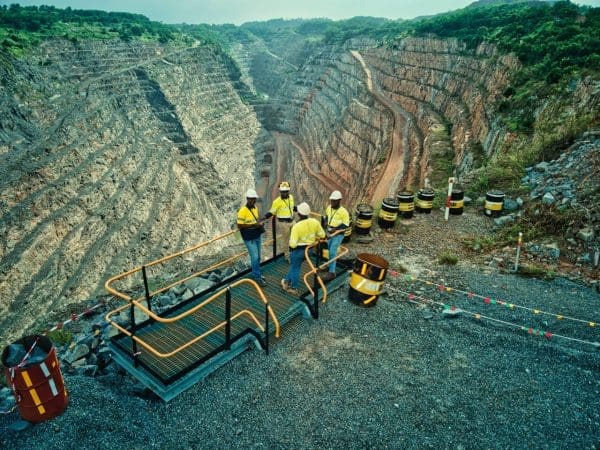
Explaining the nature of Tarkwa’s gold deposit, Twum said its relatively low-grade but consistent ore body requires the movement of large volumes of material to sustain production.
“We do have an ore body which is low-grade. Very consistent, but it’s low-grade and very high strength. So Tarkwa is built on volumes. We move about 100 million tonnes of material every year. Just about 10 million tonnes of that is ore. The 90 million tonnes goes to waste,” he said.
He contrasted Tarkwa’s deposit with that of Damang, which he described as a hydrothermal deposit with higher grades and requiring closer-spaced drilling to define the ore body.
Twum also highlighted the investments in infrastructure, equipment and technology that transformed Tarkwa from the underground operation Gold Fields inherited into a large-scale surface mine.
He said the government previously had to provide support to keep the underground operation running before Gold Fields undertook extensive rehabilitation and modernisation.
“When Gold Fields took over in Tarkwa, government had to supplement and be able to pay salaries, suppliers and contractors, and buy reagents to continue to treat. What Gold Fields did was to refurbish the winding machinery, the shaft infrastructure and brought in some new technology to try and stretch that, push that,” he said.
Gold Fields is now seeking to secure the renewal of its mining leases to sustain production and implement its proposed $7.5 billion investment programme over the next two decades.
Gold Fields operates major gold mines in Ghana, including the Tarkwa mine, and has historically contributed significantly to the country’s gold production and local development.