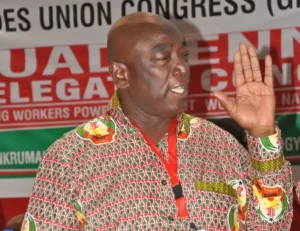
TUC supports five-year presidency

TUC Secretary-General Joshua Ansah
The Trades Union Congress (TUC) has backed the proposed extension of Ghana’s presidential term from four to five years, but says the change must be accompanied by broader constitutional reforms to strengthen governance, accountability and democratic institutions.
The TUC said it had taken note of the government’s acceptance of the proposal, but cautioned that extending the presidential tenure could also mean citizens would have to endure the effects of poor governance for a longer period if adequate safeguards were not introduced.
The union is therefore calling for the proposed five-year presidential term to be considered alongside other reforms intended to improve Ghana’s governance system.
Speaking to the press on Wednesday, September 9, 2026, TUC Secretary-General Joshua Ansah stressed that extending the presidential tenure alone would not achieve the objectives of the ongoing constitutional review.
“One cannot therefore merely agree to tenure extension and leave everything else the same,” the TUC said.
According to the union, any decision to increase the presidential term should be supported by measures that strengthen accountability and ensure that public officials remain responsive to citizens throughout their tenure.
The TUC has also expressed support for a proposal to prevent sitting Members of Parliament (MPs) from simultaneously serving as Ministers of State, Deputy Ministers or Regional Ministers.
However, the union disagrees with another proposed reform that would bar an MP who resigns from Parliament from being appointed as a minister during the same parliamentary term.
The TUC argues that such a restriction could unnecessarily narrow the government’s pool of qualified persons available for ministerial appointments.
The union’s position forms part of the broader national debate over proposed amendments to Ghana’s constitutional and governance framework.
While supporting some of the proposed changes, the TUC has emphasised the need for reforms that promote effective leadership, accountability and stronger democratic institutions rather than focusing solely on extending the presidential tenure.
The Constitutional Review Committee (CRC) agreed to extend the tenure of both the President and Parliament from the current four years to five years.
In its report, the Committee also called for an amendment to Article 62(b) of the 1992 Constitution to “lower the minimum age a person must attain to qualify for election as President from forty years to thirty years.”
Members argued that the change would open up the country’s highest office to a younger generation of leaders, in line with broader efforts to make Ghana’s democracy more inclusive and responsive to the aspirations of its youthful population.