
BoG highlights $4.8bn SME financing gap
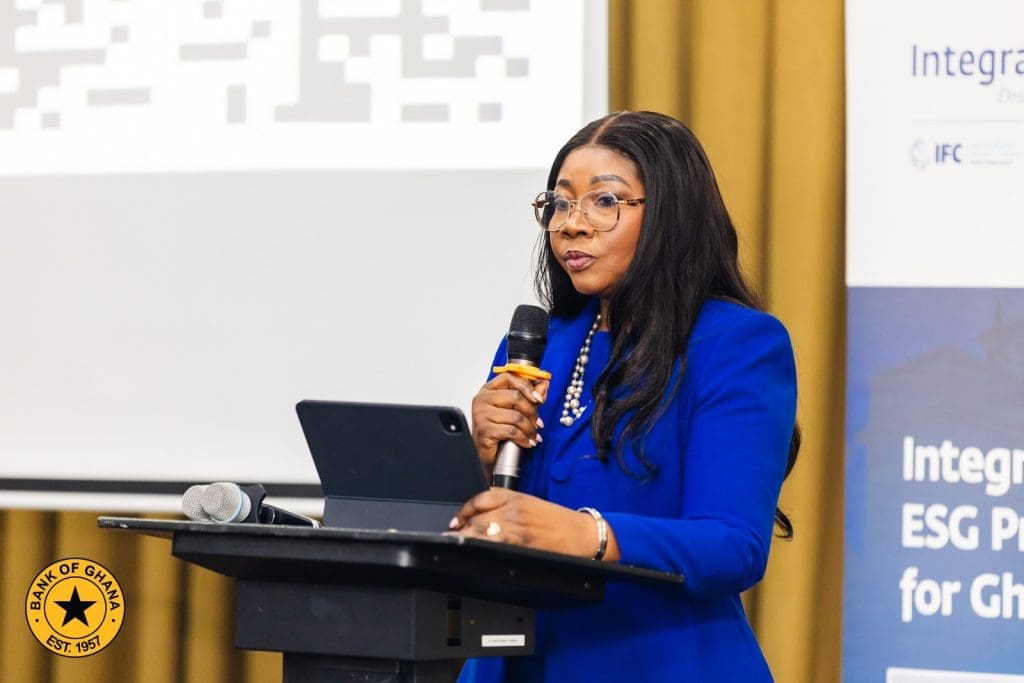
Matilda Asante-Asiedu
The Bank of Ghana’s (BoG) Second Deputy Governor, Matilda Asante-Asiedu, has urged stakeholders to redefine financial inclusion by focusing not only on access to payment services but also on whether individuals and businesses can obtain credit, insurance and investment opportunities at fair rates.
She acknowledged Ghana’s progress in expanding financial access through mobile money and interoperable payment platforms but said significant gaps remained, particularly for small and medium-sized businesses seeking financing.
“The next standard for inclusion when we measure our performance as a country should be whether people have access to credit, insurance and investment on fair terms when they need to,” she said.
Matilda Asante-Asiedu made the remarks at the Distinguished Digital Finance Lecture held as part of National ICT Week.
She noted that Ghana had built a sophisticated digital payments ecosystem but had yet to develop equally effective systems for extending credit.
The Second Deputy Governor pointed to the $4.8 billion annual financing gap confronting SMEs, describing it as a serious challenge that must be addressed if the country’s financial sector is to fully support economic growth.
“We have built extraordinary payment rails, but we have not yet built equally extraordinary credit rails,” she observed.
She said one of the biggest opportunities for the financial sector lies in using transaction data to connect small businesses with credit providers.
According to her, digital payment records can reveal important information about a business, including transaction frequency, sales trends and the consistency of its income.
“It shows merchant payment activity, how frequent transactions occur, whether volumes are growing or falling, and how regular and predictable income is. This is not just background information. It is a credit record,” she stressed.
She further argued that Ghana’s dependence on conventional collateral requirements was preventing viable businesses from accessing financing.
Many SMEs with reliable cash flows, contracts and receivables, she explained, could still be denied loans because they lacked land, buildings or other assets traditionally accepted as collateral.
To address the challenge, she advocated the adoption of open banking and open finance frameworks, while cautioning that their success should not be measured merely by the number of digital systems or application programming interfaces created.
“The SME financing gap [should be] the explicit measure of success,” she said.
Matilda Asante-Asiedu also called for closer collaboration among financial regulators, including the Bank of Ghana, National Insurance Commission, Securities and Exchange Commission and the Pensions Regulatory Authority.
She said stronger coordination would help regulators evaluate emerging financial technologies based on their actual risks while allowing responsible innovation to thrive.
She also stressed the need to strengthen cybersecurity across the financial ecosystem, particularly among smaller institutions that may have limited resources to protect themselves against digital threats.
According to her, Ghana’s digital transformation should ultimately make it easier for ordinary people and small businesses to turn their economic activity into meaningful access to finance.
“Our task now as a people, as regulators, as industry players, is to make sure that the same phone that lets a market trader in Techiman send money in 3 seconds also lets her borrow against the business she has spent a decade building and lets her choose preferential terms instead of being limited to whatever her financial services provider offers to her. For me, this is what innovation at scale means, and that is the work that all of us must do together,” she remarked.