
Emergency healthcare gaps exposed

Dr Daniel Osei-Kwame, President of the Emergency Medicine Society of Ghana, Dr Bernard Okoe Boye, Former Deputy Health Minister, Justice Sedinam Awo Kwadam, High Court Judge, Prof Agyeman Badu Akosa, Isaac Gyeabour Esq, Founder of Patients Right
Health experts, legal practitioners and policymakers have delivered a blunt diagnosis of Ghana’s worsening emergency healthcare crisis, warning that the country’s persistent “no bed syndrome” reflects far deeper failures in healthcare financing, hospital management, infrastructure planning and constitutional protection of patients’ rights.
At a high-level Medico-Legal Symposium organised by Patient Rights Watch, speakers called for urgent reforms to prevent accident victims, unconscious patients and vulnerable persons from being denied treatment because of inability to pay or lack of hospital space.
Central to the discussions was a strong appeal for the establishment of a national Emergency Health Care Fund to support unidentified patients and accident victims often abandoned at hospitals due to fears over treatment costs.
The symposium brought together medical practitioners, legal experts and policymakers who argued that Ghana’s emergency healthcare system had reached a dangerous tipping point where financial barriers, overcrowding, weak administration and constitutional neglect were increasingly putting lives at risk.
Participants stressed that emergency healthcare must never depend on the financial status of patients or the willingness of Good Samaritans to bear medical expenses before treatment begins.
Okoe Boye pushes Emergency Health Care Fund
Former Deputy Health Minister and immediate past Chief Executive Officer of the National Health Insurance Authority (NHIA), Dr Bernard Okoe Boye, led calls for the creation of a dedicated Emergency Health Care Fund to address what he described as one of the most disturbing realities within Ghana’s health sector.

According to him, many accident victims brought to hospitals by concerned citizens are often denied immediate care because health workers insist that the persons who brought them assume financial responsibility for treatment.
He described the situation as unacceptable and inconsistent with the humanitarian obligations of the healthcare system.
Dr Okoe Boye said the proposed fund would help eliminate the lingering “cash-and-carry” mentality that continues to haunt emergency healthcare delivery despite years of reforms.
He further advocated measures to ensure that every Ghanaian acquires some form of health insurance coverage to reduce the number of patients denied treatment because of payment concerns.
“The NHIS premium in Ghana is GH₵20 per year, so if you find anyone without health insurance, the cause is not financial, it’s ignorance. We must find a way to make sure every Ghanaian is having their insurance,” he stated.
According to him, many health facilities remain reluctant to treat uninsured patients because hospitals fear they may never recover the cost of treatment.
Dr Okoe Boye also blamed the worsening no-bed syndrome partly on the politicisation of healthcare decisions in Ghana.
He cited the closure of the La General Hospital as an example of how political considerations sometimes interfere with critical healthcare infrastructure decisions.
The former Deputy Minister explained that the hospital had been declared structurally unsafe following an audit recommendation that it should be demolished, yet the consequences of its closure continue to place enormous pressure on nearby facilities.

Existing emergency treatment policy ignored
Moderating the panel discussion, Dr Edward Addo Dankwa, Esq., argued that Ghana already possesses policy guidelines guaranteeing emergency treatment without upfront payment, but implementation remains weak.
He drew attention to Section 10 of the Accident and Emergency Service Guidelines published by the Ministry of Health in 2011, which clearly states that all persons in Ghana have the right to receive quality accident and emergency care.
According to the guideline, accident and emergency patients are supposed to receive treatment within the first 48 hours without being asked to make payment.
The policy further outlines possible funding sources including Government of Ghana support, National Health Insurance Authority contributions, private health insurance and special levies such as emergency service taxes and vehicle insurance premiums.

“It’s already clearly stated, the problem is with the implementation,” Dr Addo Dankwa stressed.
Emergency departments exposing wider system failures
President of the Emergency Medicine Society of Ghana (EMSOG), Dr Daniel Osei-Kwame of the Komfo Anokye Teaching Hospital (KATH), argued that emergency departments themselves were not the true cause of overcrowding.
Instead, he said they merely expose deeper structural failures within the broader healthcare system.
“Emergency Departments rarely create overcrowding leading to the no bed syndrome. They rather reveal it,” he stated.
Dr Osei-Kwame explained that hospitals often suffer from what health professionals describe as “entry block” and “exit block” challenges.
These occur when patients either cannot access treatment quickly enough or cannot be discharged efficiently because of delays in diagnosis, specialist review, referrals or treatment decisions elsewhere within the system.
According to him, simply constructing additional hospital beds without fixing underlying inefficiencies would not solve the crisis.

“If you put a hospital here and everyone is using that facility, it doesn’t matter the number of beds you put in there, it will choke,” he explained.
The emergency medicine specialist identified inadequate equipment, shortage of specialists and poor patient management systems as major contributors to overcrowding.
He described hospital management inefficiencies as “the elephant in the room,” warning that delays in diagnosis and patient movement often create bottlenecks that spread across entire facilities.
According to him, once such delays accumulate, hospitals become overwhelmed, eventually leading to situations where new patients are denied care.
Dr Osei-Kwame therefore called for stronger healthcare protocols, improved coordination systems and more efficient emergency response mechanisms.
“We need to make sure that we have mechanisms we can trigger, and put in structures and protocols to address these challenges,” he said.
“We need processes and protocols to be effective. Once we get all these done, we will be able to mitigate and fight and possibly win.”
Justice Kwadam links healthcare to constitutional rights
Her Ladyship Justice Sedinam Awo Kwadam, a Justice of the High Court, shifted the discussion beyond medicine into constitutional law and human rights.
According to her, emergency healthcare should not merely be viewed as a medical issue but as a constitutional obligation tied directly to human dignity and the right to life.
“The question on the lips of a patient, ‘Who will help me?’ is not merely medical, but constitutional and legal,” she stated.
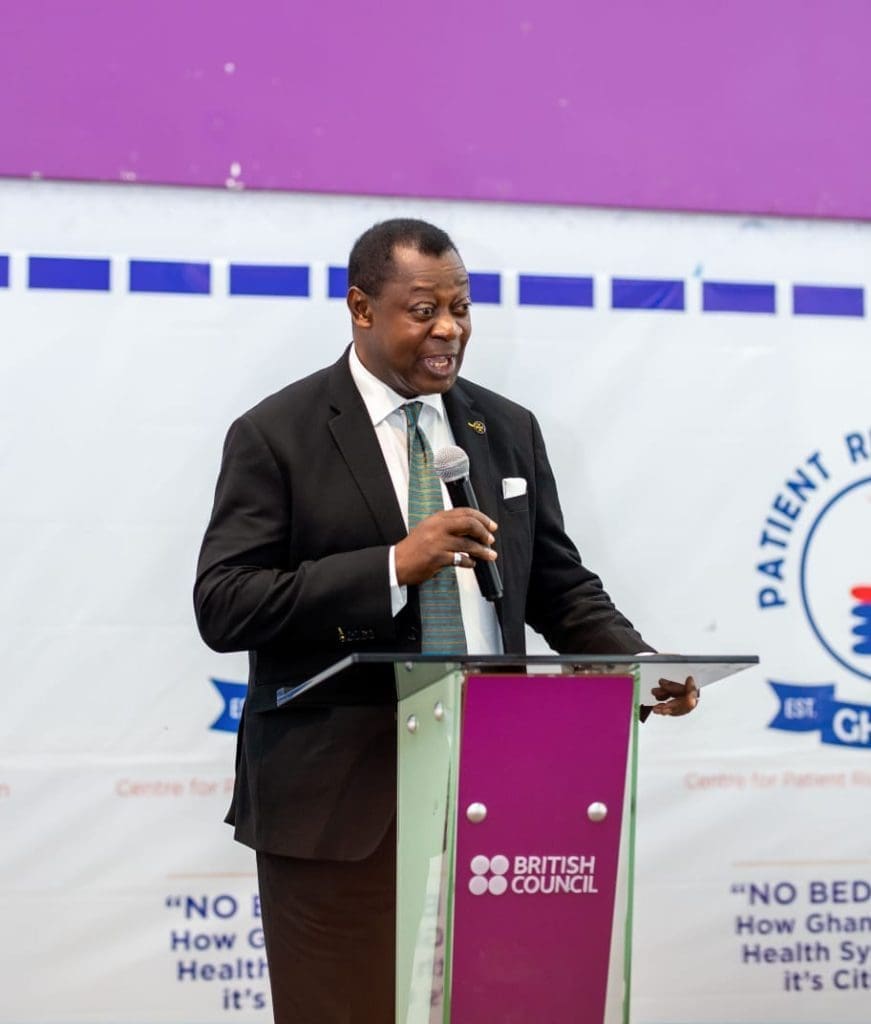
Drawing from personal experiences with emergency healthcare services in Cape Coast, Accra and abroad, Justice Kwadam concluded that Ghana’s emergency healthcare system remained deeply inadequate.
“If we give the average Ghanaian the opportunity to tell their story, we will see that ‘no bed’ is not a funny phrase to play with, and we need to diagnose where the problem is coming from and find workable solutions,” she stressed.
The High Court Judge explained that although Ghana’s Constitution does not expressly contain an article titled “right to health,” several constitutional provisions collectively imply and protect that right.
She cited Article 13 on the right to life, Article 15 on human dignity and Article 17 on equality and freedom from discrimination as constitutional foundations supporting access to healthcare.

According to Justice Kwadam, constitutional interpretation extends beyond explicit wording to include values, moral commitments and broader democratic principles.
“Constitutions speak in text and context, but they also speak in value. They speak in structure, and they speak in implication. They speak in moral commitment,” she explained.
She argued that constitutional rights must always be interpreted in ways that advance justice, dignity and democratic governance.
Justice Kwadam further maintained that the right to health is justiciable under Ghanaian law and that persons denied emergency treatment because of the no-bed syndrome could seek legal redress in court.
Growing pressure for urgent reforms
The symposium ended with mounting calls for comprehensive reforms to Ghana’s emergency healthcare system.

Speakers insisted that no patient should lose their life because of financial barriers, poor management systems or lack of available hospital beds.
Participants stressed that solving the no-bed syndrome would require coordinated reforms involving healthcare financing, infrastructure expansion, hospital administration, constitutional accountability and public education.
They warned that unless urgent interventions are undertaken, the crisis could continue to erode public confidence in Ghana’s healthcare system while placing countless lives at risk.