Audit uncovers zero revenue from 60 Aayalolo buses since 2018
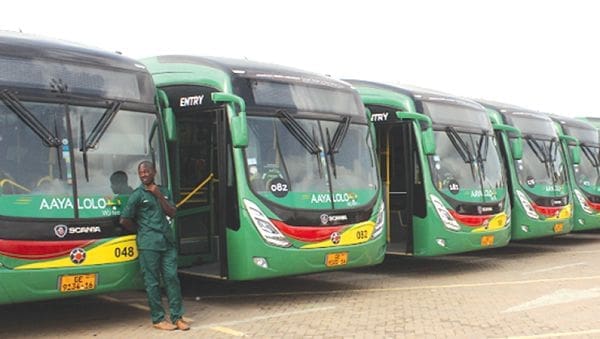
An audit into Ghana’s public transport assets has revealed that 60 buses originally procured under the Aayalolo Bus System and later sent to Kumasi have generated no revenue since their relocation in 2018.
The findings raise serious concerns about asset management, operational efficiency, and accountability within the country’s publicly funded transport initiatives. The buses, part of a broader effort to modernise urban mobility, were initially deployed in Accra to support the Bus Rapid Transit (BRT) system before being reassigned to Kumasi to expand public transport options in the Ashanti Region.
An independent audit has been commissioned by the Managing Director of the Greater Accra Passenger Transport Executive (GAPTE), Awudu Dawuda, to establish the circumstances under which the 60 buses were sent to Kumasi, how they were operated, and the revenue that accrued from their operations.
According to the audit report, despite the significant investment in acquiring and maintaining the fleet, none of the 60 buses has contributed financially to the state or local transport authorities over the past several years. The report cited a combination of logistical challenges, poor maintenance, and unclear management structures as key factors behind the buses’ inactivity.
Dawuda, who spoke to the Daily Graphic, said the audit forms part of GAPTE’s broader transformation agenda aimed at recovering assets and revamping the Bus Rapid Transit (BRT) system to improve urban mobility.
He explained that upon assuming office six months ago, it emerged that 60 out of the 245 Aayalolo buses procured for designated corridors in the Greater Accra Region had been moved to Kumasi, while 10 others were relocated to Takoradi in the Western Region.
Dawuda said an initial probe into the management of the buses in Kumasi showed that since 2018, no revenue had accrued to GAPTE, the entity responsible for overseeing the Aayalolo system.
“The problem is that ever since the buses were taken to Kumasi in 2018, not even a single pesewa was received as revenue to GAPTE; there was no proper plan for these buses – they were sent there without recourse to law, and revenues never came to GAPTE since 2018,” he said.
He further explained that initial findings indicated the buses had been handed over to the Kumasi Metropolitan Assembly (KMA) for management in 2018, while GAPTE engineers undertook most of the repairs, with costs borne by the council.
“The audit team will establish the circumstances under which the buses got to Kumasi: who received them; how revenues were managed; and the circumstances under which six of the buses got burnt,” he said.
He added that with the support of the Minister of Local Government, Chieftaincy and Religious Affairs, Ahmed Ibrahim, GAPTE has taken over the management of the remaining 54 buses in Kumasi, while processes are underway to reclaim the 10 buses in the Western Region.
The GAPTE boss noted that upon taking control of the 54 buses, only 16 were found to be operational, with the rest grounded.
“Since we started operating those 16 buses two weeks ago, we are getting very good revenue; so, we are taking steps to fix the other buses and put them to use,” he said.
Collapsed system
Dawuda said the situation in Kumasi reflects a broader systemic breakdown that the current GAPTE management inherited.
For instance, out of the 245 BRT buses procured by the government in 2016, only 80 were functional, largely due to poor maintenance practices.
He also revealed that several GAPTE terminals — including those at Kasoa, Adenta, Kinbu and Achimota — had been heavily encroached upon.
Additionally, he said GAPTE has been burdened with significant debt related to fuel purchases since 2018.
Progress
Dawuda said that as part of the government’s transformation agenda, GAPTE has begun reclaiming encroached properties and refurbishing broken-down buses to restore efficient operations.
“When I came to office, there were 80 functional buses, but we have repaired and added 60 more buses, taking the current functional fleet to 140 buses, and these buses now operate beyond the 5p.m. closing time to around 11p.m.,” he said.
He added that all previously encroached terminals have now been recovered and are under full GAPTE control.
Additionally, a passenger waiting area has been established at the Kinbu terminal to improve service delivery.
“We have also renovated the depot or workshop at Achimota for all our buses. All our broken down buses are repaired at that facility and we also do routine maintenance there,” he added.
Urban traffic management
Dawuda further noted that, as part of efforts to improve traffic flow and reduce congestion in the city, GAPTE is taking steps to restore dedicated lanes for the Aayalolo buses.
“We approached the Spanish government for funding support to get the dedicated lanes back in use, and we have the green light for a €1 million grant that will be put into feasibility study for the operation of the dedicated lanes,” he said.
He explained that while awaiting the grant, GAPTE is collaborating with the Mayor of Accra and the Ministry of Local Government, Chieftaincy and Religious Affairs to begin reintroducing the dedicated BRT lanes.
“Very soon, the Aayalolo buses will start operating on the dedicated lanes. The letters have been sent out already, and we will meet the Motor Traffic and Transport Division (MTTD) of the Ghana Police Service to start enforcement,” he said.